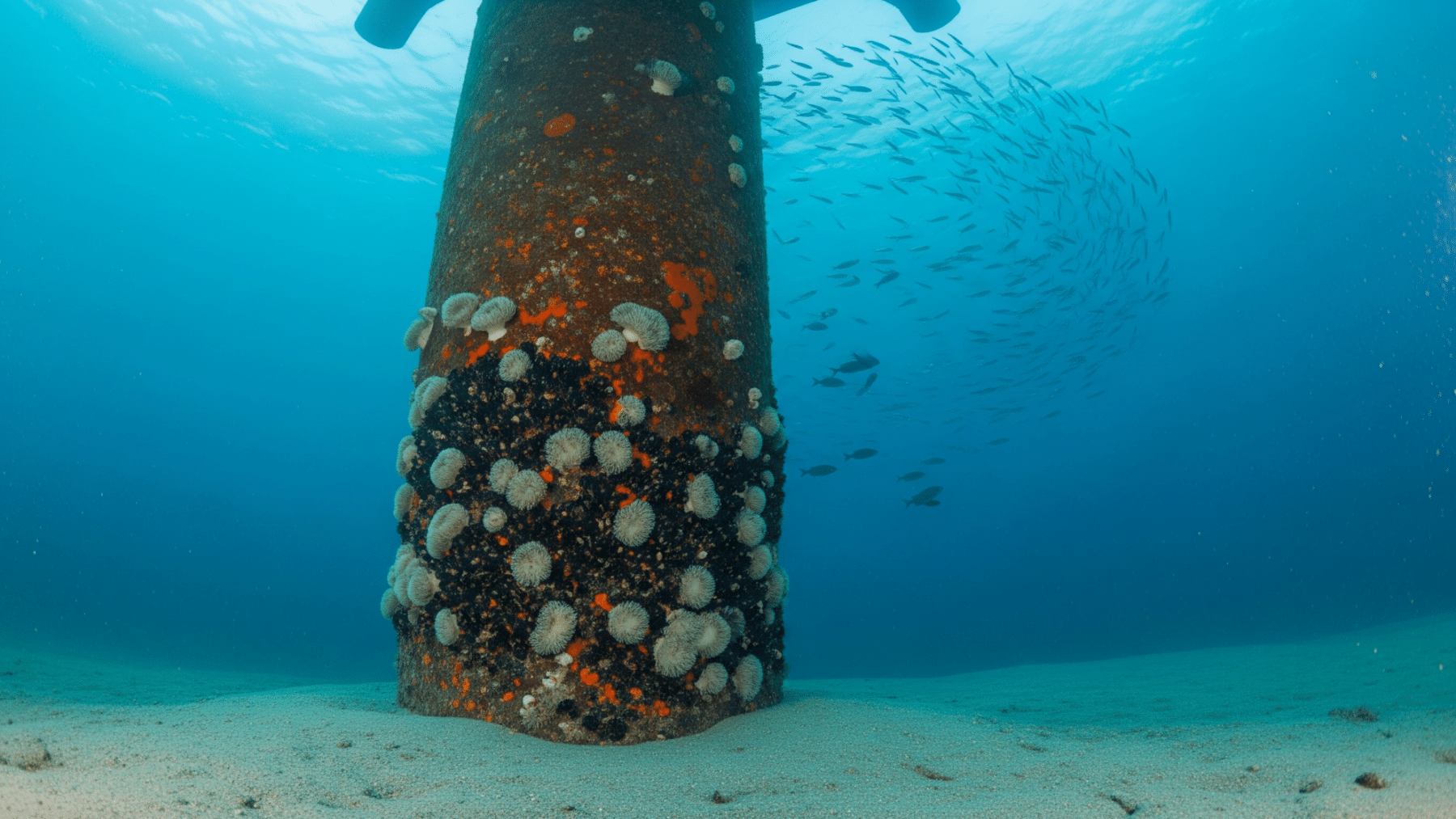
Thirty-five miles off the eastern tip of Long Island, in up to 135 feet of Atlantic water, twelve steel towers stand in a loose grid on the seafloor.
They spin. They generate electricity. They send power ashore to Long Island homes.
Nobody planted anything down there. Nobody seeded the rock. Nobody laid bait.
And yet something remarkable started happening almost as soon as the concrete cured.
A wind farm built for the grid, not the ocean floor
The South Fork Wind project received federal construction approval from the Bureau of Ocean Energy Management on January 18, 2022, in an area located off Long Island in New York State, and its 12 turbines reached full commercial operation delivering 132 megawatts on March 14, 2024.
It sits in federal waters administered by the Bureau of Ocean Energy Management.
The lease area is located approximately 16.5 nautical miles southeast of Block Island and 35 miles east of Montauk Point, New York.
The engineering challenge was enormous: each foundation had to be driven into the seabed and then surrounded by rock armor to guard against scour, the slow erosion that ocean currents carve around any fixed object.
The purpose of all that rock was purely structural.
What the engineers left behind on the seafloor
When a fixed steel structure rises from a sandy ocean bottom, it does something the flat seafloor around it cannot: it creates vertical surface.
Some sea creatures rely on rocky habitats with lots of nooks and crannies for hiding from predators and foraging for food, and the infrastructure that keeps offshore wind turbines anchored to the seafloor provides exactly that.
The parts of the South Fork Wind project that touch the bottom of the ocean take up just 0.02% of the project’s area.
That fraction of a percent turns out to matter more than anyone predicted.
The project’s developers commissioned a rigorous monitoring program that tracked the seafloor before construction, during it, and after the turbines went live.
The monitoring cameras rolled, and the footage was unexpected
South Fork Wind’s comprehensive benthic monitoring program includes targeted visual surveys at pre-construction, construction, and post-construction time periods.
Researchers from INSPIRE Environmental, an independent environmental firm, reviewed the footage at regular intervals.
Key findings of the study include no detectable changes to the biological communities on the seafloor surrounding the turbines, marine life using the wind turbine foundations as habitat, and the project already creating a reef effect.
The last point was the one that drew attention.
A “reef effect” is what happens when hard substrate appears in a soft-bottom environment: life rushes in.
Invertebrates colonize first. Predators follow the invertebrates. The chain builds fast.
Similar dynamics have reshaped how the country thinks about energy land use, just as solar farms built on exhausted Minnesota cropland turned out to be thriving pollinator habitats, the lesson keeps repeating itself across energy infrastructure.
Lobster and sea bass moving into a steel apartment complex
Here is the payoff the cameras captured.
Between 2023 and 2024, scientists observed a shift from bare concrete and rocks to “artificial reefs,” glimpsing beloved species like lobster and black sea bass in and around the structures.
The environmental monitoring program documented “numerous commercially, recreationally, and ecologically important species such as black sea bass, lobster, and flounder” near the South Fork structures, along with Atlantic cod, scup, cunner, barrel fish, butterfish, jack, mahi mahi, triggerfish, winter and summer flounder, sculpin, and both spotted and red hake.
Turbine foundations are now functioning as artificial reefs, creating new habitat for commercially valuable species including black sea bass, lobster, flounder, and Atlantic cod.
This is documented in Ørsted’s published environmental report on South Fork Wind’s environmental performance, drawn from the project’s formal benthic visual survey program.
Peer-reviewed studies of North Sea wind farms have documented significant increases in both species richness and species abundance on turbine structures and scour-protection rock, with colonized surfaces supporting far more life than the surrounding soft seafloor, a pattern now appearing at South Fork as well.
What this means for the grid, the sea, and every offshore turbine to come
This implies that offshore wind energy production can be used as a tool to combine climate change mitigation with local biodiversity conservation, though careful consideration of wind farm design is required.
The rock armor piles around each foundation turn out to be a critical variable: studies confirm that foundation type and scour protection design significantly influence how many fish and invertebrates a structure attracts.
That means future projects could deliberately design their scour protection to maximize reef habitat, essentially building a fish nursery into every foundation specification.
The South Fork result is early and limited to 12 structures, but it fits a pattern confirmed by European wind farms over a decade and, closer to home, by the kind of energy-meets-ecology surprise that the 250-year arc of U.S. energy history rarely anticipated.
This early report suggests that construction has had beneficial impacts by adding new structures to the environment that marine invertebrates attach to and grow on.
A steel tower built to catch wind is, it turns out, also catching life, one colony of mussels, one sheltering lobster, one circling sea bass at a time.
