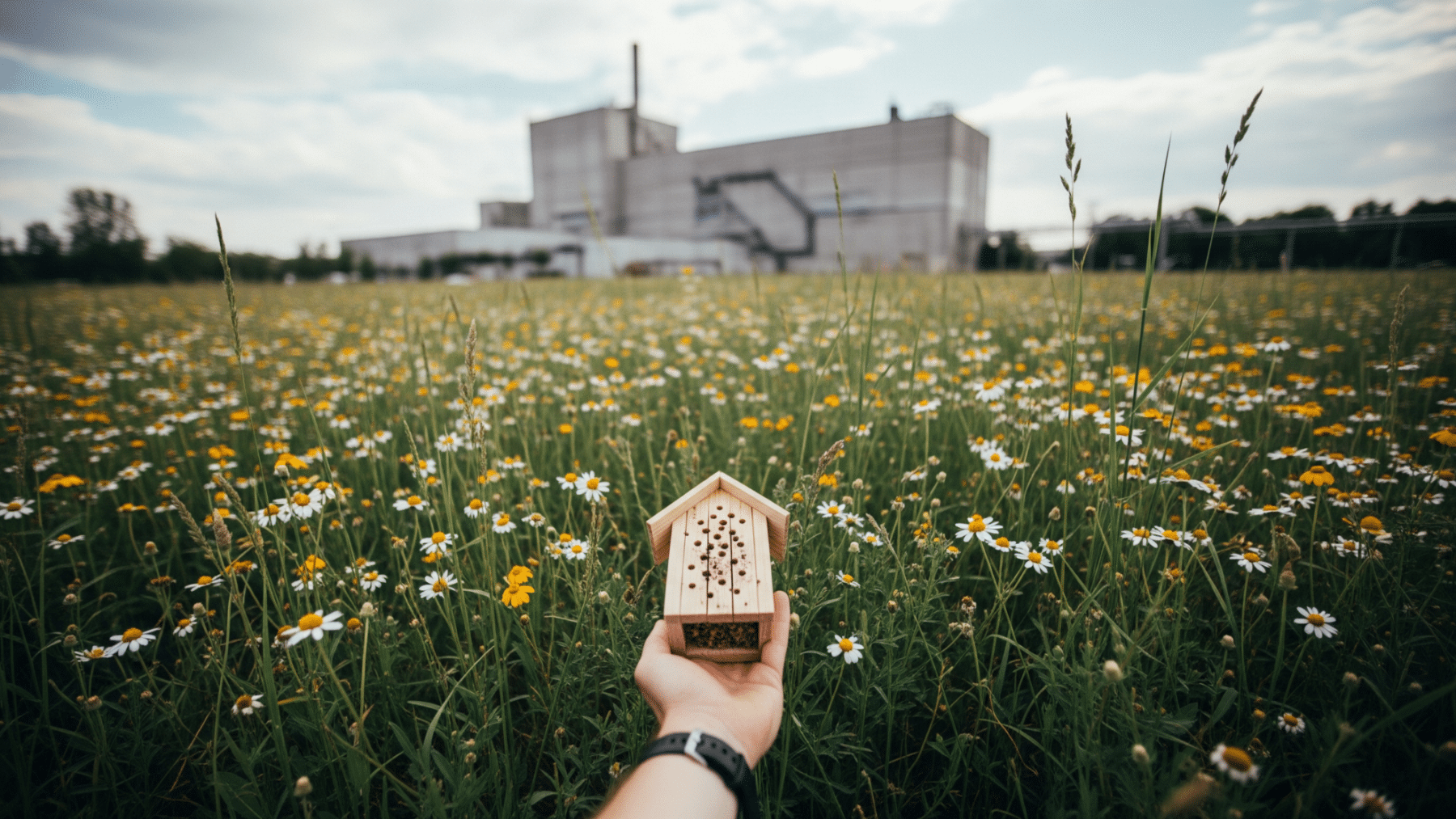
Every day, thousands of workers clock in at Toyota’s sprawling North American manufacturing campuses to stamp steel, thread wiring and roll finished trucks off the line.
It is heavy industry at full roar.
But there is something else growing alongside that industrial footprint, something that has nothing to do with torque specs or production targets, and the numbers behind it are genuinely hard to believe.
A footprint bigger than most people picture when they think about a car factory
Auto plants are not just buildings.
They are campuses, and the biggest ones swallow land by the thousands of acres.
Toyota’s total land footprint across North America runs to about 26,000 acres, a number that surprises almost everyone who hears it for the first time.
That is more than 40 square miles of property that the automaker owns or manages across the United States, Canada and Mexico.
Most of us picture a factory as a building.
The reality is closer to a small county.
What happens to the land between the parking lot and the fence line
Inside that perimeter there are buffer zones, stormwater ponds, grassy margins and idle ground that production lines never touch.
For most of industrial history, that land just sat there.
Toyota Mississippi maintains more than 1,500 acres at its Blue Springs site thriving with tree afforestation, pollinator gardens, a bio-retention pond and wildlife habitat havens. The site also maintains diverse wildlife habitats, including grasslands, forests, wetlands and stormwater ponds. Conservation efforts there include maintenance of wood duck nest boxes and monitoring of indicator species on site.
Similar quiet patches exist at 17 Toyota sites across the continent, and crews have been doing something deliberate with them for years now.
The scale of what they built there is the part nobody outside the industry has heard about.
The machinery that moves slowest on a car campus turns out to be the most powerful
Not a press. Not a paint robot.
The slowest machine on a Toyota campus is a seed.
An added 6,185 acres of pollinator habitat were developed in FY2025 through collaboration with Pollinator Partnership and the National Environmental Education Foundation, bringing the total to 20,616 acres since 2022.
That is a city-sized patch of living habitat generated in just a few years by a company whose core business is internal combustion and electric drivetrains.
Something is living in all of it, and the reveal changes the way the whole story feels.
The creatures now nesting, foraging and migrating across a car company’s program
Bees. Monarch butterflies. Moths. Bats.
Since 2022, Pollinator Partnership has collaborated with Toyota Motor North America to enhance and restore vital pollinator habitat across the United States, Mexico and Canada, providing a home for bumble bees, honey bees, monarch butterflies and a host of other species that together help sustain food production and ecosystem health.
Toyota’s environmental sustainability leadership has described the logic plainly: the 26,000-acre habitat goal was chosen because it matches the size of Toyota’s direct land footprint in North America, with experts in pollinator conservation guiding the work.
About 75 percent of crop plants require or benefit from pollination, and every third bite of food we eat is made possible by the efforts of pollinators.
These are creatures now supported directly by the same company building your next Tundra or RAV4.
Conservation programs at 17 Toyota sites covering over 640 acres have achieved Wildlife Habitat Council Conservation Certification, a voluntary certification standard.
Toyota is not the only automaker doing this: researchers studying the relationship between roads, vehicles and wildlife have underscored just how much the auto industry and the natural world remain intertwined, making habitat programs like this one matter even more.
GM’s Spring Hill, Tennessee campus takes a parallel approach. That 2,100-acre site includes 700 acres dedicated to farming and 100 acres of wildlife habitat.
Why the acreage number is growing, and what it means for the road ahead
Toyota set its original goal in 2022 at 26,000 acres by 2026.
An added 6,185 acres of pollinator habitat were developed in FY2025, bringing the total to 20,616 acres across Canada, the United States and Mexico since 2022.
That puts the program within striking distance of its finish line with room to spare on the calendar.
The ongoing grant rounds are designed to benefit a wide range of pollinator species, including monarch butterflies, the federally listed rusty patched bumblebee, and other at-risk insects whose ranges span the continent.
And while other EV news cycles this year have focused on what is coming off assembly lines, from BMW’s pre-production i3 to Rivian’s R2 launch planned for Normal, Illinois, this quieter story asks a different question.
The car sitting in your driveway was built by a company that is also, right now, helping feed a monarch butterfly.
That is not a metaphor. It is just what the acreage numbers, confirmed by Toyota’s own newsroom on December 3, 2025 , actually say.
