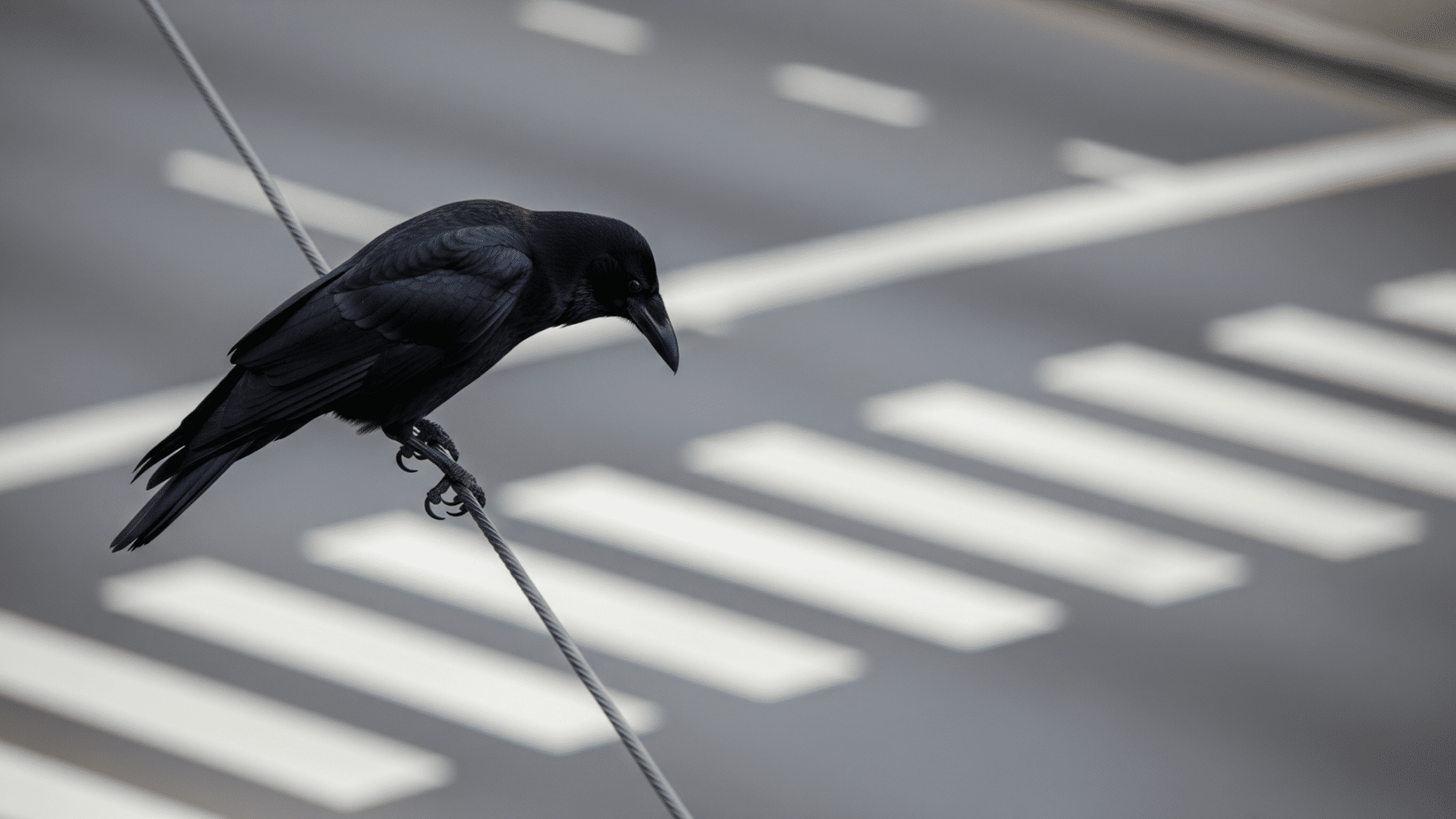
Something happens at a certain city intersection every time the traffic slows. A black bird lands, drops something onto the road, and waits. It does not flinch when a car rolls over the object. It simply watches, patient as a commuter checking a phone.
Then the light turns red. And the bird swoops down to collect its meal.
It sounds like a nature film plot. It is not.
It is one of the most quietly astonishing animal behaviors scientists have ever confirmed, and it involves a creature you have almost certainly seen on your morning drive.
The bird most drivers ignore entirely
Crows are part of the same family as ravens, jays, magpies and nutcrackers.
Although they are sometimes dismissed as noisy pests, crows are clever, curious and deeply social creatures.
Most Americans barely register them. They perch on fences, pick at roadside trash, and scatter when a truck rolls by. Easy to overlook. Easy to underestimate.
Although they have brains roughly the size of an average human thumb, scientists have been learning that crows and ravens rank among the most intelligent of birds.
Once disregarded in the world of animal intelligence studies, many crow and raven species are now ranked near primates in terms of cognitive abilities.
That comparison is not casual flattery. It is where the road story begins.
Why researchers started watching the crosswalk
Crows eat roadkill. That fact is unremarkable. What scientists noticed next was not.
A carrion feeder attempting to forage on a road benefits greatly from an appropriate response to vehicular traffic. In one observational study, researchers tested the ability of American crows to judge the behavior of fast-moving vehicles and avoid collision on a narrow road.
Unsurprisingly, American crows feeding in the same lane as the approaching vehicle always flew off, but a significant proportion of crows in the opposite lane chose to remain on the road.
Crows were not simply fleeing all vehicles. They were reading the situation and calculating.
In addition, 21% of the American Crows in the same lane as the approaching vehicle walked over to the opposite lane to avoid injury.
They were making lane decisions. Like drivers. The question was whether that intelligence went even further.
The object that started a scientific debate
Hard walnuts are almost impossible for a crow to crack with its beak alone. Pavement helps, but a nut dropped from a wire onto asphalt often survives intact.
The use of automobiles to crack open nuts by the carrion crow is a remarkable example of tool use among birds. Previously studied in Sendai City during the 1990s, researchers later studied this behavior in Hakodate City, Hokkaido, Japan during autumn and winter 2016.
But these birds were not just dropping nuts randomly. They were timing their drops with remarkable precision.
The phenomenon drew attention from biologists studying urban animal adaptation. GCN has previously reported on how researchers studying road behavior in animals, from the 23 deer in a headlight chute to AI systems trained on thousands of wildlife images, keep finding that animals interact with traffic in ways engineers never anticipated.
In Hakodate, crows frequently dropped walnuts randomly from electric lines onto roads, and the study’s authors concluded that the nut-cracking behavior there was less sophisticated than that observed in Sendai.
The most deliberate behavior had been documented in one city in particular. And it was more calculated than anyone expected.
The traffic light is the real tool
Here is the confirmed payoff that makes this almost unbelievable: the crow is not using the car as the tool. It is using the traffic light.
The now-famous video of these crows in Japan shows one stationed above a pedestrian crossing. When the light turns red, it positions its nut on the crossing, then flies back to its perch and waits while the light changes and traffic passes; when the light turns red again, it flutters down to safely collect the cracked nut.
Crows station themselves on treetops and electricity wires beside pedestrian walkways and crosswalks connected to a traffic-bearing road. At the signal of the green light, the crows drop the nuts they have foraged onto the road. While the cars and other vehicles pass by, their rolling wheels crack the nuts open.
Then the red light arrives, traffic stops, and the bird retrieves its meal safely from the crosswalk.
The system works because the crow has learned exactly what a vehicle sensor cannot: the rhythm of a signalized intersection.
A 1995 paper published in the Japanese Journal of Ornithology recorded the Sendai crows over 21 months and concluded that the behavior was systematic, not accidental, with crows adjusting walnut placement to maximize the chance of a tire strike.
This is learned behavior passed between generations through cultural transmission.
Young crows learn how to survive by watching their parents work. When an older crow cracks a nut on a crosswalk, the younger birds watch from the trees. They see the success and copy the exact steps later on. This social learning allows the skill to pass down through generations.
Nut-cracking behavior using automobiles was observed most often at intersections rather than on straight roads. That is not coincidence. Intersections are where predictable stop-and-go cycles happen. The crow figured that out.
What this says about the road we share every day
The intersection is one of the most engineered spaces humans have ever built. Signal timing, lane geometry, pedestrian phases. Every second is calculated for human movement.
As research progressed, especially within the field of comparative cognition, scientists began to uncover astonishing evidence that corvids possess advanced mental abilities.
According to biologists, the corvid family, including crows, ravens, rooks, magpies, and jackdaws, is regarded as one of the smartest groups of creatures in the bird kingdom.
Corvids have incredibly sharp visual resolution that allows them to navigate while flying at high speeds and to find potential sources of food.
“Birdbrain” used to be a common insult, but corvids show such surprising intelligence that scientists and science writers sometimes describe them as nature’s “feathered apes.”
The crow did not read an engineering manual. It watched and learned, generation by generation, until the traffic signal became as familiar as a tree branch.
Every morning, millions of drivers sit at red lights and wait. It turns out they have company. And that company has been studying the system far longer than most of us realize.
