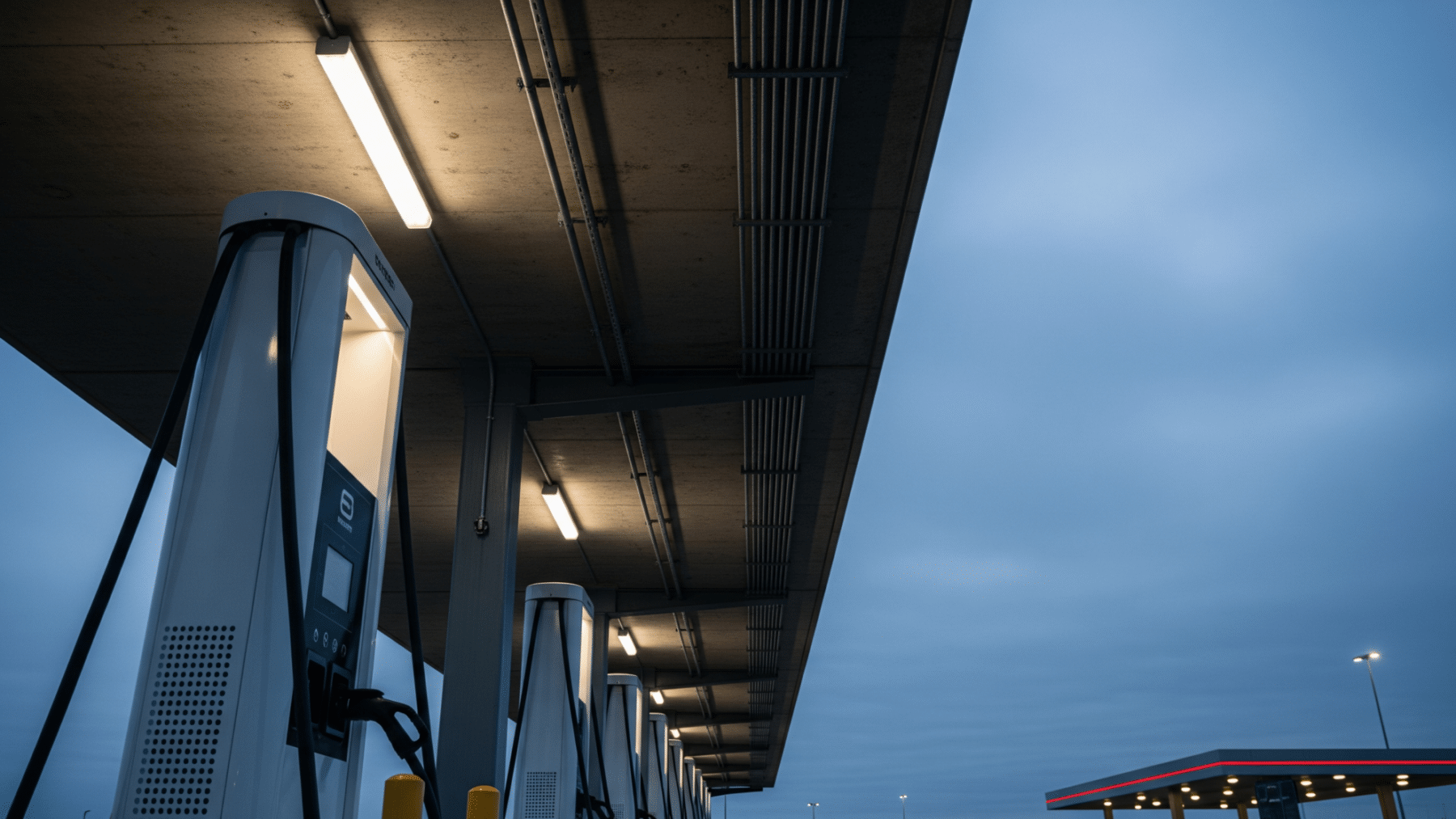
Picture a highway travel plaza somewhere in middle America. The fast-charging columns are there, lit up and humming. But the federal program that was supposed to pay for them spent most of last year tied up in federal court.
The fight over who builds America’s EV charging network, and who pays for it, is reshaping how much electricity the grid has to absorb, street by street and substation by substation.
A $5 billion program built over years got frozen in a single memo
The National Electric Vehicle Infrastructure program, known as NEVI, is a $7.5 billion appropriation passed by Congress in 2021 as part of the Bipartisan Infrastructure Law.
That total covers two programs: the $5 billion NEVI Formula Program and a $2.5 billion discretionary grant program. The $5 billion in formula funding is allocated to each state to build out a network of EV charging stations along highways across the country.
Then, in early 2025, it stopped.
The Trump administration issued a February 6, 2025 memorandum through the Federal Highway Administration that suspended state EV infrastructure deployment plans and rescinded related guidance, effectively telling state transportation directors that “no new obligations” could occur until guidance was updated.
The Federal Highway Administration committed to honoring existing contracts, but new spending was locked.
States took the freeze to court and won, but the damage was already running
The freeze did not go unchallenged for long.
Although a significant share of allocated NEVI funds had been committed to specific projects before the freeze, a large portion of the total remained without approved obligations. A coalition of 17 states and the District of Columbia filed suit to challenge the Trump administration’s unlawful, indefinite freeze.
United States District Court Judge Tana Lin issued a preliminary injunction lifting the funding freeze, restoring roughly $1 billion in funds for the 14 states whose claims the court found most immediately at risk. After a roughly six-month freeze and a legal battle with states, the Trump administration reopened the program by releasing new guidance in August 2025. A federal judge ultimately ruled on January 23, 2026 that the Department of Transportation and the Federal Highway Administration had acted unlawfully and must release obligated funds.
But the legal clock kept ticking against real construction schedules.
At the start of 2025, before the freeze took hold, approximately 26 NEVI-funded charging stations were open; by year-end 2025, 99 NEVI stations and 497 ports had come online, a meaningful gain, but only a fraction of what the program was designed to deliver.
Congress then cut hundreds of millions more from the program’s future
Even after the courts pushed funding back open, Capitol Hill moved in the opposite direction.
A funding bill would eliminate $879 million in funding for EV charging infrastructure under the NEVI program, throwing money that states had counted on for future charger installations into doubt.
That left the program limping into the year analysts had expected to be its breakout.
States had obligated just over 16 percent of the total allocated by Congress, a figure that frames just how far the program’s results have trailed its ambitions, even before the latest cuts.
Meanwhile, EV drivers kept plugging in. Demand for public charging did not pause while the lawyers argued.
Private capital read the gap and added 18,000 fast-charging ports in a single year
Here is the consequence that utility planners are now tracking on spreadsheets: private investment surged precisely where federal momentum stalled.
More than 18,000 new DC fast-charging ports were added in the U.S. during 2025, representing roughly 30 percent year-over-year growth and the largest single-year increase on record.
NEVI-funded sites contributed 99 stations and 497 ports, only about 3 percent of total 2025 additions, indicating most growth came from private investment.
That math tells the real story of who is now driving EV charging infrastructure, and who is driving the load that comes with it.
As of February 2026, the U.S. had more than 77,000 publicly accessible EV charging stations collectively hosting more than 236,000 public charging ports nationwide.
Every one of those ports draws from the grid that utilities are racing to reinforce for a surge in demand that arrives unevenly and fast. The IEA has flagged that megawatt-class chargers impose significant loads on grids, often requiring upgrades that could substantially slow deployment.
And on the distribution side, a building that adds 20 EV chargers could double or triple its total load, forcing utilities to support increased demand with substation and feeder infrastructure upgrades, not just transformer replacements.
The grid math has changed regardless of what Washington does next
Although media narratives pointed to weakening EV demand, actual charging data showed strong, sustained growth across infrastructure, usage, and operational reliability, with 2025 demonstrating a clear trend toward network maturity and long-term infrastructure planning.
For utilities, that means the load is arriving on its own schedule.
Federal funding was not really a story of 2025, but is set up to matter more into 2026, particularly in rural areas and for medium and heavy-duty charging, where even a stepped-up private sector has still left significant gaps to fill.
Those gaps matter because rural fast-charging and heavy-duty corridors are exactly where grid infrastructure is thinnest and upgrade costs are highest.
The federal program that was meant to sequence the buildout carefully, pairing charger deployment with grid upgrades, has instead delivered a patchwork year: courts ordering funds released, Congress clawing some back, and private networks pressing ahead on their own timelines.
Despite a more cautious market backdrop, 2025 was a record-breaking year for U.S. fast-charging infrastructure, defying the prevailing narrative of a broad slowdown in EV adoption, which says something both about the resilience of private capital and about how much ground the NEVI program still has to cover. The grid does not grade on a curve.
