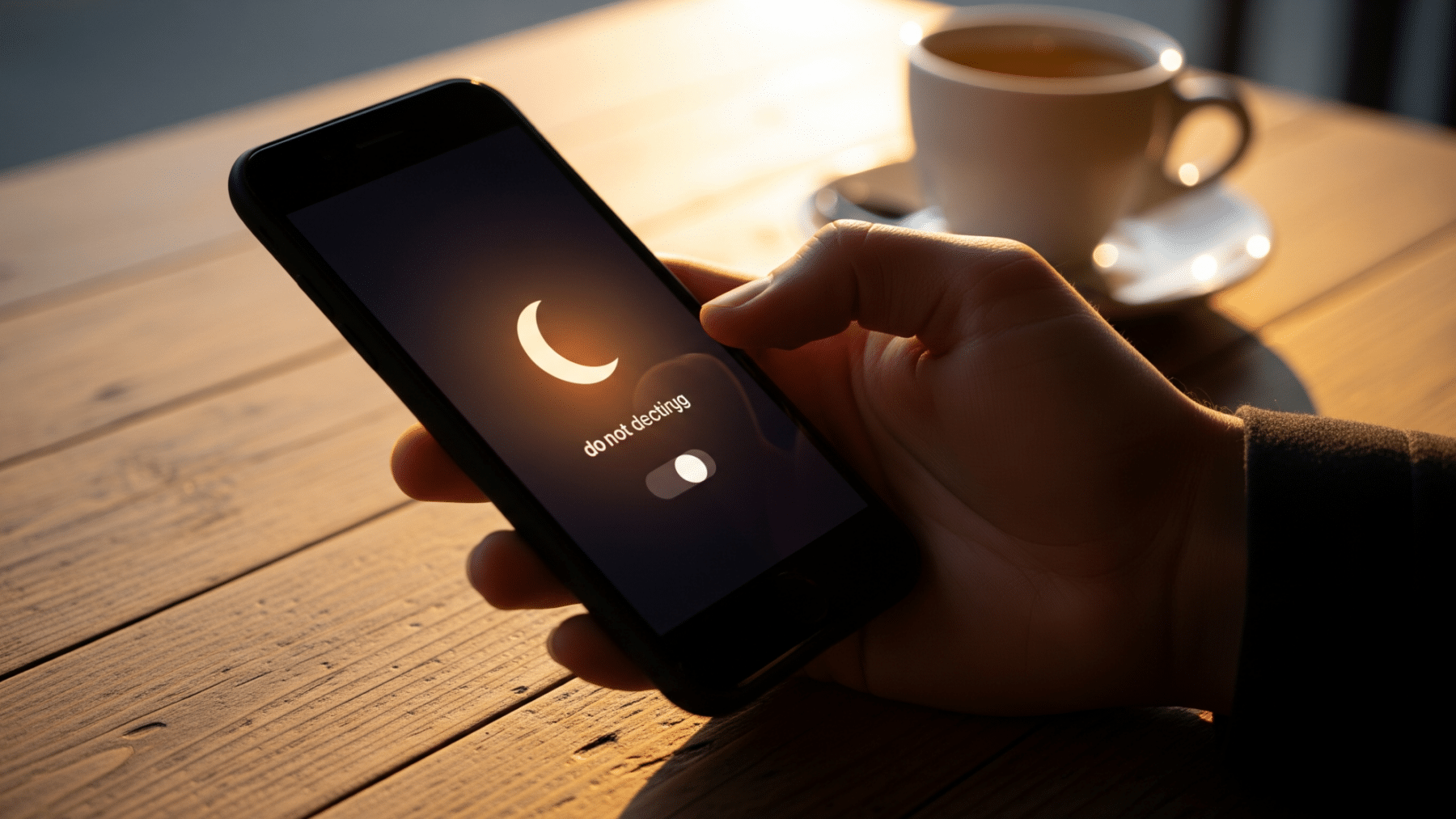
Almost every phone sold in America ships with the same quiet promise: flip one switch, silence the noise, get your focus back. Hundreds of millions of people use Do Not Disturb or Focus Mode every week. It feels like the simplest possible solution to the loudest problem in daily life.
But researchers have been watching what people actually do after they tap that button. And what some of them do is not rest.
The feature that promised to fix your phone problem
Do Not Disturb is a system-level feature designed to suppress non-essential notifications. Apple wraps it inside a broader suite called Focus Mode. Android calls its version Focus Mode or Digital Wellbeing.
Modern mobile devices also let users restrict access to specific apps entirely, through tools like Apple’s Screen Time downtime limits and Android’s Digital Wellbeing controls.
The pitch is consistent everywhere: silence the phone, save the brain. Productivity forums and study guides repeat it as received wisdom.
Why millions of people turned the feature on in the first place
Smartphone notifications have become a pervasive feature of daily life, and research has consistently found that the sheer volume of alerts drives users toward notification fatigue, the point at which every buzz feels less like useful information and more like unwanted noise.
That pressure explains the appeal perfectly. Every buzz and ping carries a small cost. Research published earlier on this site showed that a single notification takes around 23 minutes to fully shake off, which makes the math for silencing everything look obvious.
The feature spread fast. Now it is baked into every major operating system and recommended by everyone from productivity coaches to pediatricians. Set it and forget it, the logic goes.
What the researchers started measuring that users never see
The pervasive integration of smartphones into daily life has increased the prominence of phone-related stimuli. Notifications and the expectation of communication can prompt habitual checking behaviors and attentional monitoring, even in the absence of explicit alerts.
Feelings tied to fear of missing out and social obligation have been linked to increased distraction and phone use.
That last part is the thing researchers kept returning to. The alerts are gone, but the urge to check? That turns out to be a different animal entirely.
Prior work suggests that while notification management tools such as Do Not Disturb can reduce interruption, their effects are context-dependent and shaped by individual differences. Users differ significantly in how they respond to reduced connectivity.
The hidden catch that the feature’s own settings screen never mentions
Here is the part that does not appear in any setup guide. Other work has shown that muting notifications does not always reduce phone use and may even increase compensatory checking behaviors, particularly among users concerned about missing important information.
The pattern has a name: compensatory checking. When the phone stops buzzing, some users start picking it up manually, more frequently than before, to find out what they are missing.
Results from one study suggest that many current solutions for mobile phone overuse, like the Do Not Disturb function, may be counter-productive. Sound and vibration cues from notifications actually appear to assuage users’ uncertainty and fulfill their informational and social surveillance needs.
A May 2026 Utah State University study tracked a group of students completing programming assignments with and without notification suppression enabled. Researchers found a notable bimodality: many students were positively affected, a small number were negatively affected, with relatively few falling in between.
The feature genuinely helps one group. For another, silencing the incoming alerts simply shifts the behavior inward, turning a passive distraction into an active one.
For students where notifications were entirely blocked, smartphone vigilance may have gradually intensified during the task. Uncertainty regarding incoming messages increased anticipation, so that when they finally accessed their devices they were more likely to engage for extended periods.
What the research actually suggests you do with this
None of this means Do Not Disturb is useless. On average, students in the Utah State study showed lower break rates and longer intervals of focus when notifications were silenced, suggesting the feature can help people stay more engaged during work.
The honest takeaway is that the feature works well for people who are not already in the habit of manually refreshing their social feeds every few minutes. For heavy habitual checkers, it may just relocate the problem.
Researchers suggest the fix is not a blunter switch but a smarter one. While Do Not Disturb was introduced to mitigate distractions, its current implementations often lack the sophistication needed to balance connectivity and focused work time effectively.
In the meantime, the same instinct driving habitual phone checks also drives the clutter that fills daily life in other ways. A 501-person home survey found that unresolved low-level anxiety tends to express itself in the environment around us, not just on our screens.
The phone is already quieter. The next step, researchers say, is understanding whether the person holding it is actually ready to let it be.
