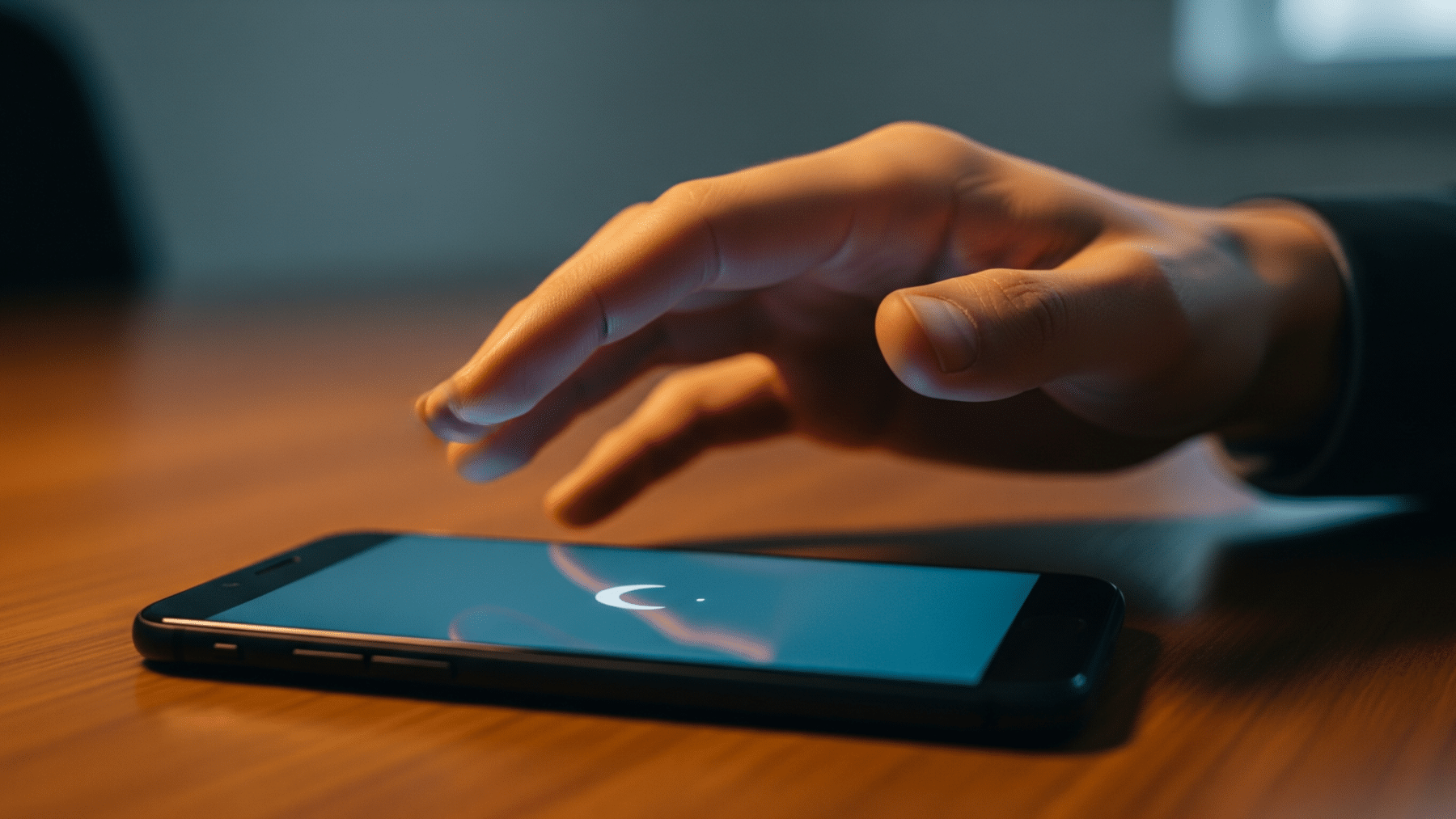
You’ve done it a hundred times. You flip on Do Not Disturb, set the phone face-down, and tell yourself you’re finally going to get something done.
It feels like a clean break. The buzzes stop. The badges freeze. The screen stays dark.
And then, a few minutes later, you pick the phone up anyway.
That moment is not a personal failing. It turns out it is a documented pattern, and researchers have been building a case around it for years.
The feature that promised to hand your attention back to you
Turning off push notifications is a common recommendation to reduce smartphone screen time and to improve daily experiences of digital well-being.
The logic is intuitive. A higher number of notifications tends to lead to increased screen time and how often people look at the screen, presumably because the notifications grab the user’s attention and trigger an urge to check their phone.
The instant shifts in attention, due to notifications, tend to distract people from what they are doing and may affect cognitive performance negatively.
So the prescription seemed simple: silence the buzzes, and the distraction disappears with them.
How the silence starts working against the plan
The problem is what happens inside the quiet.
Notifications and the expectation of communication can prompt habitual checking behaviors and attentional monitoring, even in the absence of explicit alerts.
In other words, the notification itself is not always the trigger. The habit of watching for one is.
Feelings associated with fear of missing out and social obligation have been linked to increased distraction and phone use.
Silence the buzzes and those feelings do not disappear with them. For many people, they intensify.
This tension is something researchers who study workplace screen distraction have circled for years, watching the gap between what people intend to do with their devices and what they actually do.
What happens when researchers put the theory to a real-world test
The evidence kept pointing in the same uncomfortable direction.
Participants in a 24-hour no-notification study reported feeling both more productive and more anxious, with some worrying more about missing important information and feeling less connected.
That anxiety is not incidental. It is the engine of the checking loop.
Even when users choose to disable notifications, research suggests that for some individuals, disabling alerts may produce anxiety over missing out.
Such anxiety may lead users to self-interrupt more frequently.
One study of information workers offered a particularly sharp illustration.
Workers had their desktop email notifications disabled for part of a study period, and for some, rates of accessing the email client actually went up rather than down.
The checking habit that undoes the silence
Muting notifications does not always reduce phone use, and the research suggests the habit of checking can persist even when the alerts are gone, particularly among users concerned about missing important information.
That persistence is the real payoff buried inside the Do Not Disturb promise.
A peer-reviewed study published in Media Psychology by researchers at the University of Amsterdam put the intervention directly to the test.
Turning off push notifications is a common recommendation to reduce smartphone screen time and to improve daily experiences of digital well-being, but the preregistered randomized controlled trial found only little empirical evidence had ever confirmed that it works as advertised, and its own results showed that a one-week notification-disabling intervention did not significantly affect checking frequency or screen time.
These factors may complicate the effects of notification suppression, as users differ in their responses to reduced connectivity.
Prior work suggests that while notification management tools such as DND have the potential to reduce interruption, their effects are context-dependent and shaped by individual differences.
For Americans already spending more than four hours a day on their smartphones, and already anxious about staying connected, that context often tips the balance the wrong way.
A smarter approach than flipping one switch and hoping for the best
None of this means Do Not Disturb is useless. It means the way most people deploy it leaves the underlying habit completely untouched.
Since iOS 15, Do Not Disturb has been just one Focus preset, not a separate system, a distinction that still trips up many users on iOS 18 and later.
The difference is granularity: DND is blunt, silencing nearly everything, while custom Focus modes let you allow specific apps during work and block them during deep work.
Live Activities and StandBy widgets can surface sports scores, ride-share ETAs, and food-delivery timers on your lock screen even when notifications are silenced.
Those are not traditional notifications, but they pull the same attention.
The research points toward a more deliberate approach: pairing silence with an intentional, time-boxed window, and understanding that the phone’s design did not change just because the buzzes did. For anyone already tracking how their daily screen habits shape behavior, the gap between silencing alerts and actually changing the checking habit is the missing variable most self-help advice skips entirely.
The silence is real. What you do inside it is still up to you.
