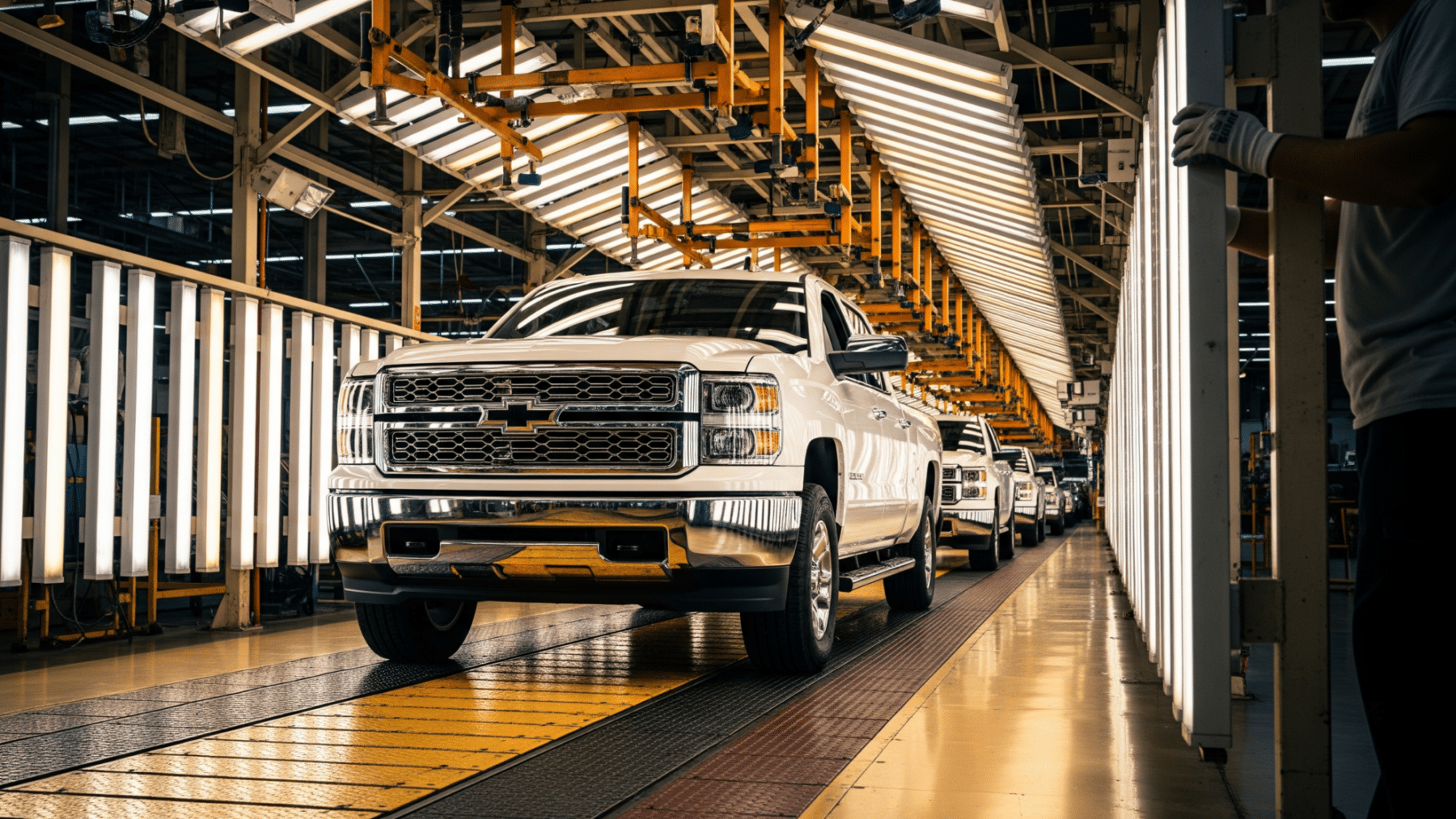
General Motors beat Wall Street’s second-quarter expectations on July 21 and lifted its full-year profit outlook for the second time in 2026, crediting strong truck pricing, shrinking electric-vehicle losses, and lower warranty costs for the outperformance.
Headline numbers top forecasts
GM reported adjusted earnings per share of $3.57 for the quarter, up 41 percent from a year earlier and above analyst estimates of $3.20. Revenue rose 1.9 percent to $48.03 billion, topping expectations of $47.01 billion.
Adjusted EBIT climbed 30 percent to $3.94 billion, ahead of the $3.79 billion analysts had forecast, while adjusted automotive free cash flow surged 78 percent to $5.03 billion.
On a GAAP basis, net income fell 31 percent to $1.31 billion, reflecting $2.3 billion in charges related to GM’s EV realignment recorded during the quarter. The quarter’s total adjustments of $2.5 billion also included China restructuring actions and prior restructuring programs.
For the full first half of 2026, GM delivered revenue of $92 billion and adjusted EPS up more than 35 percent year over year to $7.27, which CFO Paul Jacobson described as the company’s best first-half adjusted EPS performance ever.
Trucks and pricing drive North American margins
The company said results in North America were boosted by strong demand for full-sized pickup trucks and large SUVs. GM’s EBIT-adjusted margin in North America reached 8.6 percent, up 2.5 percentage points from a year ago.
At the total company level, EBIT-adjusted margin improved to 8.2 percent from 6.4 percent a year earlier.
Ford reported second-quarter U.S. sales of 549,200 vehicles, down 10.3 percent, as the company battled a supplier issue affecting its F-Series pickup trucks and a 40.7 percent drop in pure EV sales. Toyota Motor North America reported second-quarter sales of 673,971 vehicles, up 1.1 percent, with electrified vehicle sales climbing 19.5 percent to represent 56.8 percent of total volume.
Analysts have noted that GM’s truck-heavy lineup insulates it from near-term hybrid competition, though when hybrids are driving industry growth, GM does not carry the same hybrid ammunition as Toyota, Honda, Hyundai, or Kia. The company relies instead on strong trucks, big SUVs, a growing EV portfolio, and fleet business.
EV pullback costs near completion
The company has now booked $10.9 billion in EV-related charges since the second half of 2025, including $7.2 billion with a cash impact.
GM attributed its guidance upgrade to consistent vehicle transaction prices, lower warranty costs, and narrowing all-electric vehicle losses as it wraps up the multibillion-dollar pullback in EVs. The company said it expects to improve EV profitability as a key driver of future growth, a timeline that investors will track alongside battery supply commitments such as those at Hyundai and SK On’s Georgia plant.
Full-year guidance raised again
GM raised its full-year 2026 guidance across all major measures. The company now expects adjusted EBIT of $14 billion to $16 billion, up from $13.5 billion to $15.5 billion; adjusted diluted EPS of $12 to $14, up from $11.50 to $13.50; and adjusted automotive free cash flow of $9.5 billion to $11.5 billion, up from $9 billion to $11 billion. The company’s full-year guidance assumes $2.5 billion to $3.5 billion in gross tariff costs.
Management also said the company expects 2027 to be stronger, helped by EV improvement, new trucks, and ongoing efficiency gains. The company declared a quarterly dividend of $0.18 per share.
CFO Paul Jacobson said on CNBC’s “Squawk Box” that “our first-half earnings per share is 25% higher than the first half at any time in our history,” adding that GM’s “momentum is palpable” and describing the company’s stock as a “bargain” even after it had increased by more than 40 percent over the past year.
GM released its second-quarter 2026 financial results on Tuesday, July 21, 2026. The full earnings release and financial highlights are available on the GM Investor Relations website.
