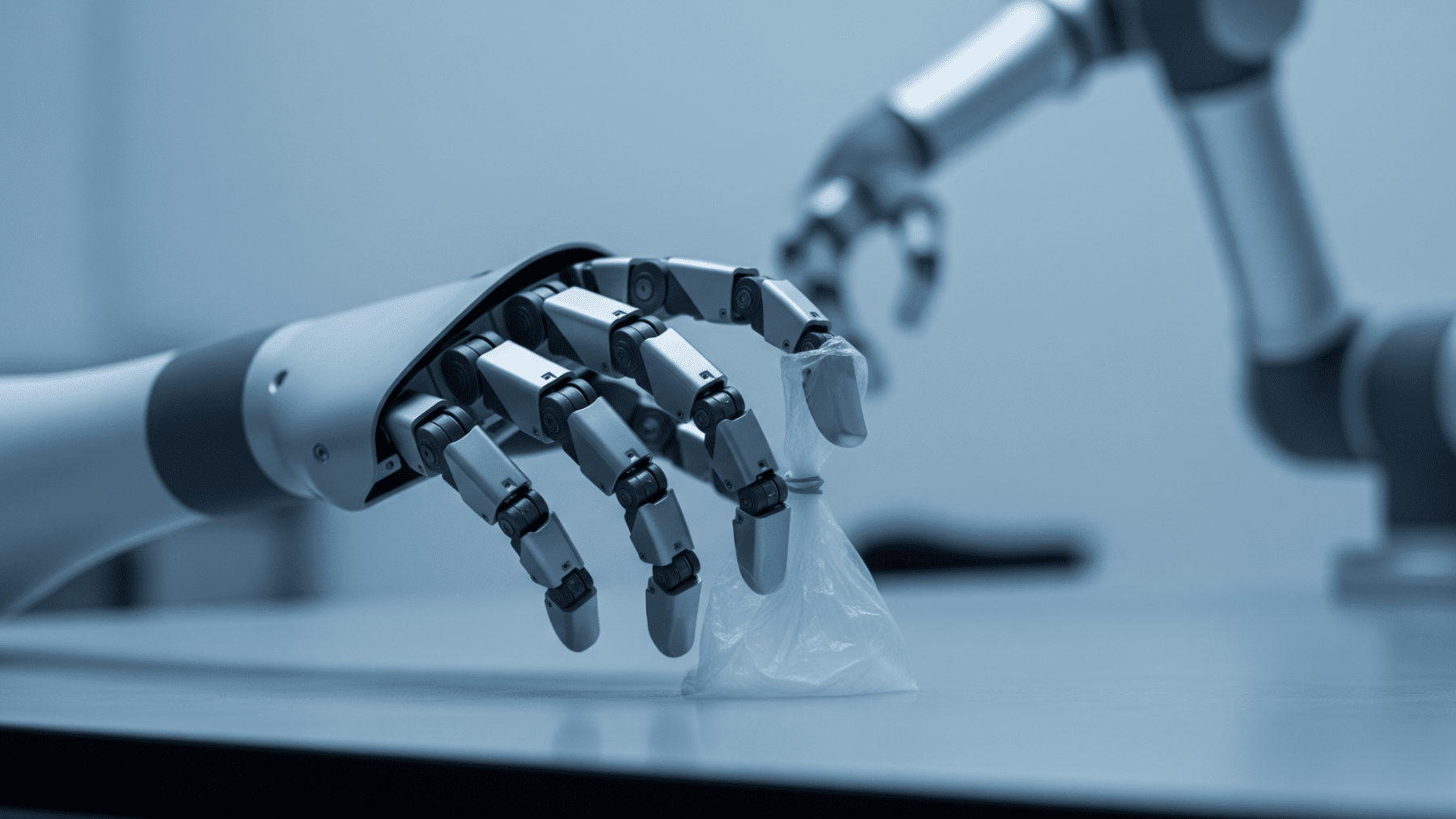
Google DeepMind on July 30 unveiled Gemini Robotics 2, a suite of AI models that runs legs, torso, arms and fingers under a single learned policy, the first time the family has extended beyond upper-body control alone. The release also introduces multi-robot collaboration and advances dexterity, in what the company calls physical AI.
Three models, one unified platform
The launch arrives in three distinct forms: the standard Gemini Robotics 2 vision-language-action model (VLA); Gemini Robotics ER 2, a vision-language model for embodied reasoning and multi-step planning; and Gemini Robotics On-Device 2, an edge-based model designed to run locally on robot hardware.
Google DeepMind says Gemini Robotics 2 extends its previous work by adding whole-body control. While earlier versions focused primarily on upper-body manipulation, the latest model enables humanoids to coordinate movements from “feet to fingertips.”
The system has been demonstrated on Apptronik’s Apollo 2, tested with both Sharpa and Inspire five-fingered hands. DeepMind also showed the model driving a two-armed Franka Duo with a Robotiq gripper, along with Dexmate, Trossen and SO101 research robots, across a wide range of dexterous manipulation tasks.
Apptronik runs Robot Park, a nearly 90,000-square-foot data collection and training facility in Austin that it opened on June 30, 2026. Apollo 2 robots continuously collect high-quality training data that is used to refine Google DeepMind’s Gemini Robotics AI models.
ER 2 acts as an on-site project manager
Gemini Robotics ER 2, the reasoning layer at the heart of the platform, is a vision-language model that acts as the system’s high-level brain, communicating with humans, understanding the physical world, and planning multi-step tasks lasting several minutes.
According to Google DeepMind’s announcement, ER 2 enables robots to more reliably execute longer task sequences lasting several minutes and involving hundreds of decisions, and measures a robot’s ability to refuse unsafe actions, determine when a task cannot be completed safely, and request human intervention when appropriate.
The model breaks down instructions into steps and tracks progress through live camera feeds. It can also divide work across multiple robots to speed complex workflows. If a robot makes a mistake, ER 2 identifies the last successful step and resumes from there.
This multi-robot coordination capability, described on the official Google DeepMind blog, allows different machines to split tasks based on their individual capabilities rather than relying on a single robot to complete every step.
ER 2 also advances spatial reasoning, operating on raw video feeds rather than static snapshots to catch mid-execution failures such as spills, slips, or misalignments. Instrument reading has been extended beyond circular dials to include digital displays, linear scales, rulers, and liquid thermometers, tested across ten different instrument types.
This kind of real-time visual awareness connects directly to the broader push from major AI labs to make language models more useful as industrial orchestrators, a trend also visible in tools like Google’s Gemini API Managed Agents.
On-device model cuts cloud dependency
Local processing is important in settings where internet service is unavailable, unreliable, or too slow for real-time movement. Google DeepMind announced Gemini Robotics On-Device 2, a lightweight model that operates on the robot itself without requiring an internet connection, adaptable to new dual-arm robot platforms with different shapes, sensors, and numbers of joints, typically using fewer than 200 real-world examples collected over a few hours of additional training.
That rapid adaptation window is a practical improvement for manufacturers and research teams deploying hardware in varied environments.
New safety benchmark
Safety is a central theme of the Gemini Robotics 2 release. Google DeepMind introduced ASIMOV-Agentic, described as “a new benchmark for agentic safety orchestration and uncertainty resolution.”
It measures the embodied reasoning agent’s ability to refuse unsafe tool calls from a VLA. Additionally, ASIMOV-Agentic measures the agent’s ability to predict whether a task is possible and to proactively request human intervention when uncertain.
Gemini Robotics ER 2 is described by Google as its safest robotics model to date in safety constraint following and human proximity benchmarks. It improves human-awareness capabilities, enabling robots to detect nearby people, trigger safety functions and stop safely when someone enters their working area, a key requirement in collaborative safety standards.
Gemini Robotics ER 2 is now available through Google AI Studio and in private preview on the Gemini Enterprise Agent Platform, while Gemini Robotics 2 and Gemini Robotics On-Device 2 are available to selected early-access partners.
The pace of development in physical AI is rapid. The general-purpose robotics market is valued at under $1 billion today; a surge of investment could propel it to an estimated $370 billion by 2040, according to McKinsey.
As humanoid robots move into shared workspaces, the ability to coordinate across machines while detecting and deferring to nearby humans will be as critical as raw capability. The scale of AI model infrastructure now required to power real-time robotic reasoning also underscores why high-throughput AI hardware has become a significant factor across the industry.
