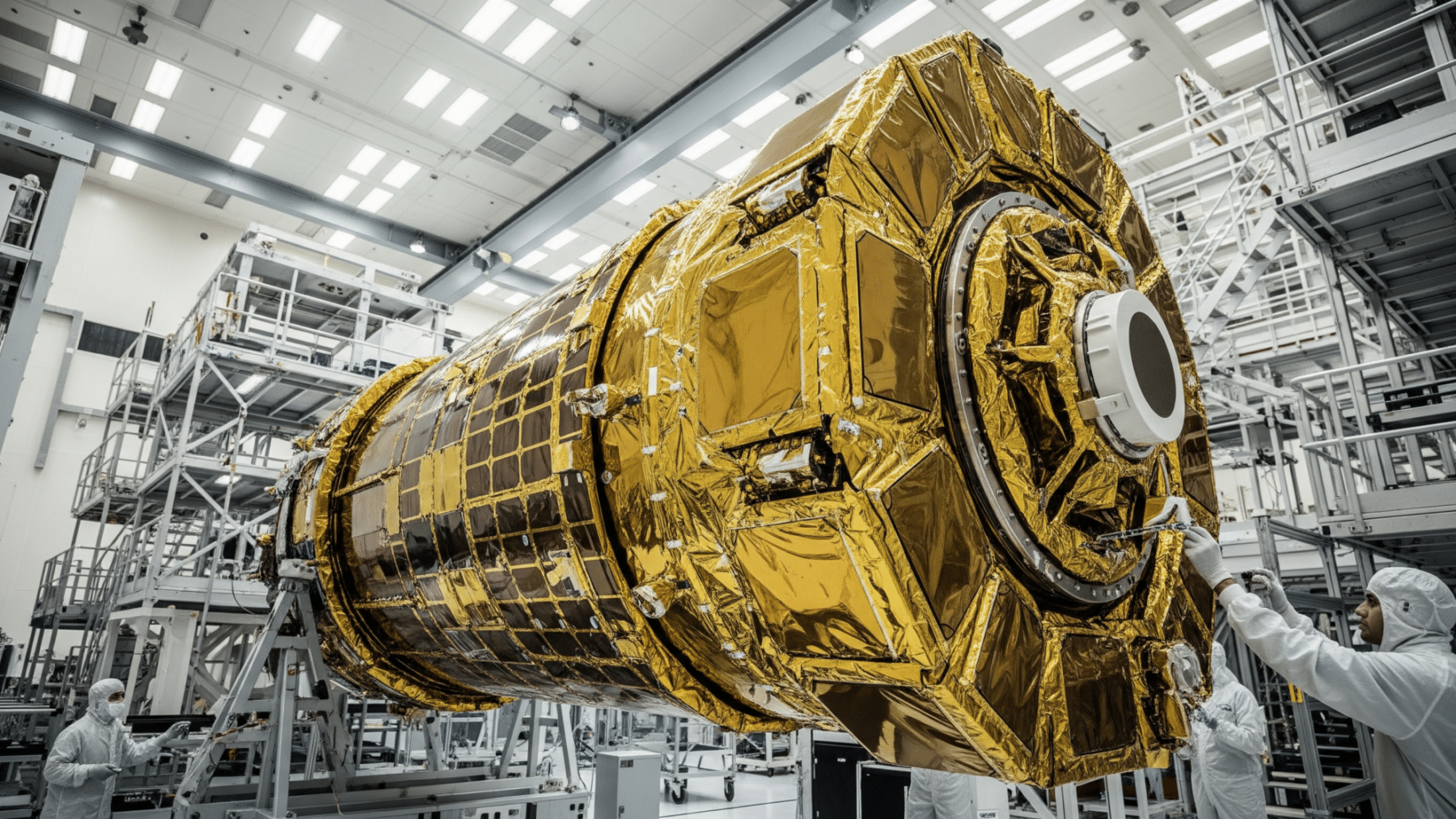
Most people outside the satellite industry missed the moment it happened.
A company dropped a brand name that had become synonymous with delay, picked a sleeker one, and then started launching hardware at a pace that turned heads inside the business.
The new name is Amazon Leo. The old one was Project Kuiper. And the gap between Leo and its dominant rival is still enormous, but it is closing faster than almost anyone expected.
A service years in the making finally has a launch window on the calendar
Amazon CEO Andy Jassy confirmed in a shareholder letter that the company’s Leo satellite internet service is scheduled to launch commercially in mid-2026, representing a delay from earlier expectations.
That admission of delay is the honest part of the story.
The more striking part is what happened in the months immediately after: April 2026 became the highest-cadence month yet for Amazon, with three launches deploying 90 satellites in just 26 days.
For a program that critics had written off as perpetually behind, that was a statement.
The rival it is chasing has a lead that looks almost impossible to close
Starlink has more than 10,000 satellites in orbit and over 9 million users. That is not a gap; it is a canyon.
The deployment schedule Amazon Leo faces is driven by FCC license requirements: 1,618 satellites by July 30, 2026 and 3,236 by July 30, 2029.
With the 2026 deadline approaching and the constellation still well short of that milestone, Amazon has requested an extension.
Amazon’s most capable terminal is designed to support download speeds up to 1 Gbps, competitive with or ahead of Starlink’s typical performance.
Speed on paper has never scared Starlink. Market share is a different problem entirely.
The business case depends on partners that already exist, not customers yet to sign up
Amazon is on track to initiate a public beta targeting initial markets in the United States, Canada, the United Kingdom, France, and Germany, with major enterprise partners including Delta Air Lines, JetBlue, and AT&T already signed on.
Amazon Leo uses five different launch vehicles, a multi-provider strategy designed to reduce single-point-of-failure risk and maximize deployment cadence. Amazon has committed more than $10 billion to the project overall.
That commitment scale puts it in a different league from smaller competitors.
Readers tracking the AST SpaceMobile BlueBird buildout will recognize the same logic: getting enough satellites up fast enough is the whole game.
But Amazon’s most important move in 2026 had nothing to do with rockets.
A single April announcement handed Amazon the satellite contract already running inside hundreds of millions of iPhones
Amazon announced a definitive agreement to acquire Globalstar, a move that would fold Globalstar’s satellite infrastructure, spectrum licenses, and its existing Apple service contract into Amazon Leo’s network.
Globalstar currently provides the satellite connectivity behind Emergency SOS via satellite on iPhone and Apple Watch in the United States. Under Amazon’s acquisition, that relationship, and the spectrum supporting it, would transfer to Amazon Leo, pending regulatory approval.
Amazon agreed to acquire Globalstar for about $11.6 billion in a deal offering shareholders $90 per share in cash or Amazon stock.
Strip away the satellite count and the financial engineering, and this deal is about inheriting an existing Apple service contract, acquiring scarce spectrum that cannot be replicated quickly, and accelerating Amazon Leo’s network reach.
Apple has 20 percent equity and 20 percent voting interests in Globalstar Licensee LLC, the subsidiary that operates the satellite system delivering connectivity to iPhone users in the U.S. Amazon is absorbing all of it.
The direct-to-device satellite services already running on hundreds of millions of iPhones will, pending regulatory sign-off, route through Amazon Leo infrastructure instead. SpaceX is also building a direct-to-device network. It holds no equivalent deal with Apple.
What the scoreboard looks like now, and why the race is far from settled
Amazon said the Globalstar acquisition will enable it to build its own direct-to-device satellite system, which it expects to start deploying in 2028.
The transaction is expected to close in 2027, subject to regulatory approvals from the FCC, the Department of Justice, and international spectrum authorities.
Starlink still holds commanding advantages in satellite count, active subscriber base, and launch cadence.
Analysts note that sustainable competition in LEO broadband will ultimately be driven by differentiated ecosystems with a sharp focus on key verticals, rather than by attempts to undercut Starlink on cost alone.
Amazon is not trying to out-Starlink Starlink. It is trying to become the infrastructure layer under the devices people already carry, the phones already in pockets, the watches already on wrists.
That is a different race, and as of April 2026, Amazon has planted its flag in the direct-to-device landscape in a way its rival did not anticipate.
The orbital gap is real. The strategic gap just got a lot smaller.
