Every day, Americans watch solar panels go up. On rooftops. In fields. Along highway corridors. Millions of installations keep accumulating, and the story of where all that energy comes from feels familiar by now.
What almost nobody pictures is what happens at the other end.
A solar panel is not a slab of inert glass. It is a layered industrial product packed with silver, copper, aluminum, silicon and specialized glass.
The mechanism for getting those materials back out is more precise, more industrial and more consequential than most households ever realize.
The clock on America’s first solar wave is already running
The United States installed its first large wave of utility-scale solar between roughly 2010 and 2015.
Panels carry a roughly 25-to-30-year lifespan, and according to a joint report by IRENA and IEA-PVPS, the volume of end-of-life panels globally could reach up to 78 million metric tons by 2050, and if fully recovered, the value of those raw materials could exceed $15 billion by that date.
The earliest installations from that first American boom are already in their mid-teens.
The Energy Information Administration projects almost 70 GW of new solar generating capacity coming online in 2026 and 2027, a 49 percent increase in U.S. solar operating capacity compared with the end of 2025.
More panels going up means more panels eventually coming down. The question is what industry does with them.
Why most retired panels end up as trash right now
The short answer is cost. Recycling a panel currently runs $20 to $30 per unit, versus $1 to $2 for landfill disposal.
The United States has no federal framework matching the EU rules that require panel producers to finance collection and recycling of every panel sold in Europe.
The U.S. currently recycles only about 10 percent of decommissioned panels, while the European Union’s producer-responsibility rules drive significantly higher recovery rates.
That gap is not a technology problem. It is a policy and infrastructure problem, and a new facility in Georgia is now targeting both at once.
What a panel is actually made of, and why recovery is so difficult
Aluminum frames, copper wiring, silicon cells, glass and plastic backing can all be recovered, refined and reused. The challenge is separation.
Removing the frame is straightforward, and a lot of recycling stops there. The rest gets shredded and sold as low-value glass cullet.
Teasing the glass from the cells and then isolating the silver and silicon is far harder. No single commercial process yet recovers all of it cleanly.
That is precisely the problem a proprietary industrial process in northwest Georgia was built to solve, and the reveal is in the numbers.
A 255,000-square-foot Georgia factory that recovers 96 percent of what a panel is worth
SOLARCYCLE began commercial operations at its new solar panel recycling facility in Cedartown, Georgia, on January 29, 2026.
The 255,000-square-foot plant is designed to process up to 5 gigawatts of panels per year at full capacity, making it the largest dedicated solar recycling facility in the United States.
The proprietary process delivers more than double the throughput of the company’s first-generation recycling lines, achieves 100 percent landfill diversion and recovers 96 percent of the value locked in silver, copper, aluminum, glass and other critical minerals.
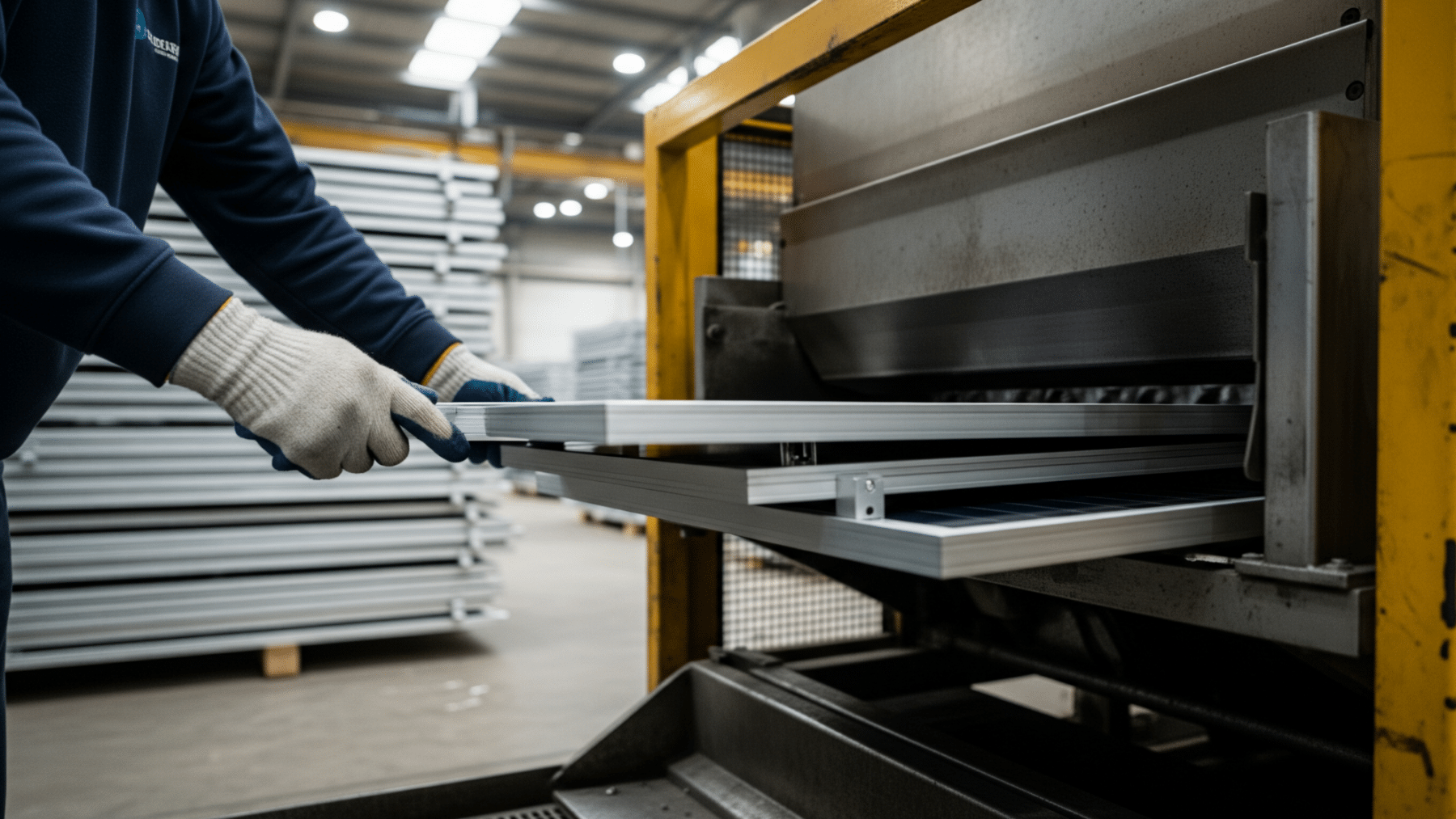
The four steps: remove aluminum frames and junction boxes; run panels through a “deglass” machine that cleanly separates glass from the solar laminate; shred the laminate; then process it through multi-stage proprietary systems to separate silver, copper and aluminum for reuse in new panels and other products.
The site is processing thousands of panels per week and will scale toward one million panels annually by the end of 2026, according to SOLARCYCLE.
But the recycling factory is only half of what is being built on that campus.
Adjacent to it, SOLARCYCLE is constructing the first U.S. factory to produce specialized glass for crystalline-silicon photovoltaics, with capacity for 5 to 6 GW of solar glass per year.
It will be the first facility in the country to use recycled materials from retired panels to make new solar glass, closing a critical domestic supply gap where most solar glass currently comes from overseas.
The company has already secured customer commitments covering more than 80 percent of planned capacity, with groundbreaking targeted for mid-2026 and first glass production in 2028.
Why closing this loop matters for every power bill in the country
According to a joint report by the International Renewable Energy Agency and IEA-PVPS, cumulative PV panel waste could reach 78 million metric tons globally by 2050, and the value of recoverable raw materials could exceed $15 billion by that date.
By housing recycling and future glass manufacturing in the same municipality, SOLARCYCLE is creating a circular economy hub in northwest Georgia, anchored by hundreds of manufacturing jobs on the horizon.
The industrial chain that will eventually connect panel recycling to remelted solar glass is taking shape now, for the first time in U.S. history, on a single campus, with the recycling side already operating and the glass factory scheduled to break ground by mid-2026.
Every panel going up today will eventually come down. The industry is finally building the infrastructure to make that moment a beginning, not a burial.
