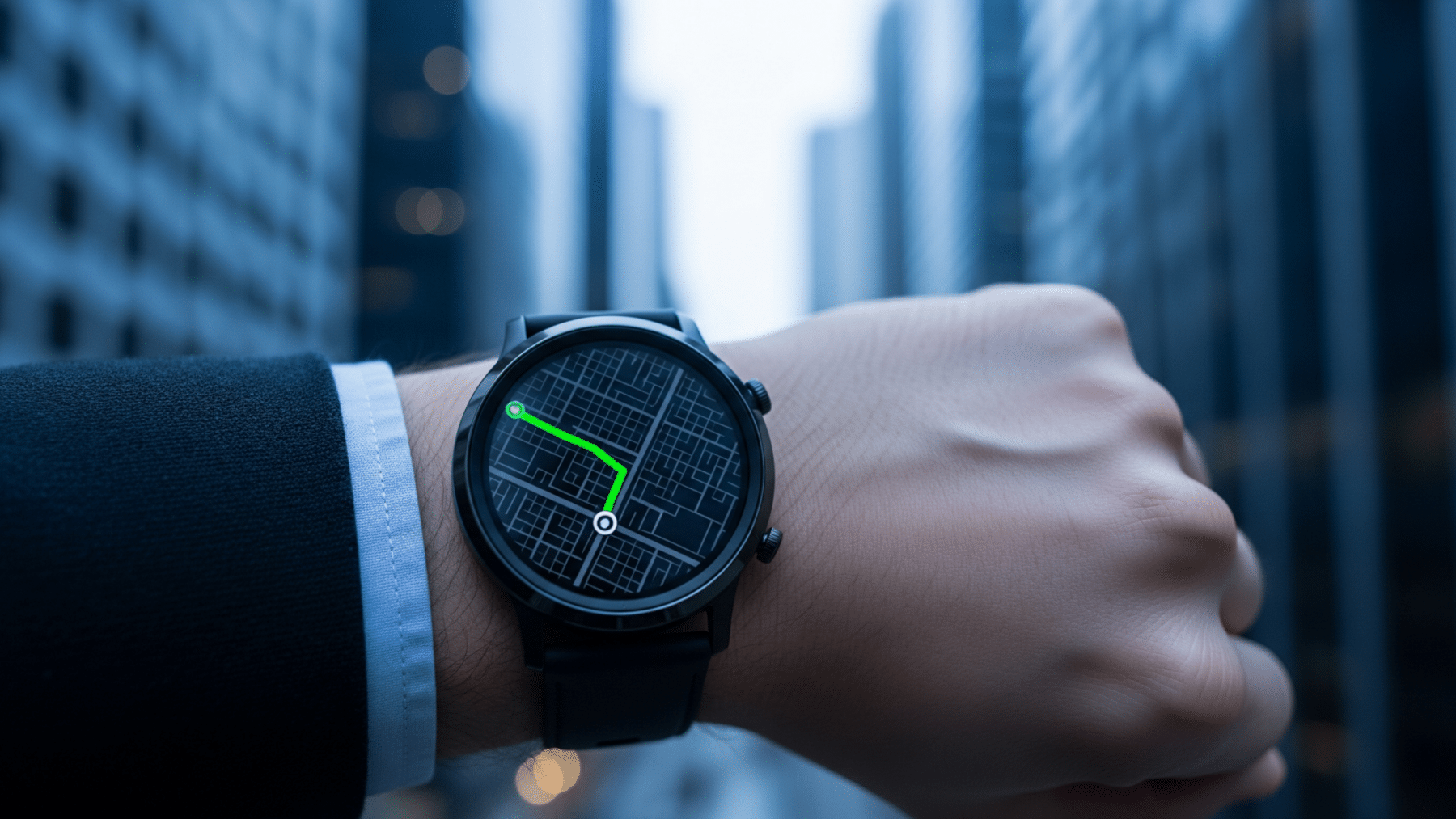
Google announced the Pixel Watch 5 on August 12 and set a general availability date of August 20. The company says the new device delivers route-tracking accuracy twice that of its previous generation by fusing artificial intelligence, Google Maps building data and a global network of weather reference stations.
What the AI-powered system actually does
Tracking was improved by combining Android Location technology with 3D building models, a GNSS reference station network, atmospheric corrections and building-reflection corrections.
The core problem the engineering team set out to solve is a well-known limitation of consumer GPS: signals that bounce off tall structures before reaching the receiver, distorting recorded routes.
Google leveraged the advanced technology behind Google Maps to trace satellite ray paths through 3D building models. By knowing the specific height of a building, the system can determine whether a satellite signal is being reflected off a structure, causing a multipath error, and re-prioritize which signals to trust.
Sharath Ananth, a lead engineer on Pixel Watch, said: “One of the pillars of any smartwatch is fitness,” and noted that having accurate GPS routes is important.
The Pixel Watch 5 also taps into a global network of weather reference stations in real time, adjusting satellite readings to account for local atmospheric conditions as they happen. Google additionally adjusts for satellite clock drift and multipath reflections from tall buildings.
Server-side processing keeps the battery intact
One of the trickier engineering constraints was fitting all of this computation onto a wrist-worn device without draining the battery.
The Pixel Watch 5 delivers its most accurate GPS tracking by combining global satellite data with AI-driven building models to correct signal errors. To maintain battery life, the watch compresses raw data and processes it externally rather than relying on heavy on-device computation.
The GPS coordinates are sent to a server, where they are combined with 3D building models, building-reflection corrections and atmospheric corrections. Google then performs calculations after a run to make the map more accurate. That information is also combined with accelerometer, gyroscope and other sensor data when Google processes the completed GPS track.
The result is a corrected route map that lands in the Google Health app after a workout concludes, rather than during it.
Google’s team verified these results through 4,000 miles of real-world testing, confirming the watch outperforms leading competitors in challenging urban environments, according to the company.
How it stacks up against rivals
Google said its new GPS route-tracking system is more accurate than the Apple Watch Ultra 3 and Garmin Fenix 8 Pro, based on an internal study it conducted in July.
Google claims the Pixel Watch 5 delivers twice the GPS accuracy of previous generations in difficult environments, using satellite data with 3D building models from Google Maps and real-time atmospheric corrections to deliver more accurate route tracking than the Apple Watch Ultra 3 and Garmin Fenix 8 Pro. The comparison was made using pre-production Pixel Watch 5 devices in July 2026, on sessions lasting three hours or less.
Independent hands-on testing by reviewers has not yet confirmed those claims.
The Pixel Watch 5 uses L1 (1575.42 MHz) and L5 (1176.45 MHz) GPS frequencies to implement a dual-band receiver , a hardware foundation that gives the software more raw signal data to work with before the AI correction layer is applied.
Hardware, pricing and availability
Powered by the Qualcomm Snapdragon W5 Gen 2 Accelerated chip, the Pixel Watch 5 delivers a 12% CPU boost and 50% more RAM, amounting to a 20% overall speed improvement. Storage doubles to 64 GB.
The 41mm model starts at $399 and the 45mm at $429, up from $349 and $399, respectively, for the equivalent Pixel Watch 4 Wi-Fi models. Pre-orders opened August 12, with general availability beginning August 20.
The new GPS system arrives on a device that also debuts Health Guardian tools, including breathing emergency detection and monthly wellness trend summaries for blood pressure, sleep and metabolic health, according to Google.
The GPS advance draws on AI and mapping infrastructure that spans Google’s broader hardware portfolio. Details are available in the Pixel Watch 5 announcement and in Google’s engineering post, How we built the new GPS on Pixel Watch 5.
