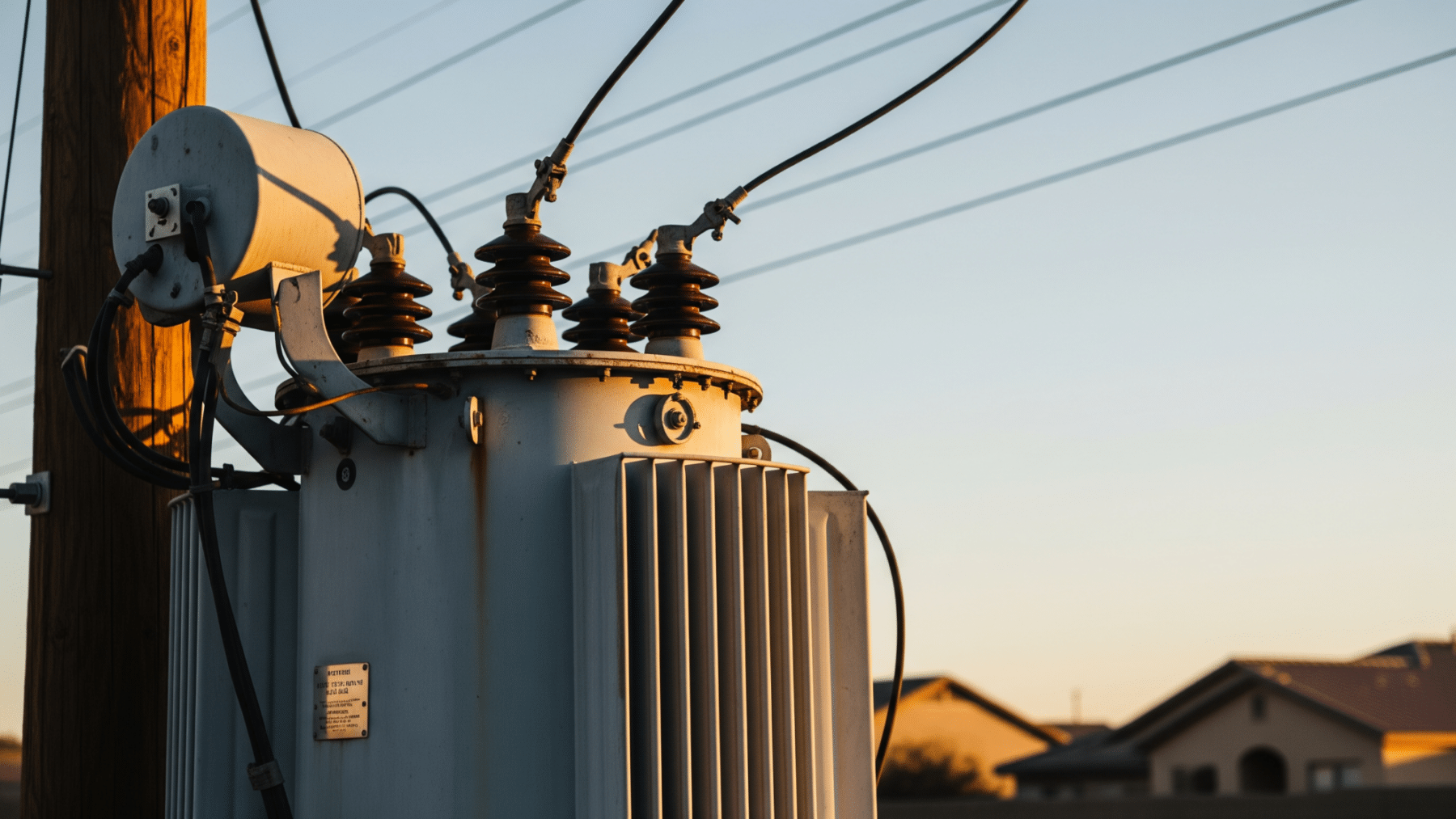
It weighs several hundred pounds, it hums faintly day and night, and almost nobody gives it a second glance.
One sits on a wooden pole at the end of your street, or tucked inside a green metal box at the edge of your lawn.
It steps high-voltage power down to the 120 volts that runs your refrigerator, your air conditioner, your phone charger.
It is, in other words, completely invisible to most Americans, until regulators start talking about it in a hearing room.
And right now, in Phoenix, they are talking about very little else.
The rate case that landed on Arizona households this summer
Arizona Public Service is the state’s largest electricity provider, serving about 1.4 million homes and businesses in 11 of Arizona’s 15 counties , and it is currently asking state regulators for its third rate increase in four years.
The rate case hearing is the latest step in a lengthy rate review process that started in June 2025 and will likely continue through the end of 2026.
Before packing two Arizona Corporation Commission hearing rooms for nearly four hours of public testimony, local advocacy groups and utility ratepayers gathered outside of the commission’s downtown Phoenix building to protest APS’s proposed 14% rate increase.
APS customers and Attorney General Kris Mayes voiced opposition at a public hearing against the proposed increase, while APS officials defended the proposal, citing a 64% rise in equipment costs and the need to reflect current economic realities.
If the current request is approved as proposed, the overall rate adjustment would reflect a 13.99% net increase to revenue collection. For a typical residential customer using 1,000 kilowatt-hours of electricity, the net monthly bill impact would be about $20.
What regulators keep hearing about on the grid
Utility rate cases are famously dry proceedings.
Engineers testify about depreciation schedules. Lawyers argue over allowed returns on equity. The public glazes over.
But one item keeps surfacing in the APS evidentiary record, and it is not a solar panel or a battery storage system or a new substation.
It is the transformer, that grey cylinder on the pole outside, or the squat metal box tucked at the edge of a lawn in underground-service neighborhoods.
The current APS rates are based on costs from five years ago; however, inflation and rising expenses have made it so that those rates no longer cover what it takes to operate and strengthen the electric grid.
Commissioners and intervenors have pressed APS witnesses repeatedly on one line item in particular.
And the answer coming back from the utility’s own testimony is hard to dismiss.
A number that keeps coming up in the hearing room
Every grid upgrade, every new neighborhood connection, every storm-damaged line that gets rebuilt requires transformers by the dozens.
The problem is that the price of those transformers has not held still.
Utilities across the country are filing rate increase requests with their respective state regulators, and transformer costs appear across many of those filings.
In Arizona, the number is specific and striking.
Current rates are based on expenses from 2021, 2022 and do not reflect today’s cost to serve customers. Over the past five years, APS has experienced rapidly rising costs of equipment needed to deliver power to customers, one example is transformer costs, which are, on average, 49, 90% higher now than when rates were last set.
APS says the request is driven by inflation, increasing costs for utility equipment, and the exploding demand for electricity in APS’s service territory, and the company is also requesting a 45% rate increase for large load customers like data centers and manufacturing facilities.
The commission has nearly three dozen intervenors in the case, ranging from consumer advocates to some of the world’s largest technology companies, all watching the same line items.
The $579.5 million ask, and the 64 percent figure behind it
APS filed a net base rate increase of $579.52 million, representing a 13.99% net increase, which would become effective no earlier than July 8, 2026.
The utility’s own testimony before the Arizona Corporation Commission, published on APS’s rate case page, puts the transformer squarely at the center of the argument.
APS stated that “the cost of some transformers, a critical component of providing energy to homes and businesses, is 64% higher now than when our current rates were set,” with transformer costs, on average, ranging from 49, 90% higher across types.
That supply-chain fact, repeated across the utility’s testimony, is one of the most concrete justifications APS has offered for why a rate structure built on 2021, 2022 cost data can no longer hold.
And the transformer price problem does not stand alone.
Utilities across the country are requesting significant electric and gas rate increases, proposals that could affect tens of millions of customer accounts.
The APS case also introduces a sharper question about who really owes what.
APS has proposed over a 45% rate increase for extra-large energy users like data centers to help ensure that they continue to pay for their costs of service.
The commission has to balance competing interests: APS needs revenue to build out infrastructure for surging demand, ratepayers want affordable electricity, and data center operators need predictable costs to justify their Arizona investments.
What the commission decides next will set a template others are watching
This is the latest step in the rate review process that began in June 2025 and will likely continue through the end of 2026.
The outcome matters well beyond Arizona.
The APS case has become a national flashpoint for two issues: the utility’s proposed formula rate adjustment mechanism that would allow annual rate increases without a full rate case, and a proposed 45-percent-plus rate hike specifically for data center customers.
Utility regulators in other states are tracking the Arizona proceedings as they weigh their own pending rate decisions on who pays for grid modernization.
The same transformer cost pressures, the same data-center load growth, and the same aging cost data appear in filings from Virginia to Pennsylvania.
Meanwhile, the broader grid capacity crunch driving much of this infrastructure spending is already reshaping how planners think about future load growth nationwide.
Utilities cannot raise prices on their own, they must file an application with their state’s Public Utility Commission, provide detailed financial justification, and go through months of review before any change takes effect.
That process is the public’s best lever. In Arizona, the hearing rooms have not been empty.
The grey cylinder on the pole outside your house, or the green box at the edge of your lawn, has been quietly getting more expensive for years. Now regulators are counting the cost, and deciding who writes the check.
