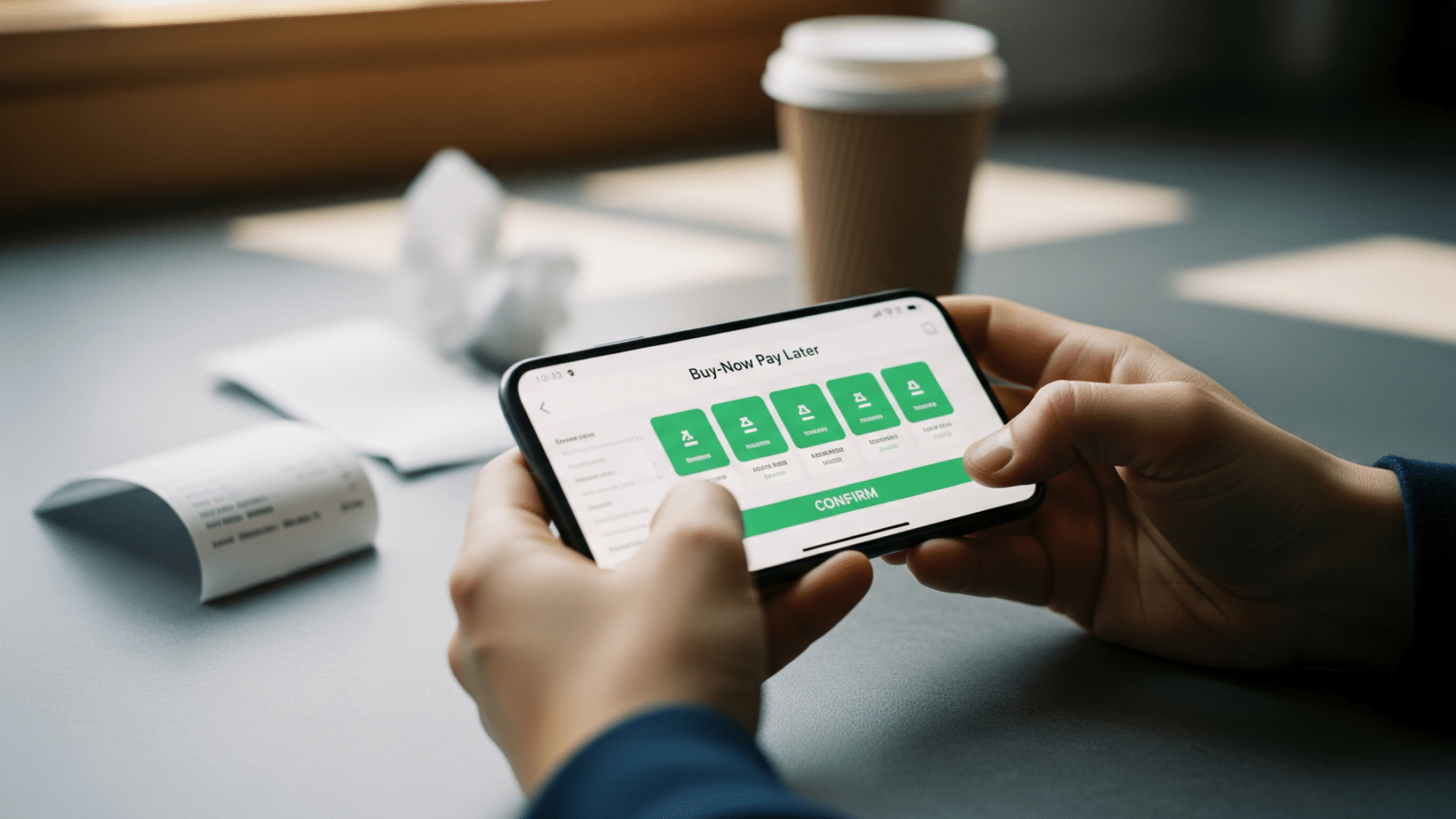
It is four small boxes on a checkout screen, each one showing a number that feels almost too reasonable to question.
The pitch is simple: split your purchase into four equal payments, pay nothing extra, and walk away with whatever you wanted right now.
An estimated 91.5 million Americans used buy now, pay later in 2025 to buy clothing, electronics, appliances, even groceries.
And most of them believed the zero-interest promise completely.
The checkout button that rewired how millions of people spend
Buy now, pay later products give consumers the option to pay for a purchase with a small number of equal payments, usually four, often without being charged interest, so someone buying a $100 item makes one $25 payment at checkout, then three more.
That structure feels nothing like debt.
It feels like a budgeting tool. A sensible choice. A small convenience.
The Federal Reserve’s most recent household survey found that 16% of U.S. adults used BNPL in the prior 12 months.
That number has climbed steadily since the Fed first started tracking it in 2021, when it stood at 10%.
Why the payments feel so painless that the total disappears
There is a well-documented psychological reason the four-box screen works the way it does.
The behavioral trap of splitting purchases into small installments masks the true cost of items and encourages spending beyond what consumers would afford upfront.
A Bankrate consumer finance expert summed it up plainly: “We maybe only look at the installment and we forgot how much we’re spending in total.”
Meanwhile, many of the newer BNPL installment plans now charge interest if stretched beyond the typical six-week period, and that interest, coupled with late fees or overlapping plans, can quickly resemble traditional credit card debt.
The mental accounting is doing exactly what the screen designed it to do.
When several open plans stack up at once, the due dates blur together
The real problem is not one plan. It is three or four running at the same time.
A 2026 LendingTree survey found that 47% of BNPL users said they had paid late in the past year.
LendingTree also found that 68% said BNPL caused them to overspend, and more than one in five users had regretted a BNPL purchase.
Even people who think they have it under control can slip. About half of all BNPL users have experienced at least one financial problem after using these services, according to a separate Bankrate survey.
That is not a fringe outcome. That is the median experience.
Many Americans are already stretched thin. Roughly half of U.S. households are living paycheck to paycheck, meaning a single missed BNPL due date can arrive at exactly the wrong moment.
The hidden catch the zero-interest label never mentions
Here is what the checkout screen does not show: the act of splitting the payment literally changes how much you spend.
A working paper by researchers at Harvard Business School found that when a consumer first opts to use BNPL, their total spending rises by around $130 and remains elevated for the next six months, showing that the effect is lasting rather than a short-term spike. Separately, a study covered by the Harvard Business Review and published in the Journal of Marketing found that BNPL drives 10% larger basket sizes at the point of purchase, an increase too large for simple convenience to explain.
The format rewires the budget decision at the moment of purchase, and the effect persists for months.
There is also a downstream banking catch. BNPL use reached 16% of all adults in the Fed’s 2025 survey, and 11% of BNPL users had a payment trigger an overdraft or non-sufficient funds fee from their bank in the prior year.
Late payments and financial strain are not rare outcomes. The 2026 LendingTree report found that nearly half of users had paid late, and the share has risen for two straight years.
And there is one more layer. BNPL providers charge merchants around 5% to 8% in processing fees versus 2% to 4% for standard credit card processors, and retailers can bake those higher costs into shelf prices that all shoppers pay regardless of payment method.
BNPL is not free, even for people who never use it. Shoppers who prefer the store aisle over digital checkout and pay cash are quietly absorbing that cost too.
What using BNPL more carefully actually looks like in practice
None of this means the product has no legitimate use.
BNPL can be genuinely useful when payments are planned and affordable.
The Federal Reserve’s 2026 SHED report, which tracks the economic well-being of U.S. households, makes clear that the product is mainstream and growing, which is reason enough to use it with clear eyes.
Consumer advocates consistently recommend one rule: when several small payment plans overlap, a convenient checkout feature can turn into a difficult-to-track web of due dates, fees, overdrafts, and financial stress.
Tracking every open plan in a single place, not just inside whichever app sent the last notification, closes most of the gap.
The four-payment screen is not going away. Knowing what it actually does to your total spend is the only number that matters.
