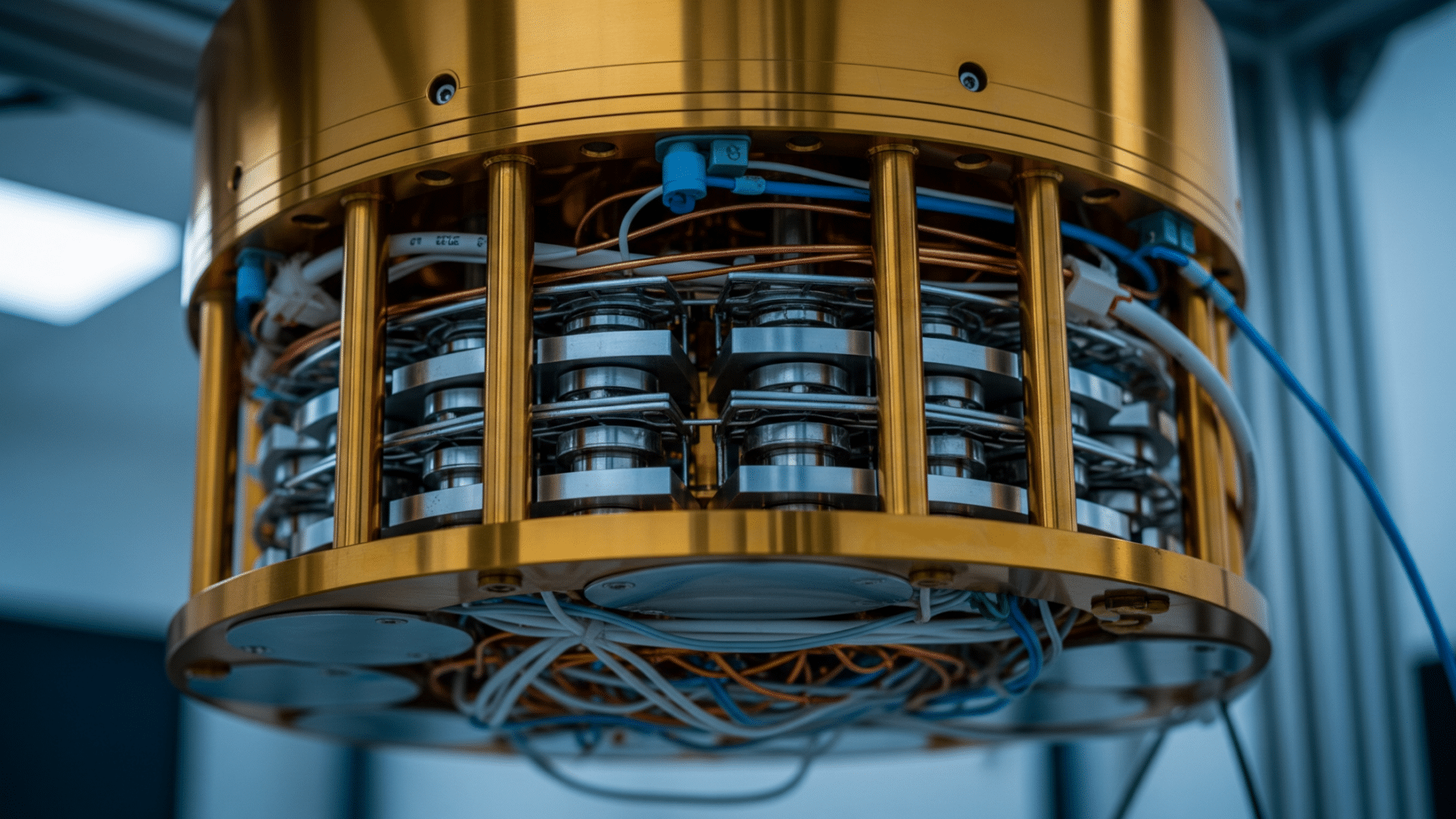
The marketing pitch is clean and easy to love. Rent time on a real quantum computer through the cloud, pay only for what you use, and tap into a machine that makes today’s fastest classical processors look like pocket calculators.
Millions of people have heard some version of that story. Companies, universities and startups have signed up. The qubit counts keep climbing.
But buried deep inside the physics of every single one of those machines is a catch so fundamental that the industry built an entirely new branch of engineering just to manage it, and it directly reshapes what those headline numbers actually mean for anyone paying the bill.
Why quantum computers sound almost too good to be true
Qubits are the building blocks of quantum computers. Unlike regular computer bits, qubits can exist in multiple states at once, making them exponentially more powerful for certain tasks.
That is the promise. It is real. It is also incomplete.
Physical qubits are sensitive to environmental noise, making them error-prone and unsuitable for solving large computational problems.
Qubits are very sensitive. Vibrations, temperature changes, really anything can cause them to generate errors.
So the giant qubit number on the spec sheet is not what you can actually put to work. Not even close.
The invisible tax every qubit carries when you run a real job
To make a quantum computer reliable enough to do useful work, engineers wrap clusters of raw physical qubits around a smaller, protected unit called a logical qubit.
Quantum error correction relies on encoding logical qubits across many physical qubits, using clever algorithms to detect and fix errors without destroying quantum coherence.
In classical computing, errors are easily managed with simple redundancy. Quantum information, however, cannot be copied due to the no-cloning theorem, and any attempt to directly measure a qubit collapses its state.
So every shortcut that makes classical error-checking trivial is physically forbidden in quantum hardware.
Global investment in quantum computing has reached tens of billions of dollars, with governments worldwide competing to lead annual funding. Almost all of that money is chasing the same underlying problem.
What happens when companies actually try to run the numbers
AWS Braket charges approximately $0.0009 to $0.03 per shot for gate-based quantum processors, while Azure Quantum and other providers offer similar pay-per-use models.
That sounds affordable. But the shot count required to complete a useful computation scales with the overhead hiding inside the machine.
A single logical qubit might require 1,000 to 10,000 physical qubits, depending on error rates. Error correction cycles introduce latency, complicating real-time computation.
Despite remarkable theoretical progress, real-world implementation is still in its infancy, bottlenecked by hardware limitations and the sheer complexity of managing quantum redundancy.
The gap between the qubit count a vendor advertises and the logical qubit count a user can actually run is not a rounding error. It is the entire story.
IBM’s June 2025 roadmap puts a real number on the hidden catch
On June 10, 2025, IBM announced a new quantum roadmap outlining a clear path to build a large-scale, fault-tolerant quantum computer by 2029, codenamed IBM Quantum “Starling,” planned to achieve on the order of 200 logical (error-corrected) qubits capable of executing 100 million quantum gates in a single computation.
Read that again: 200 logical qubits is the big goal for 2029.
Error-correction approaches spread each unit of information across many physical qubits to create “logical qubits.” One of the most widely studied approaches, the surface code, requires roughly 1,000 physical qubits to make up one logical qubit.
IBM’s new architecture shifts from surface codes to quantum LDPC codes, reducing physical qubit overhead by up to 90 percent. Even so, Starling is expected to have 200 logical qubits comprising roughly 10,000 physical qubits.
You can read IBM’s full roadmap explanation on the IBM Quantum blog, which lays out the engineering in detail. The challenge behind that ratio also drove the findings in GCN’s earlier look at D-Wave’s two-qubit gate result, where gate fidelity and error correction were at the center of the announcement.
The Riverlane QEC Report 2025, released in November 2025 in partnership with Resonance, calls real-time error correction “the crucial foundation” for quantum computers to surpass classical machines, and identifies QEC as a “universal priority” for achieving utility-scale quantum computing.
The talent pipeline needed to build these systems is also nowhere near ready. An estimated 1,800 to 2,200 professionals currently specialize in quantum error correction worldwide, with 5,000 to 16,000 needed by 2030. The training required for QEC specialists can take up to 10 years.
Where the industry goes from here, and what it means before you sign a contract
None of this means quantum computing is a mirage. The surge in quantum bookings and the pace of new hardware announcements confirm the momentum is real.
The Quantum Error Correction Report 2025 indicates that quantum computing has crossed a turning point. Error correction, once treated as an abstract theory, is now the axis around which government funding, commercial strategies and scientific priorities revolve.
IBM’s roadmap is specific enough to hold the industry accountable. IBM released a full-stack roadmap to build a fault-tolerant quantum computer by 2029, starting with modular processors and culminating in the Quantum Starling system, capable of executing over 100 million quantum operations using 200 logical qubits.
For any business looking at a cloud quantum contract today, the number to ask for is not the physical qubit count. It is the logical qubit count, the overhead ratio and the error rate per gate.
Those three numbers tell the real story that the headline spec sheet never quite gets around to mentioning.
