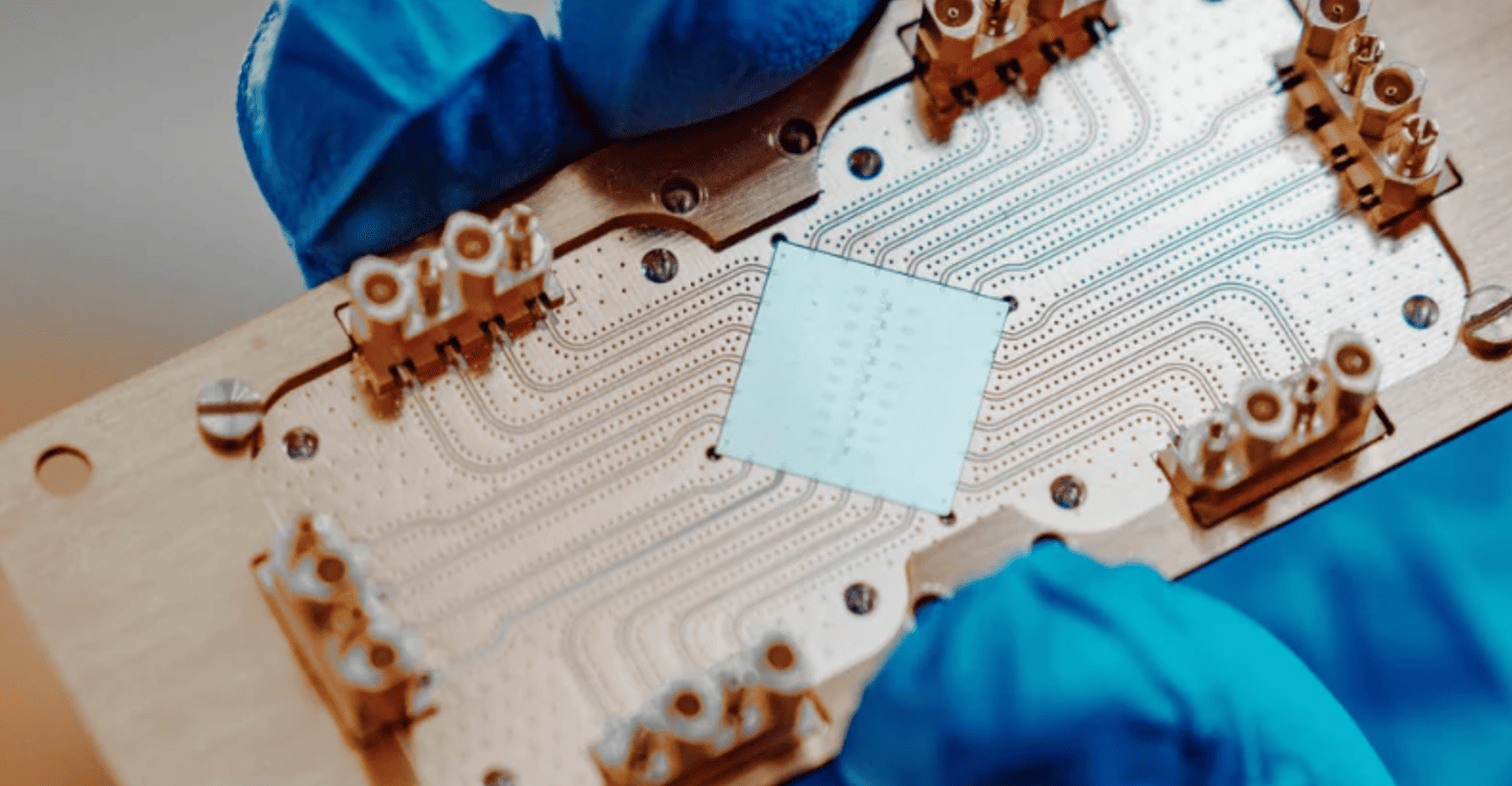
A vacuum chamber the size of a shoebox holds a handful of charged atoms suspended in laser light.
Each one stands in for a sliver of computer memory.
Inside, nothing moves that a human eye could see.
Yet those trapped atoms just posted a result that rippled through an entire industry.
Engineers in Colorado watched their error count fall by a factor of ten in a matter of weeks.
So what actually changed inside that chamber to make the mistakes disappear so fast?
How adding more atoms made the errors vanish
The trick is not a faster chip or a bigger laser. Engineers simply spread each unit of memory across more physical atoms, letting the group check and correct each other constantly, a redundancy scheme that only pays off once the underlying hardware is clean enough to benefit from it.
The team swapped in a denser error correcting pattern known as a color code. Tests on the same Helios hardware showed a tradeoff between codes, with Helix using 10 physical qubits per logical qubit while the color code used up to 37 but achieved lower logical error rates. Using that many physical qubits to guard a single logical qubit sounds wasteful, but it bought a dramatic payoff.
Each tested increase reduced the remaining logical errors by a record factor of 12, demonstrating increasingly effective error suppression as the code grows , a critical capability for scaling fault tolerance.
That scaling curve is the real finding. It shows the machine does not just have fewer errors today, it gets proportionally better every time engineers add protection, the exact signature fault-tolerant quantum computing is supposed to show. None of it required new silicon, since it ran on the same trapped-ion hardware already installed.
Inside the machine that set the new bar
The computer behind the result is called Helios, a trapped-ion system that holds its atoms steady with electromagnetic fields rather than cooling superconducting loops to near absolute zero. The 98-qubit Helios trapped-ion quantum computer reached 99.9995% logical fidelity, equal to about five errors per million operations , with 48 logical qubits achieving better than physical performance.
Helios is not a prototype sitting in a basement. It is already rented out to paying customers, and the company behind it is deploying Helios in a US-based Oracle Cloud Infrastructure AI data center through a multiyear partnership announced earlier this year.
That commercial detail separates this from headlines that never leave a university lab. Customers can book time on the exact machine that produced the result, not a future version promised for later.
Meanwhile the company is already pointing past Helios. It says the accuracy is now in the target range for Apollo, its planned fault-tolerant quantum computer due by 2029.
The number that made rival chipmakers take notice
On October 19, 2026, Quantinuum announced a world-record quantum error-correction result, achieving a logical fidelity of 99.9995% on its Helios commercial computer using the company’s error correction architecture, which works out to roughly five mistakes for every million operations run.
That is not a small step. The error rate is 10x lower than Quantinuum’s own September 2026 record and 100x lower than the best published result across all other hardware modalities, which was reported by Google Quantum AI using a superconducting system , a comparison that instantly reframed which hardware approach looks ahead in the race. The company laid out the full result in its own announcement.
The company’s chief executive did not undersell it. Chief executive officer Rajeeb Hazra said the company has “crossed the threshold necessary for exponential improvements in accuracy.”
Independent trackers treated the scaling behavior, not just the headline percentage, as the real substance. One detailed writeup concluded Helios now operates at logical fidelities and scaling rates that place Quantinuum inside its stated 2029 target window for Apollo, calling it a substantive milestone.
Where the advantage still runs thin
Even so, the comparison has limits worth keeping straight. The announcement focuses primarily on logical memory fidelity and scaling under active syndrome extraction , rather than the success probability of an arbitrary computation involving many gates. One technical rundown cautioned that the headline memory fidelity should not be applied to the gate result, a separate and still improving benchmark.
Scale is also still modest everywhere. The 98-qubit Helios trapped-ion quantum computer tops out well below the tens of thousands of qubits engineers broadly agree a truly useful machine will eventually need.
That gap is why rivals betting on superconducting circuits, neutral atoms and photonics have not folded.
Each approach still has a plausible path to scale, including a separately simulated fault-tolerant processor built to stress test these architectures before real hardware catches up. The shift here is directional, not final.
What the result means for the next few years
For a market used to funding rounds and qubit counts as the only scoreboard, a pure accuracy record is a different kind of signal. It tells customers which physical approach is proving out the math behind fault tolerance first, well before any machine runs a commercially decisive calculation.
That is also why the result matters to people who will never touch a vacuum chamber. Every cloud platform renting access to these machines, and every security team watching encryption timelines, is reading these fidelity numbers as a clock.
The open question is whether trapped-ion hardware can keep compounding this advantage while adding far more qubits. Three more years stand between here and the fault-tolerant machine the company has promised.
Until then, the industry has a new number to beat. For the first time in a while, it was not a superconducting chip that set it.
