Concrete is still curing in parts of the new wing.
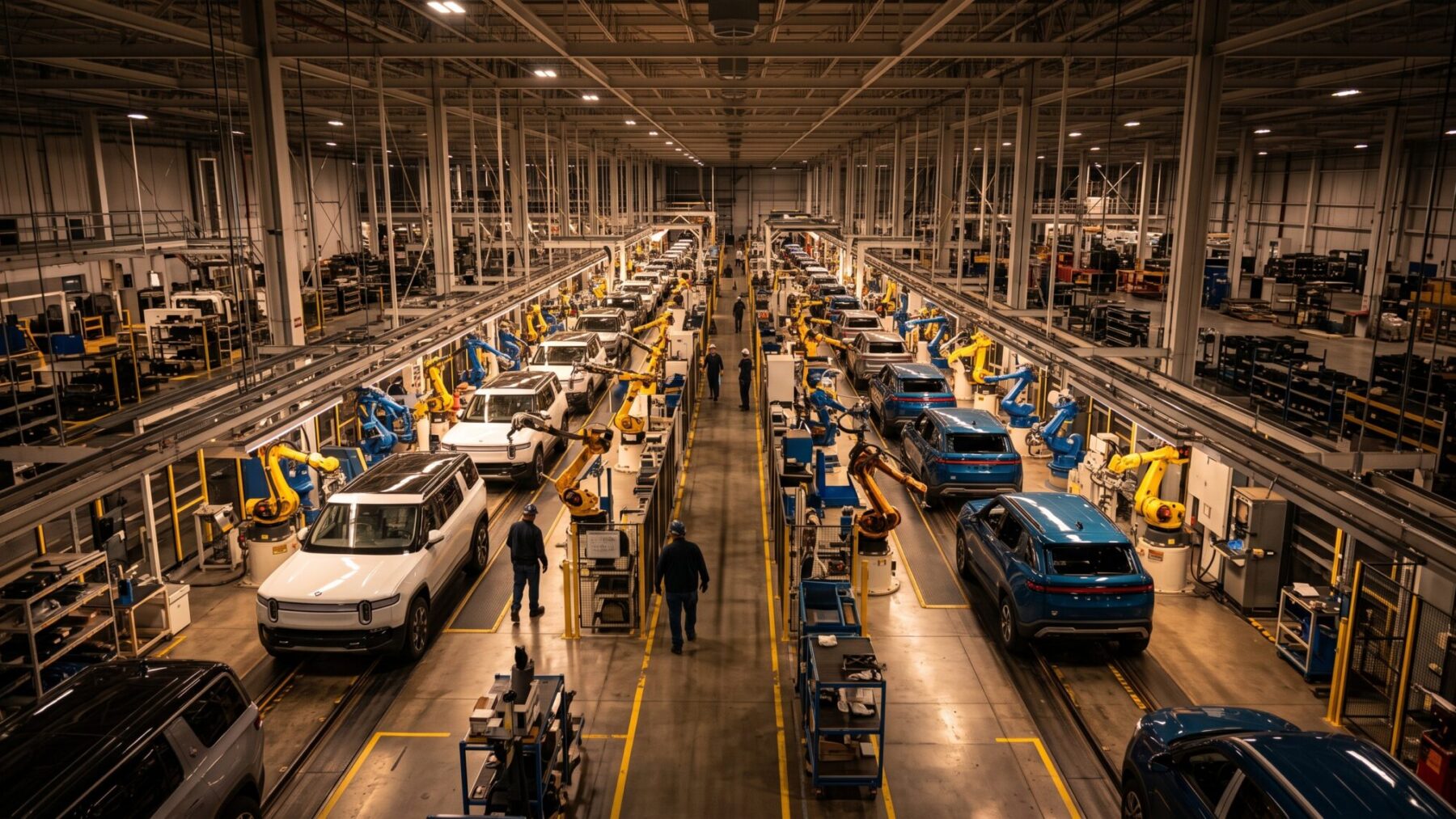
Steel columns cast long shadows across a factory floor spanning millions of square feet, laid out like a small city under one roof.
Outside, a rail yard is being doubled in length to handle the surge of finished vehicles about to roll out.
At the center of it all sits a compact electric SUV engineered, from the very first weld, to cost half as much to build as the truck assembled next door.
The construction came in roughly on the schedule Rivian’s facilities team promised. But how does a factory actually make that math work?
Why two vehicles under the same roof can carry completely different build costs
Every car that rolls down an assembly line moves through the same basic sequence: body shop, paint shop, general assembly, end-of-line checks. But the cost of each step is shaped almost entirely by how the line is physically laid out, how many robots share a station, and whether the paint shop is splitting its time between multiple body styles or running one body exclusively.
That last detail alone changes cycle time and chemistry changeover costs by a measurable margin. So when engineers designed the new compact SUV to cost roughly half as much to build as its larger sibling, the factory layout had to be rebuilt from the ground up to support that target.
The expansion includes a new facility dedicated to body shop and general assembly operations, along with separate structures for paint, battery assembly, and material flow. By keeping those functions in purpose-built spaces rather than threading them through an existing line, the plant avoids the slowdowns and retooling costs that come when a single shop handles two very different vehicles. Parts painting has been moved entirely out of the main paint shop into a dedicated Parts Pre-Treat and E-Coat Dip facility, compressing cycle time and cutting chemical waste from changeovers.
What the factory floor in Normal, Illinois actually looks like right now
The plant in central Illinois is not a newcomer. Rivian currently produces R1 SUVs and pickup trucks, in addition to commercial vans, in the existing plant. An experienced workforce and established infrastructure were already in place.
The new expansion sits on the east side of that campus, physically connected but operationally distinct. The 1.1 million square foot plant expansion at the Normal, Illinois site is now substantially complete, with the new facility designed to house the body shop, general assembly, and end-of-line operations for the R2, marking a significant addition to Rivian’s existing 4.3 million square foot plant. The expansion is supported by a $1.5 billion investment from Rivian. As Tony Sanger, Rivian’s vice president of production facilities, described it in a news release: “All of the new buildings are now ‘going vertical’, that is, walls, structural steel bays, roof decking and roofing material are well underway.” That overlap cut months off a timeline that would have been impossible using conventional sequential construction.
The 1.1 million square foot plant expansion at the Normal, Illinois site is now substantially complete, and Rivian expects to commission the new R2 line to start validating equipment and production processes.
The numbers that confirm how different this build approach really is
Rivian says its R2 costs 50% less to build than its flagship R1. As confirmed in Rivian’s own Q2 earnings release filed with the SEC, the plant expansion is substantially complete and the R2 line is being commissioned to validate production processes. The compact SUV is the automaker’s first true mainstream offering, with a base model targeting around $45,000 and a range of more than 300 miles. The automaker says it developed the new model to cost about half as much to build as its current larger vehicles, and that target is what forced every manufacturing decision that followed.
Originally, the automaker planned to produce this model at a new plant in Georgia. Instead, it shifted production to Illinois, a move the company says accelerated production of the R2 model. That shift was projected to save the company $2.25 billion on capital expenditures, product development, and supplier sourcing. That is not a rounding error; it is a strategic reorientation of where and how a vehicle enters the market.
Rivian started production of saleable R2 vehicles and made first deliveries to employees, with external customer deliveries expected in the coming weeks. At full scale, the facility is expected to reach a total capacity of approximately 215,000 units annually, representing a fundamentally different revenue profile than the higher-priced trucks the plant previously focused on.
Where the Georgia factory fits in and what its massive capacity actually demands
Even with Normal running at full tilt, it will not be enough. Faced with a cash crunch, Rivian paused construction on the factory and changed plans to build its next-generation R2 midsize SUV there. Instead, Rivian announced in March 2024 during the R2 reveal that the new EV would be produced at its Normal, Illinois, factory. The electric automaker Rivian officially broke ground on its second manufacturing plant, in Georgia, on September 16, 2025, with Georgia Governor Brian Kemp and other state and local officials in attendance. Rivian has reworked its loan deal with the Department of Energy and now expects to borrow $4.5 billion to build the new factory, down from the original amount of $6.6 billion.
Rivian said production of the company’s upcoming R2 electric vehicle is on track to begin at the facility in late 2028. Rivian increased Phase 1 capacity at the Georgia plant by 50%, from 200,000 units annually to 300,000 units, while restructuring the DOE loan from up to $6.6 billion down to up to $4.5 billion. That is a plant engineered from scratch rather than grafted onto an existing line.
Preparations are underway for the development of the stamping press area, one of the most capital-intensive and technically demanding projects within the plant from a construction perspective. Stamping presses are among the longest-lead items in any factory build because they are custom-engineered for specific body architectures. The Georgia plant will not be limited to consumer R2 production: Rivian’s partnership with Uber will see up to 50,000 R2-based robotaxis built at the facility, also beginning in late 2028. For context on how fast a purpose-built plant can ramp when design and building align, the record set by a European EV factory that hit 50,000 units in nine months shows what dedicated-line investment can unlock.
What the two-plant strategy means for buyers and what is still unresolved
For anyone watching the American EV market, the Normal-to-Georgia sequence reveals a deliberate logic. Illinois gets the compact SUV into driveways faster and at lower capital cost. Georgia scales the volume once the cost model is proven.
Yet the half-the-cost-to-build claim still has to hold at volume. Manufacturing cost targets set during design are frequently revised once high-rate production begins, because tooling wear, supplier variation, and line rebalancing introduce costs that simulations miss. The Illinois expansion was completed substantially on schedule, which is encouraging, but build cost per vehicle at scale is a different measurement entirely.
What is already confirmed is that the expansion will increase total Illinois capacity to 215,000 vehicles annually. The two-factory plan, with Normal proving the cost model and Georgia scaling it, is the most concrete manufacturing strategy any American EV startup has yet committed to paper, with real steel and concrete to back it up.
