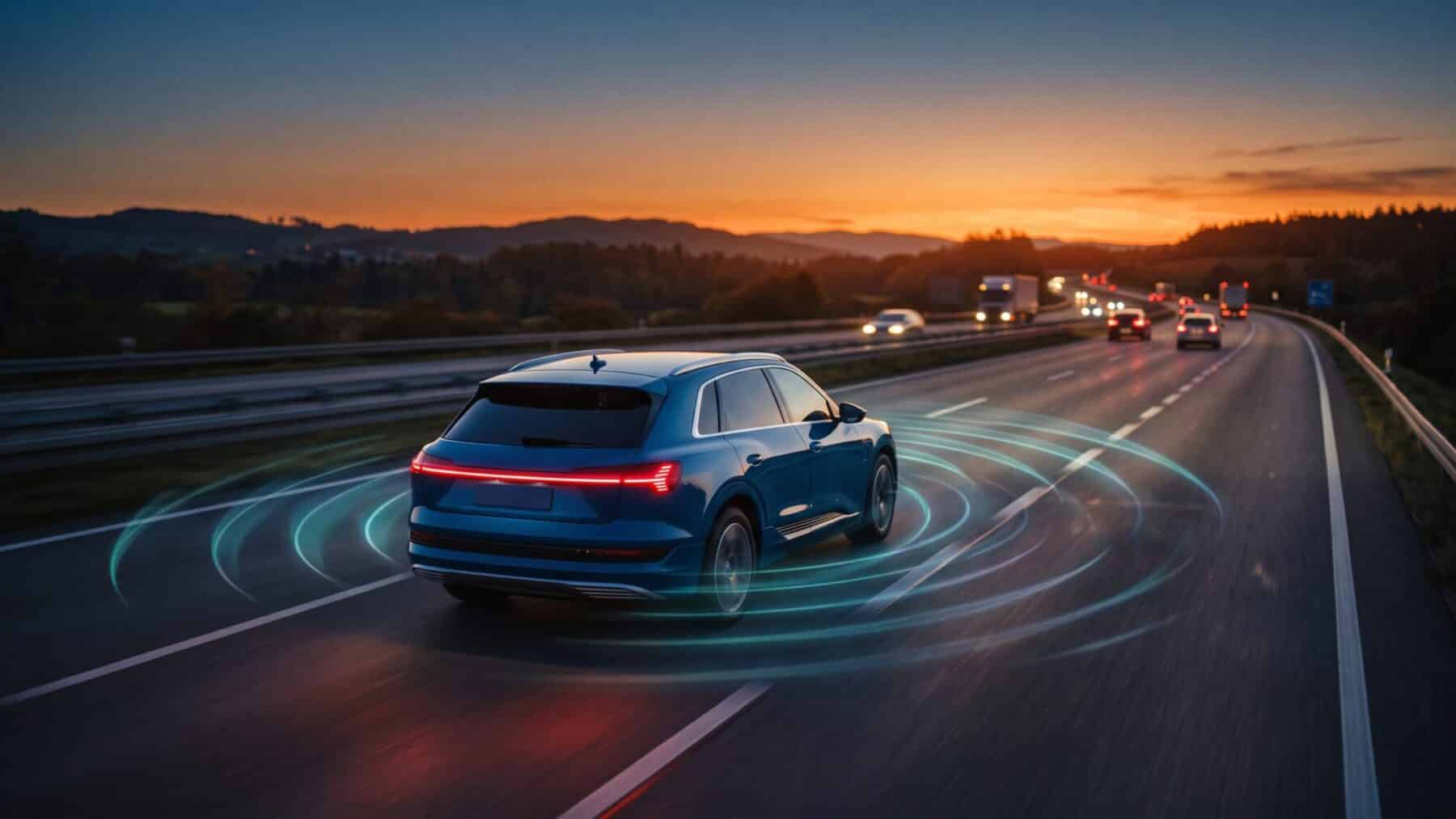
A pedestrian target crosses the path of a moving car. A camera locked to the windshield tracks it.
The car brakes on its own, or it doesn’t. That single pass-fail moment is one of eight criteria now built into America’s federal car safety ratings. Most vehicles on sale today have never faced them. One electric SUV just did, and cleared them all.
How the 8-test gauntlet actually measures a car’s driver-assist brain
Each evaluation measures actual stopping distance, lane-correction performance, and warning timing in repeatable test conditions, not just the presence of an icon on the dashboard. For years, a car could earn a top safety rating with a blind-spot warning system that was technically present but set so conservatively it barely fired. The new pass-fail framework closes that gap by putting each system through timed, measured scenarios with published thresholds it must hit.
The federal safety program expanded its previous suite by adding four fresh pass-fail criteria: pedestrian automatic emergency braking, lane keeping assistance, blind spot warning, and blind spot intervention. The four pre-existing criteria are forward collision warning, crash imminent braking, dynamic brake support, and lane departure warning.
Five of the eight depend on brake-system actuation, so the car’s braking hardware and software must work together, not independently. A system that warns but hesitates to actuate fails. That is a harder bar than almost any previous federal benchmark set for consumer vehicles.
What happens on a real test track when a car faces these 8 scenarios
The test facility is not a simulation. Engineers stage repeatable physical scenarios: a foam pedestrian target crossing at a fixed speed, a lane-departure trigger on a marked road surface, a lead vehicle braking hard from highway speed. No partial credit exists in a pass-fail system, which is what makes the format stricter than the weighted scoring consumers are used to seeing.
Blind spot intervention is the most demanding of the four newcomers. The car must not only warn the driver that a vehicle is alongside, but must actively intervene if the driver begins to merge anyway, requiring the lane-keeping and sensing systems to coordinate in real time under pressure.
The pedestrian AEB test draws the most public attention because it is the most viscerally legible. Passing it in a verified government scenario is meaningfully different from a manufacturer’s own demonstration video.
The certification that put the first passing vehicle on record
On May 7, NHTSA and the Department of Transportation announced that the 2026 Tesla Model Y is the first vehicle to pass the updated New Car Assessment Program test suite for advanced driver assistance systems. The agency stated that by including ADAS in these new tests, it is encouraging automakers to prioritize innovations that keep families safe on the roads.
The certification applies only to Model Y units built on or after November 12, 2025. Earlier production runs do not qualify. That cutoff is a reminder that a software update tied to a specific build date can be the difference between a passing and a non-passing vehicle, even within the same model year.
The new framework grew out of NCAP’s 10-year roadmap, finalized in late 2024. The new evaluations are pass-fail checkmarks and do not affect a vehicle’s overall five-star rating, which remains based on crashworthiness. The two systems sit side by side on the rating page, giving shoppers two distinct lenses.
Where the benchmark falls short and what rivals still have to prove
Blind spot warning, lane keeping assistance, and pedestrian AEB are standard or widely available on dozens of vehicles. Being first to pass does not mean the Model Y is the only car with these capabilities. The rest of the industry has simply not yet submitted to the same scrutiny.
Full NCAP implementation was postponed from model year 2026 to model year 2027 after the Alliance for Automotive Innovation, the industry’s main lobbying group, requested more time. That delay means automakers have breathing room before the tests become an industry-wide expectation.
The gap between passing and not being tested can be wide. Shoppers currently have no way to know which side of the line any given vehicle sits on, which is itself an argument for volunteering early.
The driver-assist landscape is also expanding fast beyond these eight tests. Most Level 3 systems, where the car rather than the driver is legally responsible for the road in defined conditions, are expected to reach consumers in the coming years. You can see how quickly new hardware reaches buyers in our coverage of a factory that hit 50,000 electric SUVs in nine months.
What the new test standard means for every car buyer shopping today
For an ordinary shopper, the five-star crash rating on a window sticker tells you how well the steel and airbags protect you after a crash. The new ADAS pass-fail mark tells you how well the electronics try to prevent the crash from happening at all. Those are different questions, and for the first time they carry separate, official, government-verified answers.
The federal label also gives auto insurers their first uniform benchmark for crash-avoidance technology. A Highway Loss Data Institute study of Mazda vehicles found that the most comprehensive ADAS bundle cut property-damage claims by 39 percent. Insurers have long given discounts for vehicles equipped with AEB, but those discounts were based on the presence of hardware, not verified performance. A certified pass changes that calculation.
NHTSA Administrator Jonathan Morrison called the announcement “a significant step forward” in providing consumers with the most comprehensive safety ratings ever, adding that the Model Y “sets a high bar for the industry.” Hyundai’s record-breaking sales momentum, built partly on strong standard safety scores, is a reminder of how powerfully safety credentials move metal on a lot.
The broader question now is how many automakers will voluntarily submit before the 2027 deadline. Those with competitive systems have every incentive to go early. The eight-test benchmark is set to become the next arena where automakers compete for credibility, and right now, only one vehicle has a score to show.
