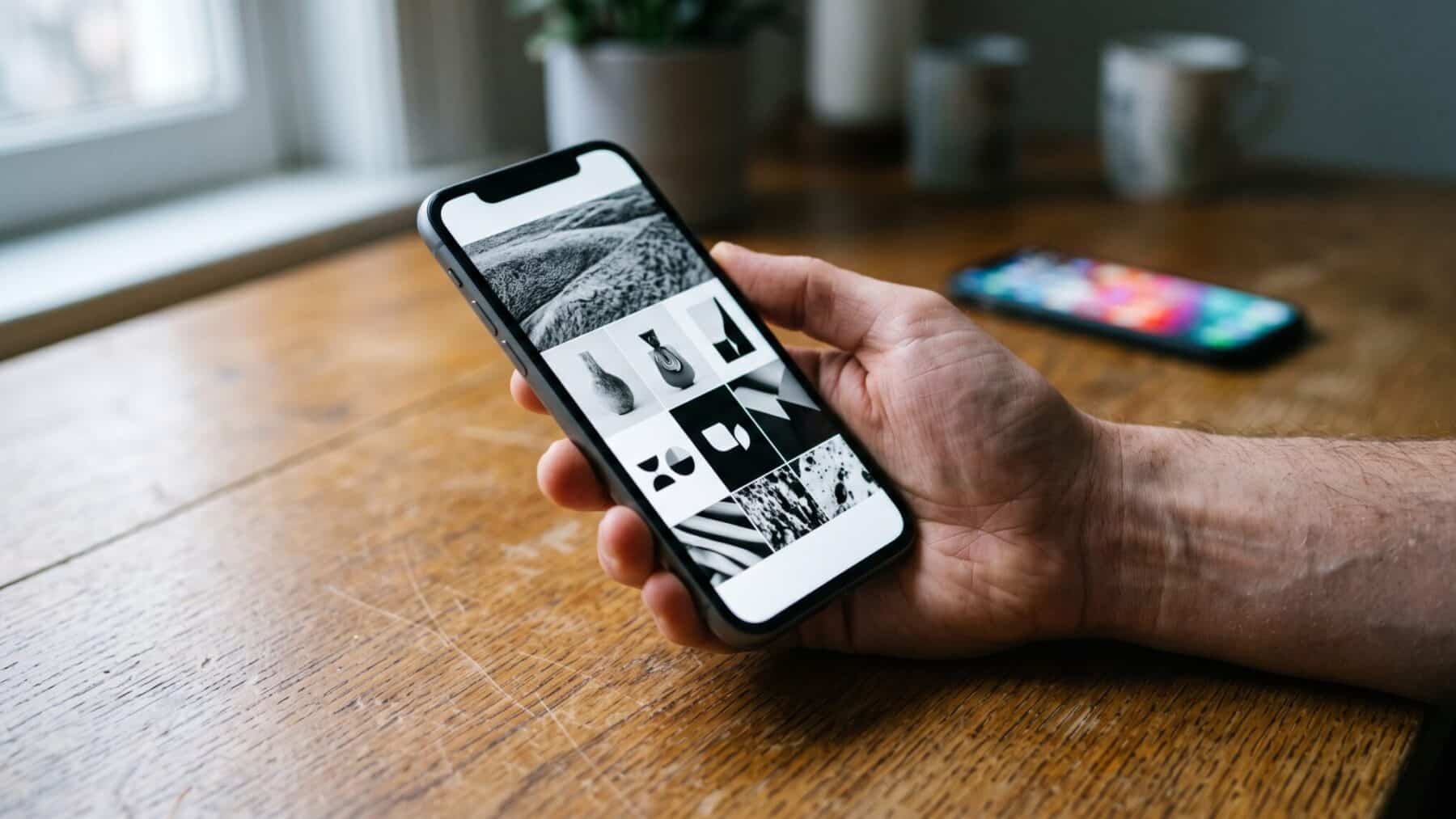
Pick up a phone and notice the colors first.
The red badge on the mail app. The warm amber of a story ring. The blue burst of a new message. Those colors carry a job, and a growing stack of research confirms that stripping them out cuts the time most people spend scrolling. But a fresh trial published this summer puts a harder number on exactly where that saving stops.
How color keeps you on the screen longer than you planned
Bright colors in apps are engineered to capture attention and keep you engaged. Grayscale removes those visual rewards. The effect is not metaphorical: when a screen goes black and white, the attentional system treats what it sees as less stimulating content and delivers less of the neurological payoff that made picking the phone up feel worth it in the first place.
So the mechanism is straightforward. Pull the color out, pull the reward signal down, and the hand reaches for the phone less often.
Video, it turns out, holds attention through motion and story, not through a saturated palette. No amount of gray makes a streaming show boring enough to quit early, and that single carve-out erases a large share of the potential saving for heavy video users.
What the numbers look like in a real two-week test
The most recent controlled trial ran two groups through back-to-back weeks, one in grayscale and one in full color, tracking every minute with the phone’s own built-in screen-time counter. Mean daily screen time fell by roughly 28 minutes during the grayscale phase compared to the color phase, a statistically significant reduction.
That gap is a real number, but the starting point was still a long time on a screen.
Earlier work suggested the ceiling could be higher. A previous study found grayscale reduced smartphone use by an average of nearly 38 minutes per day, and research across multiple trials shows a range of 22 to 50 minutes less per day. The range is wide because the people are wide: heavy scrollers gain the most, and people who mostly watch video gain almost nothing.
Where the evidence comes from and what the studies actually measured
The cross-over trial was published in Frontiers in Digital Health and involved first-year medical students assigned in alternating sequence to one week of grayscale, then one week of standard color. Both phases used the phone’s own tracking tools to record usage rather than self-report, which makes the numbers more reliable than most screen-habit surveys. The reduction in mean daily screen time was statistically significant.
The earlier study, published in The Social Science Journal, involved 161 undergraduate students, with 73 having their phones switched to grayscale for eight to ten days. Time on social media and internet browsing fell meaningfully. Video did not move.
The authors of that Social Science Journal study noted that grayscale appears to make smartphones less gratifying overall, and can assist individuals in controlling use. Qualitative feedback pointed the same direction: participants reported picking up the phone less often, but when they did sit down for video, they stayed just as long.
The real friction that makes the trick harder to keep up
The numbers above assume the user actually stays in grayscale. Many do not. Some participants assigned to the grayscale condition toggled color back on within a couple of days and never returned. Color-coded navigation maps, Pinterest boards, and quick-settings icons all become genuinely harder to use, not just less fun, and the moment someone toggles back for a practical reason, the habit breaks.
That pattern connects to a broader truth about how digital habits reshape daily life: the pull of the phone is not purely visual. According to an industry survey, the average smartphone user receives an estimated 146 notifications per day, climbing to 181 for Gen Z.
Every ping is a reason to unlock, and an unlocked, colorful screen is exactly what the grayscale trick was trying to prevent.
What works alongside grayscale and what is still unsettled
Researchers suggest using grayscale short-term rather than permanently, combining it with app limits and scheduled phone-free time. The strongest gains appear in the first week, when the gray screen still feels novel enough to pause the automatic reach. After that, the brain adapts and the effect softens considerably.
Some users have landed on a middle path: dialing saturation to a low level rather than full grayscale. That keeps just enough color to navigate interfaces while reducing the temptation to toggle back entirely. On Android, the built-in grayscale filter is strictly binary, fully on or fully off, so partial desaturation requires a third-party workaround; the native accessibility path on iPhone makes the full switch more straightforward but offers no intermediate slider either.
The open question is the one the video finding points at most directly. Screen time as a single number does not separate passive video consumption from restless social scrolling and browsing, and only those latter habits drop when the screen goes gray. Grayscale is a real tool with a real, measurable effect, just a narrower one than most people flipping the switch for the first time expect.
