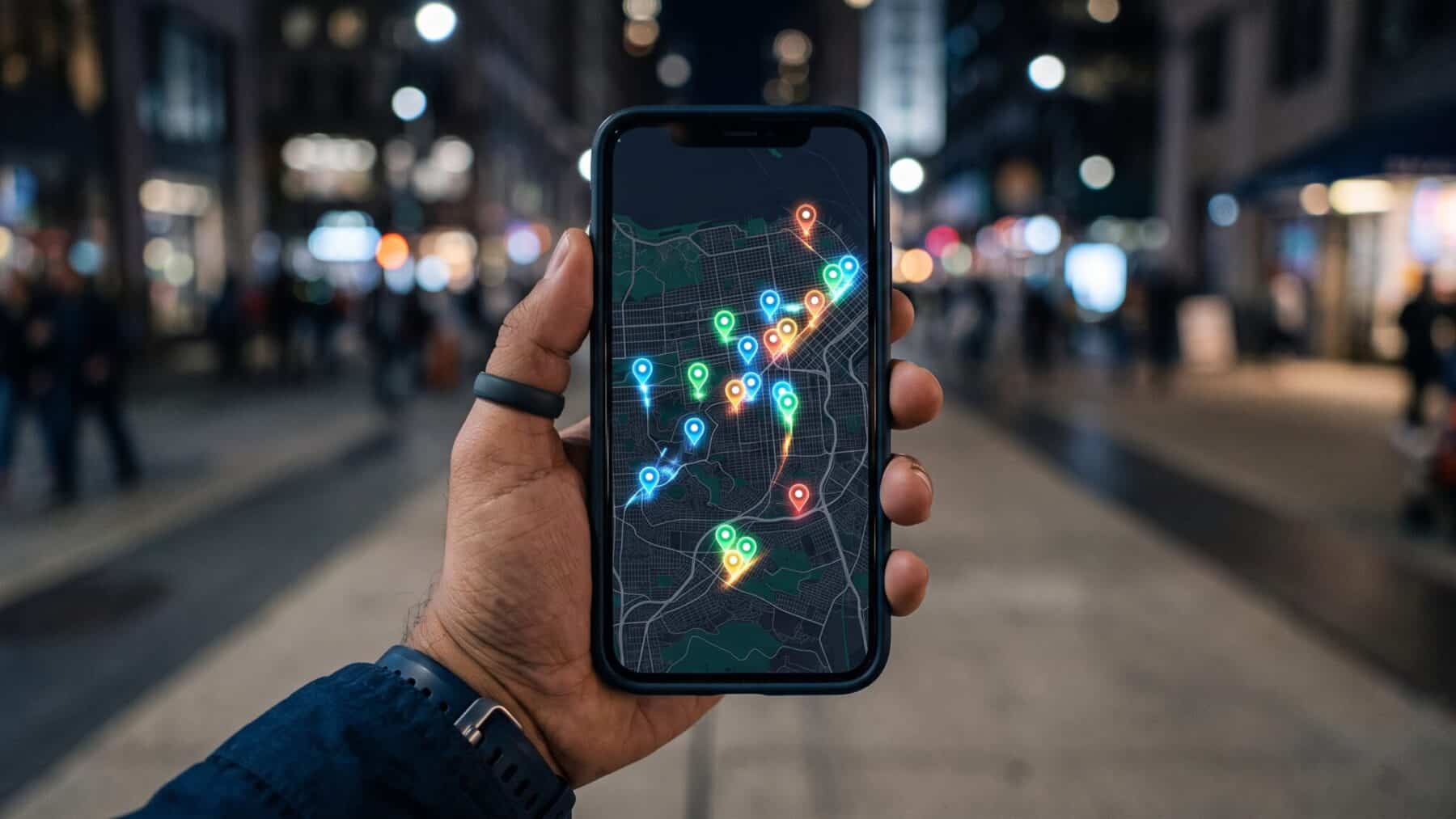
A small circle, labeled with a friend’s name, slides past a coffee shop you didn’t know they were visiting.
Nobody texted. Nobody called. You just watched it happen from your couch.
That is the daily reality of location sharing, sold as closeness, now routine for tens of millions of people.
But a peer-reviewed study found something uncomfortable underneath the convenience: real back-and-forth communication may be at risk when location data quietly fills the gap.
The map tells you where your friend is. So who is using these apps, and what exactly happens to a friendship once the dot goes live?
How a live dot on a map starts doing the talking for you
Location-sharing apps work by broadcasting a device’s GPS position to a selected list of contacts, silently and without requiring either person to send a message. That passivity is precisely the mechanism at the center of the concern.
When a friend can see your dot parked outside a restaurant, they no longer need to ask where you are. As Ogolsky put it: “You can check where someone is and decide you don’t want to bother them, so you don’t call or text. It takes away the ability of the person to say whether they would like to talk right now, and removes interpersonal negotiation.” The app answers those questions before they are asked, and the conversation never starts.
Casual, unplanned communication is not decorative. It is precisely how friendships stay warm between bigger occasions. Automation removes that choice, and with it a quiet but steady stream of social investment.
Researchers also noted reduced interpersonal negotiation and a growing reliance on technology for coordination. What is gained in efficiency may be subtracted from connection.
The apps that made location sharing feel normal, and how far it has spread
A few years ago, sharing your live location was something you did temporarily, on the way to meet someone, and then switched off. That behavior has shifted substantially. On August 6, 2025, Meta announced a new Instagram Map feature that lets users share their real-time location with friends they pick.
The rollout introduced a map that lets U.S. users share their locations and see location-based content from friends, similar to Snapchat’s Snap Map or Apple’s Find My. The feature is opt-in and off by default. When a platform with that kind of reach builds location sharing into its core experience, the social pressure to participate intensifies. Younger users in particular report feeling conspicuous if they are the only person in a friend group who has not turned the feature on.
The spread is visible in the sheer variety of apps now doing this work. Popular apps include Find My, Google Maps, Life360, Snapchat, and WhatsApp. Location sharing has stopped being a specialized behavior and become a cross-platform default.
What 203 adults actually reported about their sharing habits
The study collected data from a sample of 203 adults who share their location with at least one person, drawn from an online survey of individuals across the U.S. and the U.K. Respondents on average shared their location with 3.86 people, with a span ranging from 1 to 83.
The study identified four main reasons for location sharing: safety, practicality, casual use, and relationship management. Safety was commonly cited with immediate family, while practicality, including coordinating plans and tracking travel, was common with friends and romantic partners. Some users shared locations casually for entertainment, while others used it to maintain trust and communication in relationships. The findings sit alongside broader data on how Americans renegotiate closeness through technology. Research on how people find committed relationships online points to the same tension: digital tools promise connection but often substitute for the messier, more effortful version of it.
“Location sharing is moving from primarily safety-related purposes into the realm of relationships, where it changes how and when we communicate,” Ogolsky said. Back-and-forth communication between friends is at risk precisely when location data flows passively and removes the need to reach out.
Where the habit breaks down and who feels it most
The research does not conclude that location sharing is uniformly harmful. For parents tracking teenagers, or for couples who find ambient awareness reassuring, the feature can serve a genuine purpose. The complication is that the same mechanism behaves very differently depending on the relationship’s existing health.
In friendships that are already strong and frequently in contact, a shared dot adds warmth without replacing much. But in friendships that are more fragile or geographically stretched, the dot can quietly stand in for contact that never arrives. Watching someone’s location move through a Saturday afternoon is not the same as being part of that Saturday.
Researchers flagged exclusion and FOMO as specific downsides, particularly when someone notices other people getting together without them. The visibility that feels like closeness can, in those moments, land as its opposite.
What the research leaves open, and what it suggests for everyday friendships
Until recently, location-sharing apps had not been studied all that much, prompting a researcher from the University of Illinois to investigate why people find these applications so useful and what that means for relationships. The authors acknowledge the sample is not nationally representative, and larger studies will be needed before the findings can be fully generalized.
But the direction of the concern is consistent enough to take seriously now. The practical implication is not that anyone needs to delete Find My. It is closer to a timing question: if you notice your friend’s dot near a place you both love, texting them will do more for the friendship than simply watching them leave.
Ogolsky’s work arrives as people already reckon with loneliness in measurable ways. Separate research has found that only 22 percent of Americans have a close friend outside their own generation, underscoring how narrow most people’s social worlds already are. Convenience and closeness are not the same thing, and the distance between them is exactly what this research is starting to map.
