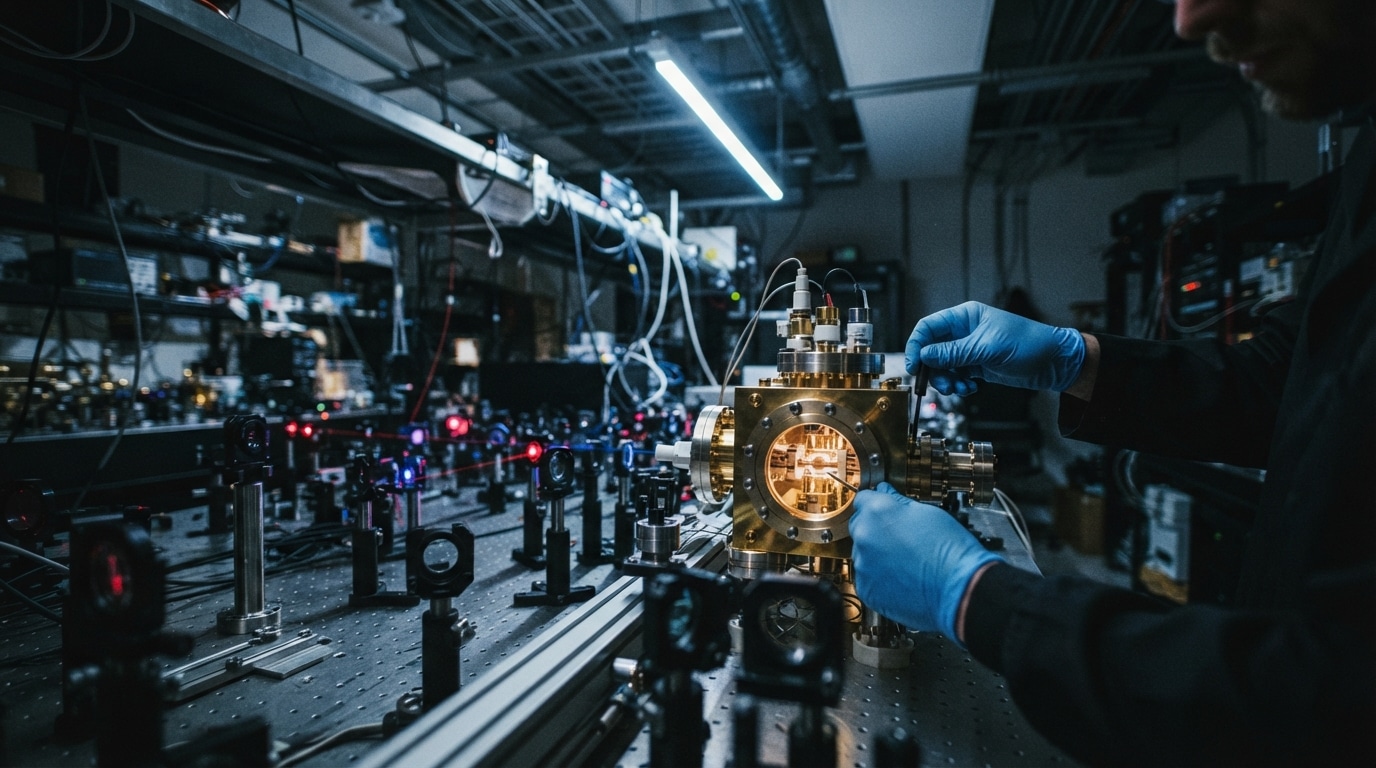
A small vacuum chamber sits at the heart of it, barely larger than a coffee mug.
Inside, individual atoms suspended in mid-air by electric fields can have their quantum states flipped one at a time by lasers.
Revenue that looked impossible eighteen months ago is now landing on the books every ninety days.
Contracts are signed. Backlogs are growing faster than the revenue line itself.
So how exactly does a machine built around floating atoms produce numbers that look like a growth-stage software company?
Why trapped ions pull ahead: the fidelity edge that makes customers pay
Most quantum computers fail not because they run out of qubits, but because the qubits they do have make too many errors. The trapped-ion approach attacks that problem directly by using actual charged atoms, rather than engineered circuits, as its computing units. Because every atom of the same element is physically identical, the qubits arrive with a precision that silicon-fabricated alternatives spend enormous engineering effort trying to replicate.
Two-qubit gate fidelity is the clearest single measure of how reliably a quantum processor runs a real computation. IonQ announced it achieved 99.99% two-qubit gate fidelity, the first quantum computing company to cross the “four-nines” benchmark, a result credited to its proprietary Electronic Qubit Control (EQC) technology, which uses precision electronics rather than lasers to control trapped-ion qubits, surpassing the previous world record of 99.97% set in 2024 by Oxford Ionics, now part of IonQ. The qubit performance was achieved using prototypes in IonQ’s R&D labs, which will form the basis for its 256-qubit systems. That precision edge is what lets commercial customers trust the output enough to pay for it.
Growth is driven by expanding deployment of IonQ Tempo quantum systems, a broadening platform into quantum semiconductor manufacturing, and increased demand for computing and security products. Each revenue stream is scaling at the same time, which is rare for any hardware company at this stage.
The quarter that rewrote what a quantum revenue number can look like
IonQ recognized record quarterly revenue of $80.05 million, representing a 287% increase year-over-year and topping the high end of its prior guidance. Buoyed by organic momentum, IonQ raised its full-year 2026 revenue guidance to between $280 million and $290 million, representing 100% year-over-year organic growth at the midpoint, excluding SkyWater’s future contributions. That single quarter exceeded what the entire global quantum computing hardware market was generating annually just a few years ago.
Remaining performance obligations grew 297% year-on-year, with approximately 50% international, 60% commercial and 25% multi-product revenue, meaning the backlog is expanding faster than the revenue line itself, and the business is not dependent on any single government contract or geography.
For full-year 2025, IonQ reported $130 million in revenue, a 202% year-over-year increase, making it the first quantum computing company to exceed $100 million in GAAP annual revenue. That annual figure is now being matched in less than two quarters of the following year.
The sources behind the numbers and the deal structure
On July 31, 2026, IonQ completed its acquisition of SkyWater Technology, integrating the largest exclusively US-based semiconductor foundry into its operations to create a vertically integrated, full-stack quantum platform company. The transaction was valued at about $1.8 billion. Under the terms of the agreement, SkyWater shareholders are receiving $15.00 in cash and 0.4883 shares of IonQ common stock for each share of SkyWater common stock held at close of the transaction. The deal was announced at $35 per share, with $15 in cash and $20 in IonQ stock, subject to a collar. SkyWater will maintain its headquarters in Bloomington, Minnesota, and its facilities in Minnesota, Florida, and Texas will serve as Regional Quantum Production Hubs.
SkyWater is a DMEA-accredited Category 1A Trusted Foundry, one of very few fully US-owned semiconductor operations with that credential, specializing in custom technology development and volume manufacturing for integrated circuits and micro devices. IonQ described the combined entity as the only vertically integrated full-stack quantum platform company, and a merchant supplier of critical components to the broader quantum ecosystem.
The parallel matters for anyone watching how chip packaging is reshaping hardware businesses beyond quantum, and it echoes the broader dynamic visible in global chip sales, where commercial traction is separating winners from the field faster than any benchmark result can.
Where the model hits friction and what rivals are doing
Vertical integration solves the manufacturing bottleneck but creates a new one: capital intensity. Updated full-year revenue guidance does not include any contribution from the acquisition itself, meaning the combined-company picture is still being assembled. As CFO Inder Singh noted, integrating operations before providing combined-company revenue or EBITDA guidance will take time, and the accounting complexity will take multiple quarters to fully unwind.
The competitive field is not standing still. Xanadu, a photonic quantum computing company, completed its reverse recapitalization SPAC merger on March 26, 2026. Gross proceeds from the transaction were $301.6 million, including $275 million of PIPE financing. The deal valued Xanadu at a pre-money equity value of approximately $3 billion. Xanadu became the world’s first publicly traded pure-play photonic quantum computing firm, using laser pulses and optical circuits to create qubits and perform computations at room temperature, sidestepping the dilution-refrigerator infrastructure required by superconducting architectures, which gives it a different manufacturing argument.
Revenue remains the separator. IonQ’s strong 2025 showing led it to raise its full-year outlook to $260, $270 million in revenue, an impressive jump from $130 million in 2025, a scale Xanadu, in its early public quarters, has not yet approached.
What vertical integration means for every company buying quantum access
For enterprise customers, a quantum provider that controls its own fab can offer faster hardware refresh cycles, tighter performance specifications, and, eventually, custom fabrication for specialized use cases in defense, finance, and pharmaceutical simulation. As a DMEA-accredited Category 1A Trusted Foundry, SkyWater plays a strategic role in securing America’s silicon foundation and ensuring long-term US technology leadership, opening a lane into classified government programs that purely commercial quantum hardware firms could not previously access as cleanly.
Even so, what the deal cannot do is move up the date when quantum computing starts paying for all of this investment at scale. That date is still years away for the most complex workloads. The honest picture is a company that has built a durable commercial business on near-term quantum applications while laying the physical infrastructure for the fault-tolerant era that follows.
That combination, revenue today and foundry capacity for tomorrow, is something the quantum field has not seen before, and it sets a template that every serious competitor will now have to respond to.
