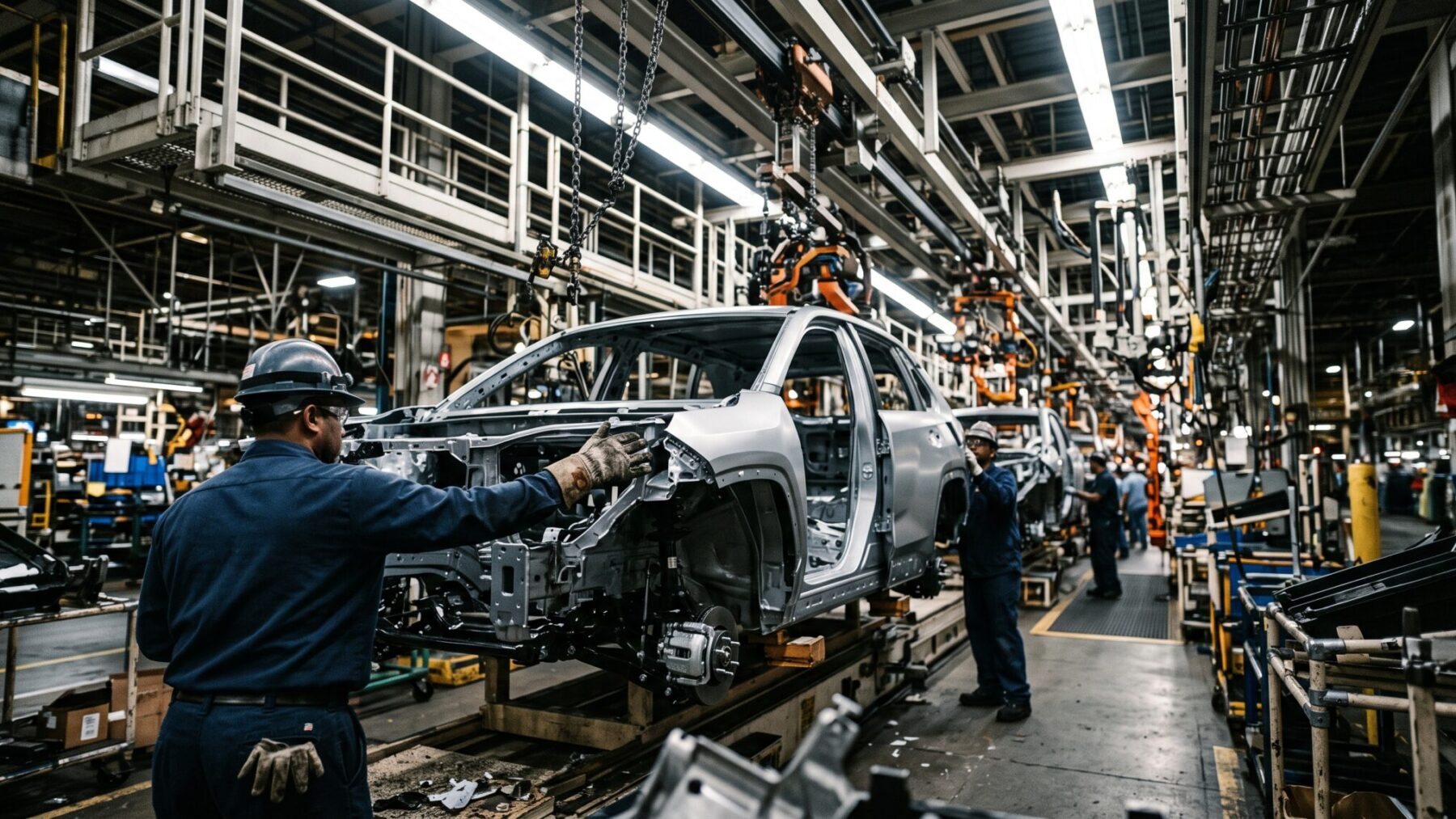
Honda Motor is considering building a new plant in the US as it seeks to expand its lineup of gas-electric hybrid models from 2030, a senior executive at the Japanese carmaker confirmed this week. The disclosure marks one of the company’s most concrete manufacturing commitments since it pivoted away from battery-electric vehicles earlier this year.
Capacity crunch behind the push
Noriya Kaihara, Honda’s executive vice president, told reporters at a media briefing in Washington: “We really need additional capacity in order to fulfill customer needs,” adding that “the next production facility should be within North America.”
Hybrids made up about a third of Honda’s US sales volume in June. Honda brand US sales rose 2.5 percent in the first half of the year, driven by record hybrid model sales, led by CR-V, Accord and Civic hybrid trims.
That demand surge has outpaced what Honda’s existing footprint can reliably absorb.
Honda currently builds vehicles at assembly plants in Alabama, Indiana and Ohio, and also runs assembly plants in Canada and Mexico. A new US facility would be Honda’s eighth factory in the country, according to the company’s executive vice president.
Fifteen new hybrid models by 2030
The move follows a broader strategic pivot earlier this year, when the Tokyo-based company canceled a trio of battery-electric models earmarked for the US. The manufacturer now plans to introduce 15 new hybrids by March 2030, primarily targeting North America.
Honda has posted its first annual loss since becoming a publicly traded company in 1957. The company also confirmed plans to expand hybrid production at its Marysville and East Liberty assembly plants in Ohio, with an ambition to make every North American Honda manufacturing facility capable of building hybrid vehicles.
The proposed new plant would sit on top of that existing overhaul rather than replace it. The leading proposal is to produce hybrid versions of sport utility vehicles, where demand remains solid.
Kaihara said Honda plans to decide on a location within the next year or two, with a goal of having the plant running by around 2030. Hybrid SUVs have been among the fastest-growing segments in the US market, as GCN has reported on record hybrid share hitting 16 percent of all new vehicle sales last quarter.
USMCA uncertainty clouds the timeline
Trade policy has grown more uncertain since July, when the Trump administration chose not to renew the North American free trade deal and shifted to rolling negotiations instead. President Trump has also threatened a 50 percent tariff on vehicles and parts made in Canada starting January 1.
Kaihara made the stakes plain, warning that if no USMCA agreement is reached, Honda may have to change its direction. Honda may adjust its plans depending on the outcome of USMCA renegotiations. Honda has built a supply network spanning all of North America, including Canada and Mexico, and may modify its US plant construction plans depending on how negotiations unfold.
Honda has not decided on a site or a final product lineup, but executives said the company plans to localize more hybrid powertrain production in the US amid trade uncertainty. Kaihara added that Honda is not currently passing tariff costs on to buyers.
What a new plant would mean for US manufacturing
The announcement arrives as other Asian automakers have also been expanding their US footprints. Hyundai CEO José Muñoz told CNBC the company is considering plans to increase the expected production capacity at its Georgia Metaplant from 500,000 units to between 700,000 and 800,000 units by 2028. Following publication, Hyundai said the plans are under consideration but not yet confirmed.
Honda’s new plant, if approved, would add a significant volume of domestically produced hybrid powertrains to a market already seeing fierce competition.
A Honda spokesperson confirmed: “It is true that we are considering it. However, no final decision has been reached,” a posture that keeps options open while trade negotiations remain unresolved.
The automaker’s broader hybrid ambitions have already attracted close industry attention, with rivals watching whether Honda can translate its North American demand surge into a durable production advantage.
A final site decision is expected within one to two years, putting the earliest groundbreaking somewhere around 2027 or 2028 and production startup near the end of the decade.
