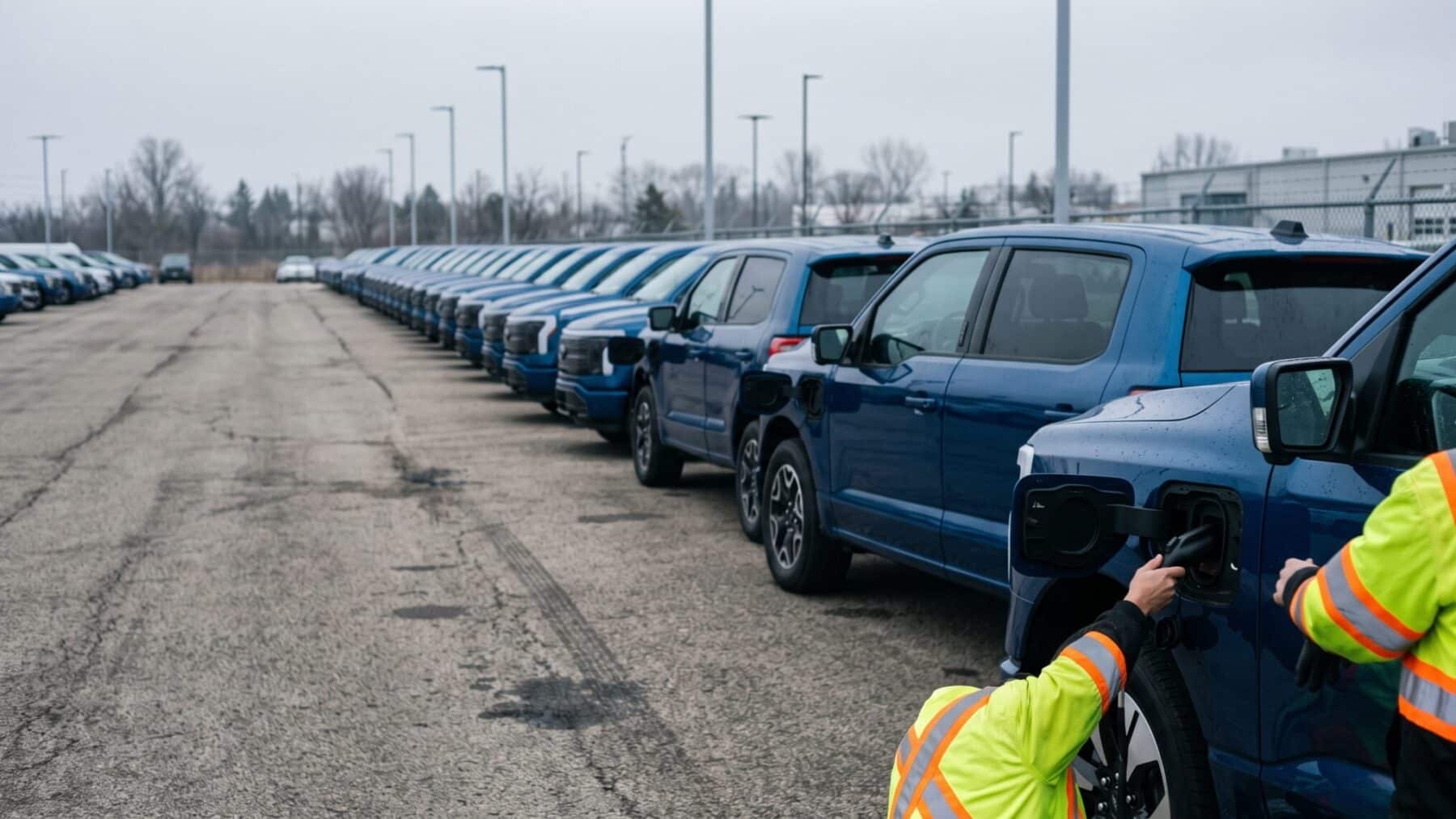
Walk onto a used-car lot today and something has changed.
Nearly-new electric cars are lined up in rows where there were almost none two years ago. The sticker prices on some of them look like typos. A luxury sedan that cost well over a hundred thousand dollars new is marked at less than fifty. And the buyers quietly circling those cars may not realize that a legal structure buried in a piece of federal legislation set the whole chain of events in motion before most of them had even started shopping.
How a tax credit written for new cars became a subsidy machine for the used lot
The mechanism starts with a legal quirk in the way the federal electric vehicle tax credit was structured. The Inflation Reduction Act, signed in 2022, created a split in how EVs were treated depending on whether they were purchased or leased. Because leased EVs were classified as commercial vehicles, they were not subject to the same domestic production and sourcing requirements that applied to EVs purchased for personal use. Dealers could still claim the full $7,500 federal tax credit and pass it on to lessees, even if the vehicle would not have qualified for an incentive when purchased outright.
With a lease, the automaker technically sells the vehicle to a leasing partner, and the U.S. Treasury Department issues the tax credit, via Section 45W of the tax code, to that leasing partner, which may then pass the savings to lessees. In plain terms: a buyer who could not qualify for the credit on a purchased EV could sign a lease and watch the same amount quietly shave their monthly payment. The math was irresistible, and showrooms noticed immediately.
The result was a sharp spike in EV leasing. Lease rates for EVs soared from around 15% in 2022 to 67% by March 2025, according to Cox Automotive data. Because nearly every one of those contracts ran for three years, the clock on a very large inventory bill was already ticking.
What 300,000 returned cars look like arriving at once
Picture a warehouse receiving dock that handled a modest shipment last year and is now being asked to process three times the volume. That is roughly what the used-car pipeline is absorbing right now. More than 300,000 electric vehicles are expected to return from lease in 2026, an increase of more than 200% from the 123,000 units projected for 2025, according to CDK Global.
The electric wave is part of a broader flood. Off-lease volumes across all powertrains are projected to rise sharply in 2026, adding hundreds of thousands of additional units compared to last year, according to industry forecasters including Edmunds.
The cars arriving are not stripped-down economy models. Most leases run two to three years, so the bulk of 2026 returns will be 2022 and 2023 models with roughly 25,000 miles, and many will still have substantial factory and battery warranty coverage remaining. Many carry significant discounts versus new EVs. Wholesale prices for EVs at auction have moved more sharply than non-EV vehicles, where broader used-car values have also firmed, according to industry remarketers tracking auction data through mid-2026.
The depreciation gap that turns a $127,000 car into a $49,000 one
A recent iSeeCars study analyzed over 950,000 five-year-old used cars sold in the U.S. from March 2025 to February 2026 and found that electric vehicles lose more value than any other vehicle type, dropping by 57.2% after five years, compared to an overall average drop of 41.8%. That roughly 15-point spread is the gap between a vehicle that holds its value and one that loses more than half of it before the second set of tires wears out.
One luxury electric sedan illustrates the scale: a model with an original lease MSRP above $127,000 can now be found selling for roughly $49,000, a dramatic gap versus the residual values lenders assumed when those contracts were written. Lenders who set residual values years ago did not anticipate a simultaneous flood of returns and a federal credit disappearing from the new-car market.
Both happened at once. For context on how EV rebates have moved in parallel, the forces pulling on the new and used markets are closely linked. Many leases written in 2022 and 2023 assumed residual values near 50%, while current market estimates place actual residuals closer to 35% to 40%, a gap that is exactly what the off-lease surge is now starting to resolve for EV shoppers.
Where the deal holds and where it breaks down
Not every off-lease EV is a bargain. Some luxury electric models were selling in early 2026 for between $10,000 and $16,000 below their estimated resale value. Others with high lease penetration were still selling $7,000 to $8,500 below projected resale prices. The steeper the original lease subsidy, the steeper the correction on the used lot.
Gas models and EVs have been moving in different directions inside the same used-car lot, sometimes parked side by side. Some high-volume gas models were selling for premiums above projected prices, while off-lease EVs continued to offer meaningful discounts relative to their original MSRPs.
Inventory tightness still bites hard at the lower end. Supply in the cheapest segments sits at just 32.2 days, well below the market average of 46 days, and options under $15,000 represent only 16.4% of all used-car inventory. The off-lease wave helps buyers who can spend $25,000 to $45,000 on a nearly-new electric car, though the hidden cost risks on used vehicles are a reminder that price alone does not tell the whole story when buying secondhand.
What buyers can realistically expect before the window closes
The flood of off-lease returns will not run forever. Leasing’s share of new-vehicle transactions pulled back from its peak, and industry data shows the rate of new EV lease signings has moderated from the highs of 2023 and 2024. Fewer leases signed now means fewer returns in three years.
The concentration of leasing happened over roughly a two-year stretch, and since most leases are three years long, those cars are coming back to dealer lots in volume now. The contracts were signed in 2022 through 2024, and the first major wave of returns is locked in for 2025 through 2027. Once that cohort has cleared, the pipeline thins considerably.
Buyers who act in the next several months are the ones most likely to find the deepest discounts on low-mileage electric vehicles. For consumers, this is a rare window where late-model electric vehicles with substantial battery warranty remaining are available at meaningful discounts to original MSRP. A provision never designed to stock dealer lots with affordable cars has, almost by accident, done exactly that.
