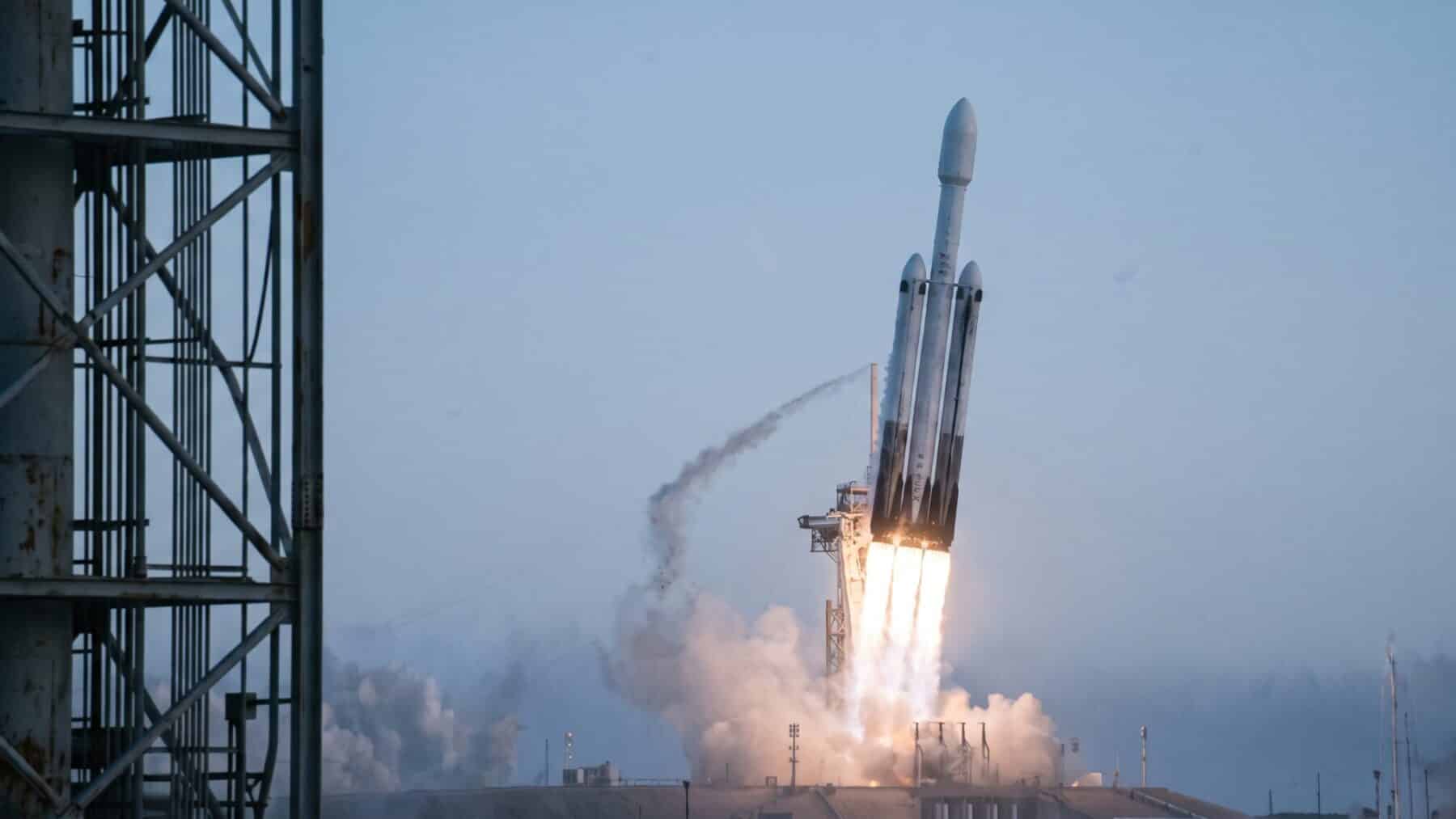
NASA’s Nancy Grace Roman Space Telescope lifted off at 7:26 a.m. EDT aboard a SpaceX Falcon Heavy from Launch Complex 39A at NASA’s Kennedy Space Center in Florida, opening a new chapter in wide-field space observation and setting the agency on course to probe some of the universe’s deepest remaining mysteries.
A flagship observatory bound for L2
NASA awarded a launch services contract to SpaceX to provide launch service for the Nancy Grace Roman Space Telescope mission, at a total cost of approximately $255 million, which includes the launch service and other mission-related costs. The contract was awarded in July 2022.
Roman will travel toward the Sun-Earth L2 Lagrange point, roughly 1.5 million kilometers from Earth, the same gravitational parking spot occupied by the James Webb Space Telescope. The spacecraft is now on a three-month, million-mile journey to its final orbit.
The telescope separated and deployed from the upper stage booster at T+31 minutes. The two side boosters separated from the center core; after shutting down their engines at about 2 minutes, 24 seconds after launch, the boosters separated seconds later and executed a flip maneuver to orient themselves for their return. Both side boosters successfully returned to land at two Cape Canaveral Space Force Station landing zones. The center core was not recovered, to ensure Falcon Heavy had enough performance to launch the telescope.
Record-breaking imaging hardware
The Nancy Grace Roman Space Telescope carries a 2.4-meter primary mirror and two scientific instruments, led by the Wide-Field Instrument (WFI). The WFI features a large-area, 300-megapixel near-infrared camera for imaging and slitless spectroscopy, with a 0.281-square-degree field of view. Roman’s WFI has a similar sensitivity and resolution to Hubble, but captures images covering about 100 times more sky in a single observation.
Roman will send back 1.4 terabytes of data every day, the highest data rate of any NASA astrophysics mission to date.
The Coronagraph Instrument (CGI) is a high-contrast, small-field-of-view camera and spectrometer covering visible and near-infrared wavelengths using novel starlight-suppression technology. It will have imaging and spectroscopy modes to perform a technology demonstration to directly image exoplanets.
Roman’s 2.4-meter primary mirror was built for a classified spy satellite and donated to NASA by the National Reconnaissance Office when the original program was canceled, a legacy component that cut years from the fabrication timeline and helped contain hardware costs.
Science targets: dark energy, dark matter, exoplanets
This flagship mission will help astronomers explore dark matter, dark energy, and worlds outside of our solar system, known as exoplanets. Over its five-year primary mission, the bus-size telescope’s observations could reveal answers to enduring mysteries such as dark energy, which fuels the accelerating expansion of the universe, and dark matter, which provides the cosmos with structure but remains unseen.
The WFI will be used in surveys to study the nature of dark energy and dark matter, and in a Galactic Bulge Time Domain Survey to search for exoplanets using the microlensing technique. Roman’s objectives also include probing the expansion history of the universe and the growth of cosmic structure, with the goal of measuring the effects of dark energy, the consistency of general relativity, and the curvature of spacetime.
Gravitational microlensing detects planets by tracking how their host stars briefly amplify background starlight, a technique that works across vast distances where direct imaging is impossible.
Nine months ahead of schedule
Roman’s official commitment was to be ready for launch no later than May 2027; launching on August 30, 2026 puts the mission nine months ahead of that formal launch commitment, a rare outcome for a flagship NASA science mission. Construction of the telescope’s bus was completed in September 2024, Roman passed its spin test that October, and by December 2024 the mirror and instruments had been integrated onto the bus, with NASA announcing full construction completion in November 2025.
After completing final testing at Goddard, the telescope was placed in a specialized container and shipped from Maryland to Kennedy Space Center in June 2026, where it was cleaned, inspected, fueled, and integrated onto launch hardware.
The accelerated schedule reflects a broader surge in space-sector investment that has compressed timelines across the industry as commercial and government launch capacity grows.
Roman’s five-year primary mission will generate an unprecedented archive of infrared sky data. Machine learning, artificial intelligence, and citizen scientists will help sift through it and flag significant findings, which astronomers can then study.
NASA’s Roman mission page and NASASpaceFlight.com’s launch coverage carry full details as the spacecraft completes its three-month transit to its L2 halo orbit.
