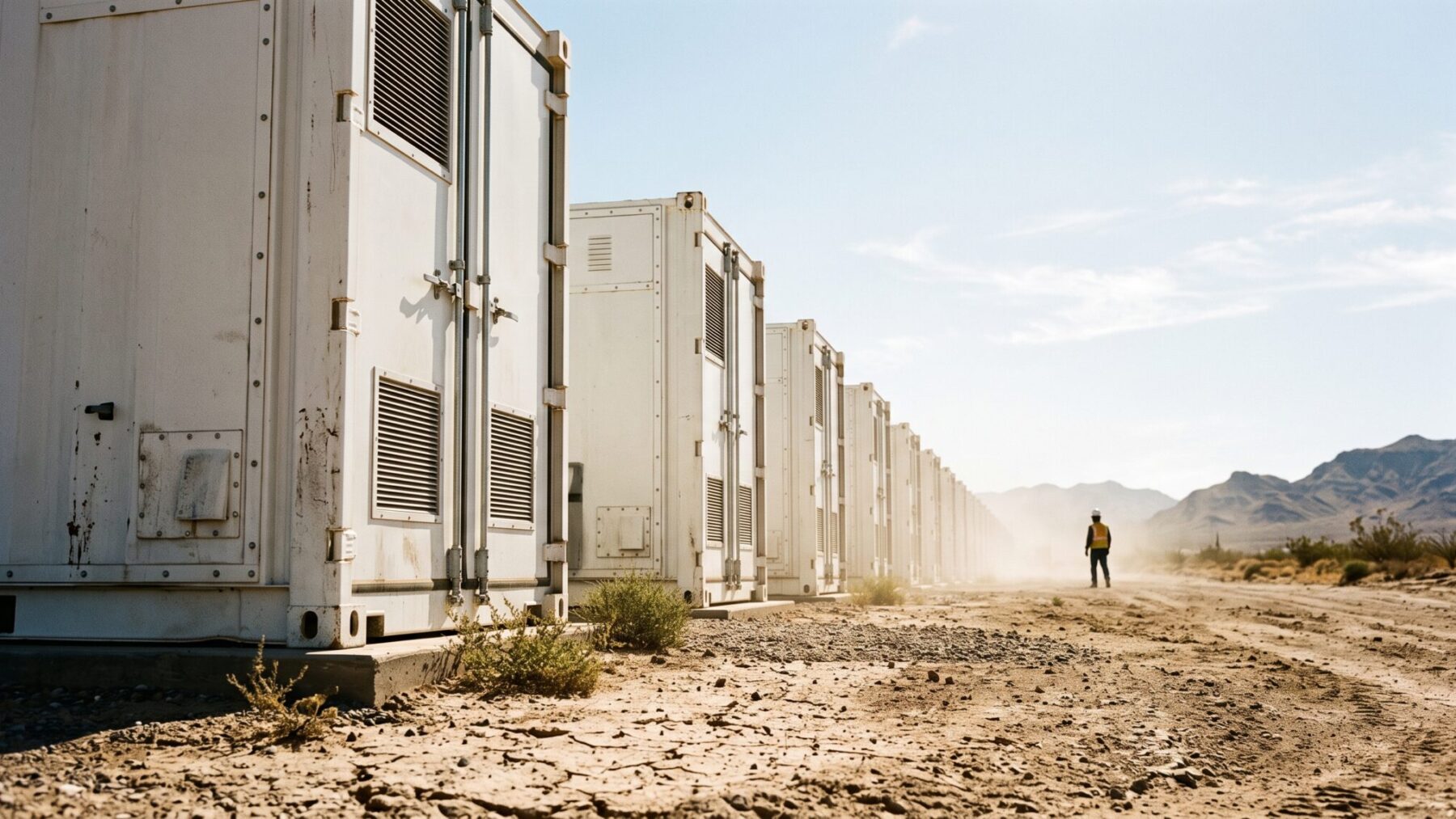
The desert floor in Arizona barely changed.
Just row after row of white steel cabinets, each the size of a shipping container, humming in the heat. In three months, crews commissioned enough of them to flip a national record. How does a single state pull that off, and what does it mean for every grid in the country?
How a grid battery actually moves power from noon to night
Solar panels overproduce at midday. Wholesale prices in Arizona, Texas and California routinely drop close to zero, or even go negative, when the sun is strong and demand is low. A battery bank next to a solar farm absorbs that cheap surplus automatically, charging through the hottest afternoon hours when most households are at work.
Then, as the sun drops and demand surges, stored charge flows back to the grid as dispatchable power. That price gap, repeated every single day, is the commercial engine driving Arizona’s buildout faster than any other state has moved before.
The physical chemistry is straightforward. Lithium-iron-phosphate cells, the dominant chemistry in utility projects right now, accept and release charge hundreds of times a year with minimal degradation. Racks of cells wire into modules, modules stack into cabinets, and cabinets line up by the acre. The whole system connects to the grid through a power-conversion unit that can switch from charging to discharging in a fraction of a second.
What actually went into the ground across Arizona in three months
Arizona alone added a state-record 6.2 gigawatt-hours of battery storage in Q2 2026, the strongest quarter ever recorded by a single state. That stored energy is enough to power roughly two million average American homes for a full hour at peak demand.
It arrived not from one flagship project but from several installations that reached commercial operation in the same quarter. Among them were Beehive, Catclaw and Pediment, each carrying 250 megawatts of power capacity paired with 1 gigawatt-hour of storage. Construction continues at a rapid clip, anchored by the nearly finished Maricopa Energy Center, which includes a 550-megawatt, 2.2-gigawatt-hour battery.
Arizona’s geography explains the pace. The state averages more than 300 days of sunshine a year. Developers locked in construction sites years ago, and the state’s pipeline of committed projects has grown into one of the largest in the nation.
The numbers behind the national quarterly record, and where they came from
The US battery storage market posted its biggest quarter ever in Q2 2026, adding 20.2 gigawatt-hours of new capacity. The record quarter brought first-half installations to 30.8 GWh, up 23 percent year over year, according to the joint market outlook from the Solar Energy Industries Association and Benchmark Mineral Intelligence.
That half-year total already exceeded the full-year figure the industry managed just three years earlier. Utility-scale projects accounted for about 18 GWh of Q2 installations, supported by seven gigawatt-hour-scale projects: four in Arizona, two in California and one in Utah. Texas added 3.8 GWh and California installed another 3.6 GWh in the same period. “Energy storage is no longer just a California and Texas story anymore,” said Shan Tomouk, BESS and Energy Lead at Benchmark Minerals.
The EIA’s primary data confirmed that utility-scale battery capacity grew at an average annual rate of 70 percent over the last three years. By mid-year, total nameplate storage had reached nearly 52 GW, with plans for an additional 54 GW over the next two and a half years.
Where the buildout runs into real limits
Speed has a cost. Interconnection queues remain the biggest single friction in the US storage market. A project that wins permits and secures financing can still wait two or three years for a grid-connection study to clear.
As the load side of the grid grows fast too, the queue problem compounds. The federal investment tax credit for storage, first authorized by the Inflation Reduction Act, can offset 30 percent or more of deployment costs. The treatment of that credit and its interaction with wind and solar incentives creates a planning asymmetry developers are still working through when sizing hybrid projects.
Supply chains face strain too. US battery manufacturing capacity has expanded sharply, but cell-level procurement still depends heavily on imported materials. Any tariff shift can alter project economics within weeks of a final investment decision.
What the record pace means for every grid paying attention
The numbers signal a structural, not cyclical, shift. The national residential solar-plus-storage attachment rate reached 45 percent in Q1 2026, up from 38 percent a year earlier, meaning the buildout is not confined to utility-scale farms.
Homeowners are making the same arbitrage calculation that grid operators make, just at a smaller scale. Battery storage is delivering meaningfully more electricity to the US grid each year than the one before it. As US utility-scale battery capacity approaches 65 GW by year-end, the gap between storage and traditional peaking plants is closing faster than most forecasts from even two years ago suggested.
Projections show Arizona adding roughly 10 gigawatt-hours of new storage across this year, with more than 20 gigawatt-hours in the pipeline for next year. The desert that once seemed an unlikely anchor for a national energy transition is now the state everyone else is benchmarking against.
