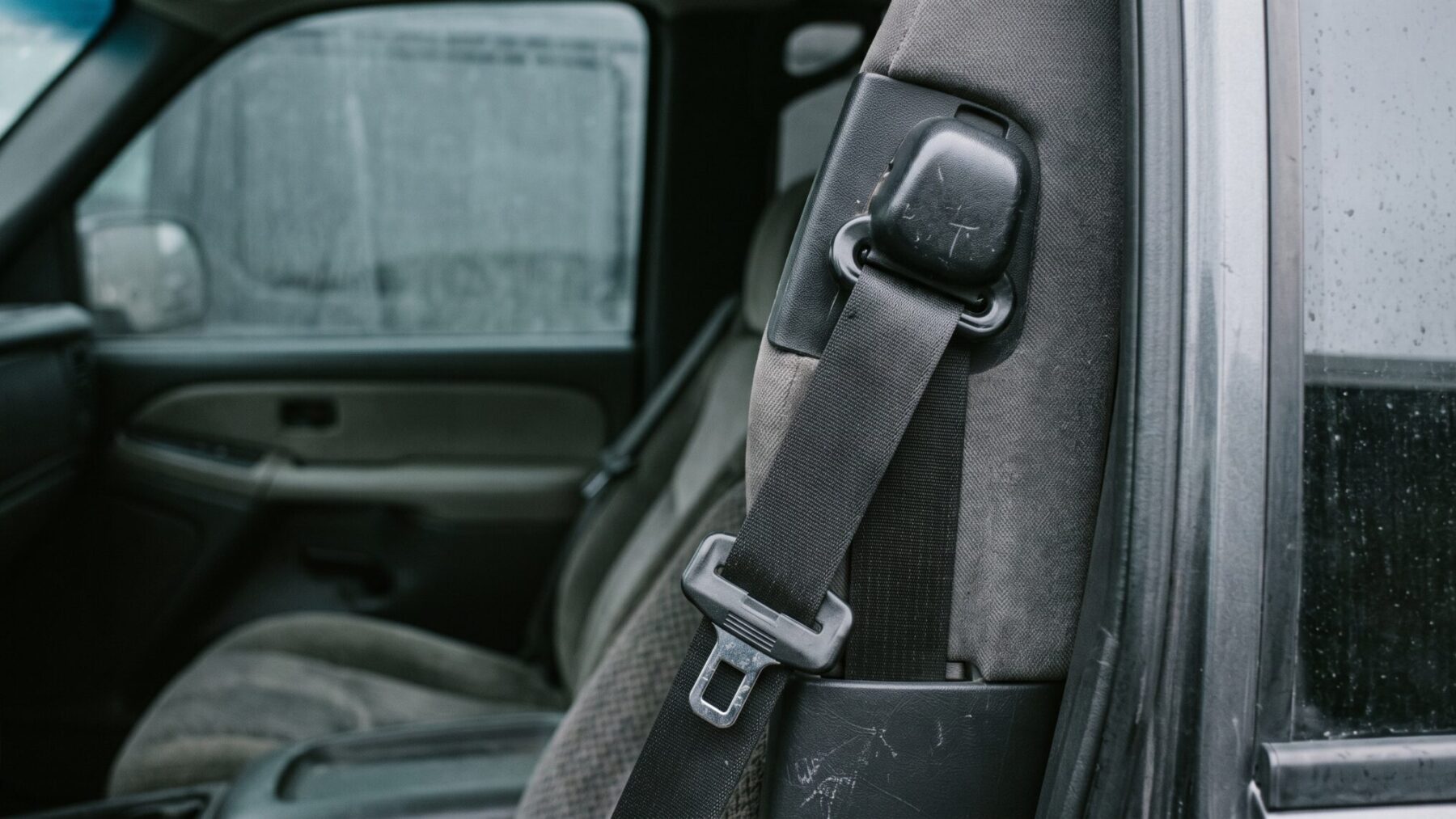
Picture the moment every driver trusts most: a collision begins, and the seat belt yanks tight.
That single snap of tension is why the belt is there. Now imagine it already fired, days or weeks before any crash, locking the webbing rigid in your lap. That is the defect. And it took three separate recalls to say so plainly. The question worth asking is how a chemical designed to save you ends up turning on you first.
How a safety chemical turns against the very belt it powers
Exposure to high-heat environments can cause the pretensioner’s propellant to emit corrosive byproducts that can damage internal parts and trigger the pretensioner to go off. That propellant can degrade in sustained high heat, producing corrosive by-products that corrode the squib pins and bridgewire used to trigger the device.
Those pins are the trigger. Corrosion of the isolated squib pin and bridgewire creates high resistance or an open circuit, which can trigger an inadvertent deployment of the seat belt pretensioner. The belt deploys with no impact, no warning and no collision in sight.
Once fired, the retractor locks rigid. The belt cannot retract or extend, which means it cannot do its job if a real crash follows. Seat belts that do not retract or extend can fail to restrain an occupant as intended, increasing the risk of injury in a crash. The safety device arrives already spent.
The two full-size SUVs at the center of a nearly 420,000-vehicle recall
The recall covers model years 2018 through 2022 Ford Expedition and Lincoln Navigator vehicles, split between 342,283 examples of the Expedition and 77,684 units of the Navigator, for a total of 419,967 vehicles. These are among the largest family haulers on American roads, routinely parked in driveways where summer cabin temperatures can soar. Most owners have no idea anything is wrong until a warning light appears.
The airbag warning light on the instrument cluster is often the first sign. In addition to a stuck seat belt, drivers may notice that the airbag warning light is illuminated on the display behind the steering wheel. Most drivers assume it is an airbag glitch and book a diagnostic appointment, not realizing their belt has already spent itself. By then, the retractor has been locked and useless for days.
The recall is filed under NHTSA campaign 26V344000, reported May 27, 2026. Ford estimates approximately 3% of the affected population carries the active defect at any given time.
Three recalls on the same vehicles and the evidence that finally named the root cause
This action replaces and expands two earlier recalls, NHTSA 24V099 and 25V197. Both addressed corroded squib pins but when those recalls were approved, Ford had not identified a root cause for the corroded squib pins that led to pretensioner inadvertent deployment. A third investigation, launched in early 2026, identified a specific propellant-and-stabilizer combination as the root cause.
Ford conducted a series of tests and investigations into the issue starting in January 2026 following two previous recalls related to seat belt pretensioners, leading to its decision in May to issue a field service action. In February 2026, Ford’s Critical Concern Review Group observed that the inadvertent deployments appeared to occur only in retractor pretensioners that used a specific combination of propellant and stabilizer. That confirmation locked in the decision to expand the recall.
Vehicles previously repaired under either earlier action will still need the new fix completed.
This pattern of a fix that itself needs fixing draws attention well beyond a routine service bulletin. It echoes the broader challenge of safety recalls tied to chemical and electrical instability inside vehicle hardware, a problem the industry has struggled to catch before it reaches owners. Owners can confirm their vehicle’s status directly on the NHTSA recall page for this campaign.
Where the defect does and does not hold, and what owners can actually do right now
Not every Expedition or Navigator is affected. Because affected vehicles are not produced in VIN order , the model year alone is not enough to confirm risk. Owners must check their specific VIN against the NHTSA recall database.
The remedy comes in the form of replacement pretensioners featuring a propellant and stabilizer combination with enhanced chemical stability. It is a complete pretensioner replacement, not a patch on the original chemistry. Parts and the official remedy are expected to be available by September 30, 2026, and the recall repair will be free.
Owners can generally keep driving while waiting for the free dealer repair, but should not ignore the notice. This situation is a reminder that passive safety features can carry hidden limitations that only surface when the feature is needed most.
What the recall signals about how heat stress is tested before a car reaches the street
The core issue is not manufacturing sloppiness. It is that thermal aging in real-world conditions, a dark SUV parked in Phoenix or Houston summer after summer, can outpace what lab qualification testing models. The gap between those two environments is where this defect lived for years.
Based on testing results, the original propellant may become unstable after being repeatedly exposed to high-temperature environments. A propellant that is chemically stable at the factory may not stay that way across five or six years of repeated heat cycles in a closed cabin. The phrase enhanced chemical stability in Ford’s own testing notes implies the original formulation’s stability was marginal enough to fail under sustained heat.
Automakers and restraint suppliers are now under pressure to include longer thermal cycling in pretensioner qualification protocols, especially for vehicles sold in hot-climate states where cabin temperatures routinely spike far above anything a temperate lab captures.
Ford is aware of one injury related to this issue. That number is low, but the defect touches the single device every other safety system in the vehicle is designed to work alongside. A seat belt that fires early and locks rigid is not a minor inconvenience. It is the primary restraint arriving already spent, right before the moment it is needed most.
