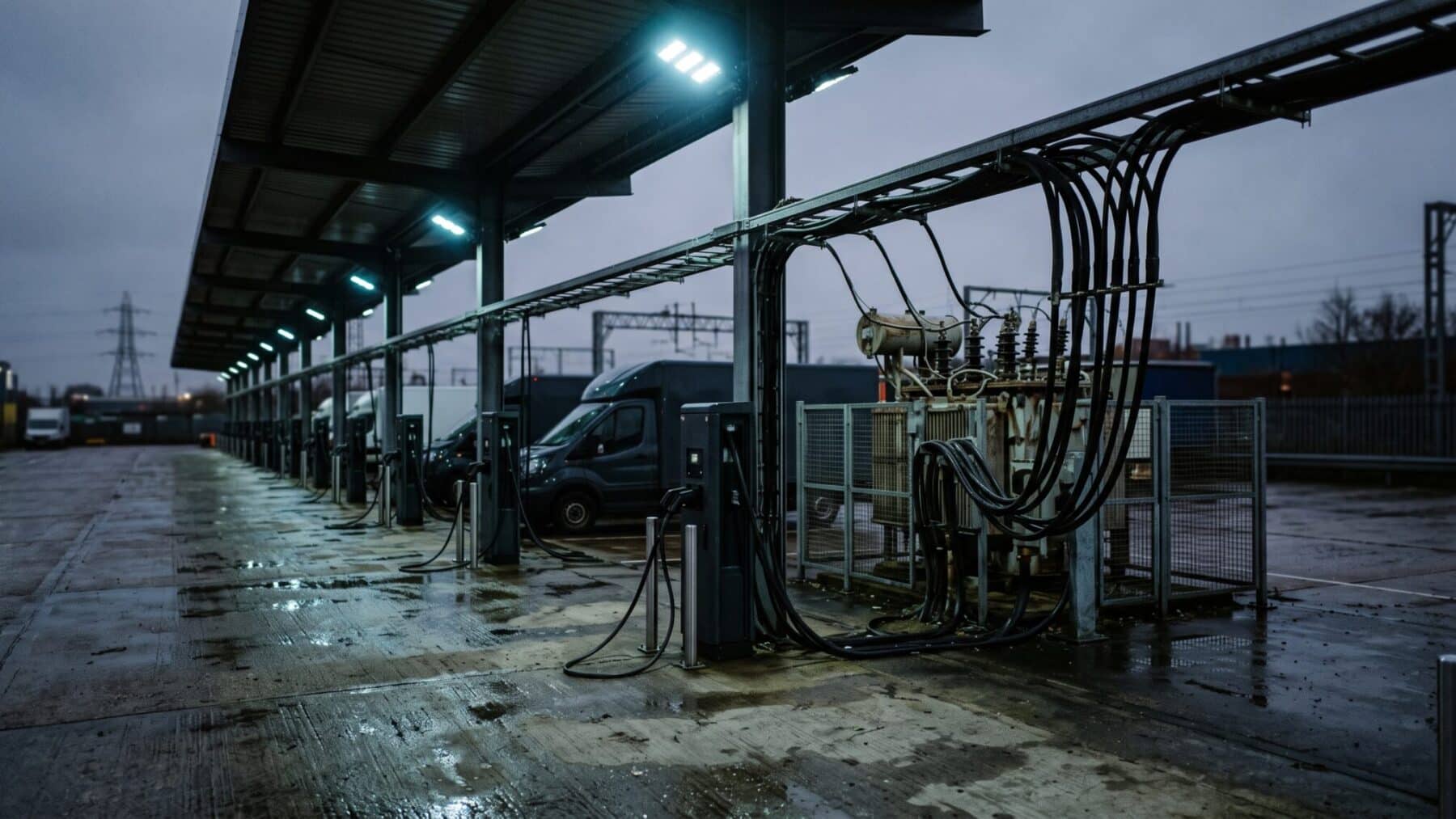
Electric vehicle charging and data-center servers together represent the dominant structural drivers of US electricity demand growth through 2050, according to the Energy Information Administration’s Annual Energy Outlook 2026, released April 8, 2026 . The agency describes the report as “a product suite for alternative futures analysis, not a set of predictions.” The finding is among the sharpest signals yet that EV charging load has moved from a grid footnote to a central variable in long-range US power planning.
What the numbers show
After more than a decade of relatively flat US electricity consumption, demand has risen 2.1 percent per year on average over the past five years, and is projected to grow at an average annual rate of 0.9 to 1.6 percent per year through 2050 across EIA’s cases. Data-center load is emerging as the dominant driver of long-term US electricity growth.
EVs sit alongside that data-center load as the second structural driver. The AEO2026 projects total electricity generation will grow 25 to 50 percent through 2050 , with EV and data-center server demand identified across cases as the leading contributors to that increase. Although EV and data-center server demand show significant growth across most of the cases, they account for a relatively small share of total load projections in 2050.
The report includes 11 cases with varying policy and market assumptions, as well as the full set of data tables and visualizations, assumptions and methodologies.
The EIA’s projections include EV charging in either residential or commercial sectors to reflect customer charging location. Commercial charging at workplaces and for school buses occurs primarily during the day, while residential charging and commercial charging of transit buses and fleet trucks occurs primarily overnight.
That time-of-day split is now a formal planning input, not an estimate, meaning utilities must engineer for two distinct daily peaks rather than one.
Why EV charging is the harder grid problem
Data-center servers are assumed to have an end-use load shape that is essentially flat, meaning demand for electricity to power servers is consistent across all hours in a day , which makes it easier for grid operators to plan around.
EV charging is concentrated in windows that already stress transmission and distribution infrastructure, particularly the early-evening residential surge. As EV deployment and charging speeds increase, grid capacity constraints could become more pronounced in some regions.
The IEA’s Global EV Outlook 2026, released May 20 , reinforces that concern, noting the implications of growing EV adoption for electricity consumption and grid infrastructure planning.
Meeting projected charging targets will also require sustained infrastructure investment, including installing public charging points at a large scale annually through 2035.
An earlier NREL-led analysis put distribution-grid upgrade costs for EV charging at up to $2.3 billion, with managed charging capable of cutting that bill by more than half.
FERC moves on the regulatory side
On June 18, 2026, FERC issued six show cause orders initiating proceedings under Section 206 of the Federal Power Act for all jurisdictional regional transmission organizations and their respective transmission owners.
The orders instruct those entities to explain why their existing open-access transmission tariffs are just and reasonable with respect to interconnection processes for large loads.
FERC took the action to facilitate access by large loads, such as AI data centers and manufacturers, to the electric grid, while protecting other customers from costs caused by large loads. The underlying question of who pays for transmission upgrades and how fast new large loads can connect applies directly to the commercial EV-charging depots now seeking high-voltage grid access.
Each tailored order addresses several categories of reform for the grid operators. These include developing efficient transmission service application and study processes, preventing cost shifting, requiring transparency into transmission costs, and providing new transmission services for flexible large loads.
What changes for utilities and planners
The AEO2026 findings shift the conversation on cost recovery. Utilities seeking rate relief have already cited rising infrastructure costs driven by new load, and a record $9.2 billion in US electric and gas rate-hike requests landed in a single second quarter, with regulators approving 58 cents of every dollar utilities asked for over the past two years.
Measures such as smart charging, which reduces peak demand by shifting charging loads, or vehicle-to-grid technology, which allows EVs to feed electricity back to the grid, can offer additional flexibility.
The first commercial offers for vehicle-to-grid for private EV owners appeared in 2025, although few V2G-capable models are available, the regulatory landscape remains fragmented, and standards are not yet uniform.
The EIA will next update the Annual Energy Outlook in 2027. In the meantime, the AEO2026 data tables and all 11 case models are publicly available on the EIA’s website, giving grid planners and regulators the most detailed federal baseline yet for sizing the infrastructure needed to absorb the coming wave of EV charging load.
