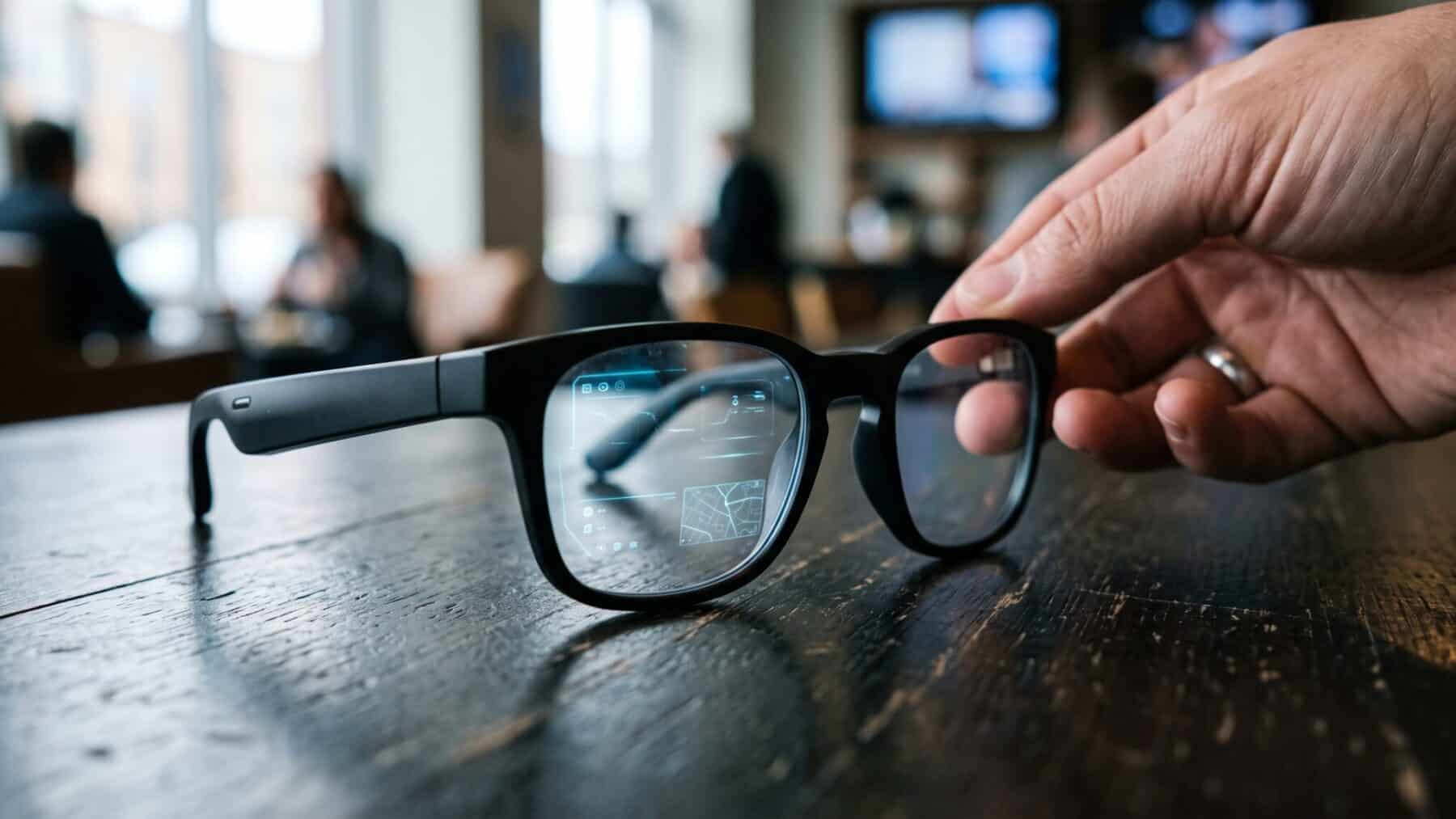
XREAL’s Aura smart glasses, formerly known as Project Aura and confirmed to launch in the fall , emerged as the hardware centerpiece of the 83rd Venice International Film Festival (2, 12 September 2026) , running live XR experiences for festivalgoers and marking the device’s most prominent public showcase ahead of a confirmed fall 2026 retail launch priced below $1,500.
What the hardware delivers
The Aura features Sony micro-OLED panels with 1,920 by 1,200 resolution per eye and a 120Hz refresh rate. A 70-degree field of view and electrochromic dimming allow for adjustable transparency in varying lighting conditions. That field of view is the widest XREAL has ever shipped.
The Aura uses a wired, split-compute architecture: XREAL’s own X1S chip sits in the glasses and drives the display, while a Snapdragon Reality Elite in a separate puck handles the Android XR work. The optical see-through frames weigh less than 95 grams and are designed for immersive mixed-reality experiences while still letting users see the real world around them.
The hardware uses a glasses-style design rather than an enclosed headset; the optical see-through lenses allow users to look directly at their physical environment while digital interfaces appear within their field of view. Digital elements are layered on top with full six-degrees-of-freedom tracking, which allows the system to understand both head rotation and physical movement through space, so digital screens and virtual objects can remain anchored to specific positions as the user moves.
Google’s Venice showcase
Google supported three projects premiering at the festival, including Nevatars, a mixed-reality animated short by Andy Serkis filled with Gemini-powered conversations, and Galápagos: The Last Eden, an immersive XR journey narrated by Margot Robbie that brings nature to life.
Festival organizers partnered with Agog, the XR institute co-founded by Wendy Schmidt, to run a four-day open demonstration where festivalgoers and industry delegates could drop in, no reservation required, to test the hardware. The XREAL Aura is being positioned as a potential jolt for a sluggish headset market.
The Immersive competition featured two experiences built specifically for the device: Andy Serkis’s “Nevatars,” starring Daisy Ridley, and the Margot Robbie-hosted “Galápagos: The Last Eden.” Nevatars is listed in the official Venice selection at 31 minutes and is categorized as an XR glasses installation.
Galápagos: The Last Eden, directed by Anthony Geffen and narrated by Margot Robbie, turns a natural-history documentary into a spatial experience. The Venice presentations mark the most sustained real-world demonstration of Android XR on consumer eyewear to date, complementing Google’s broader Gemini rollout across its device lineup.
Pricing and availability
XREAL says the Aura will launch sometime in fall 2026, noting on its reservation page that the final retail price of the base model “will not exceed US$1,500, excluding applicable taxes,” with supported countries including the US, UK, Japan, South Korea, and selected countries in the EU.
The company has offered two distinct reservation formats: a Founder Priority Pass for $299 that guarantees first-batch shipments and applies toward the final price (limited to 2,000 units), and a $100 reservation fee for later shipments that will turn into a $200 discount off the final price. A $199 Priority Deposit, fully refundable, is also available and is applied toward the purchase at launch. The glasses will launch in two waves: the US, UK, South Korea, and Japan in fall 2026, with Europe to follow shortly after.
The XREAL Aura has secured over 10,000 reservations ahead of release; XREAL confirmed the milestone and called it an “exciting signal” of demand. The XREAL launch announcement confirmed the fall window in June.
A crowded market taking shape
If the upcoming audio-only glasses from Warby Parker and Gentle Monster represent the minimalist form of Android XR on glasses, XREAL’s Aura is the maximalist version. Google has also partnered with Samsung on Android XR hardware. Those audio-focused models, which carry no display, are distinct from the Aura’s optical see-through approach.
The broader Android XR initiative covers two types of devices: AI glasses for screen-free assistance equipped with speakers, microphones, and cameras, and display AI glasses featuring an in-lens display for private access to navigation or translation captions.
Global shipments of smart glasses are projected to grow substantially through the end of the decade, a trajectory that explains why Google, XREAL, and competitors are converging on hardware launches before year-end.
With the Aura’s Venice outing now complete, the device’s commercial debut is the next test of whether Android XR can build a developer and consumer base fast enough to matter. That platform ambition also extends well beyond headsets, as evidenced by Google’s on-device AI push across its Pixel hardware line.
