Picture a traditional car body shop: hundreds of metal stampings, each cut, moved, clamped and sparked into a growing skeleton.
The line stretches for hundreds of yards.
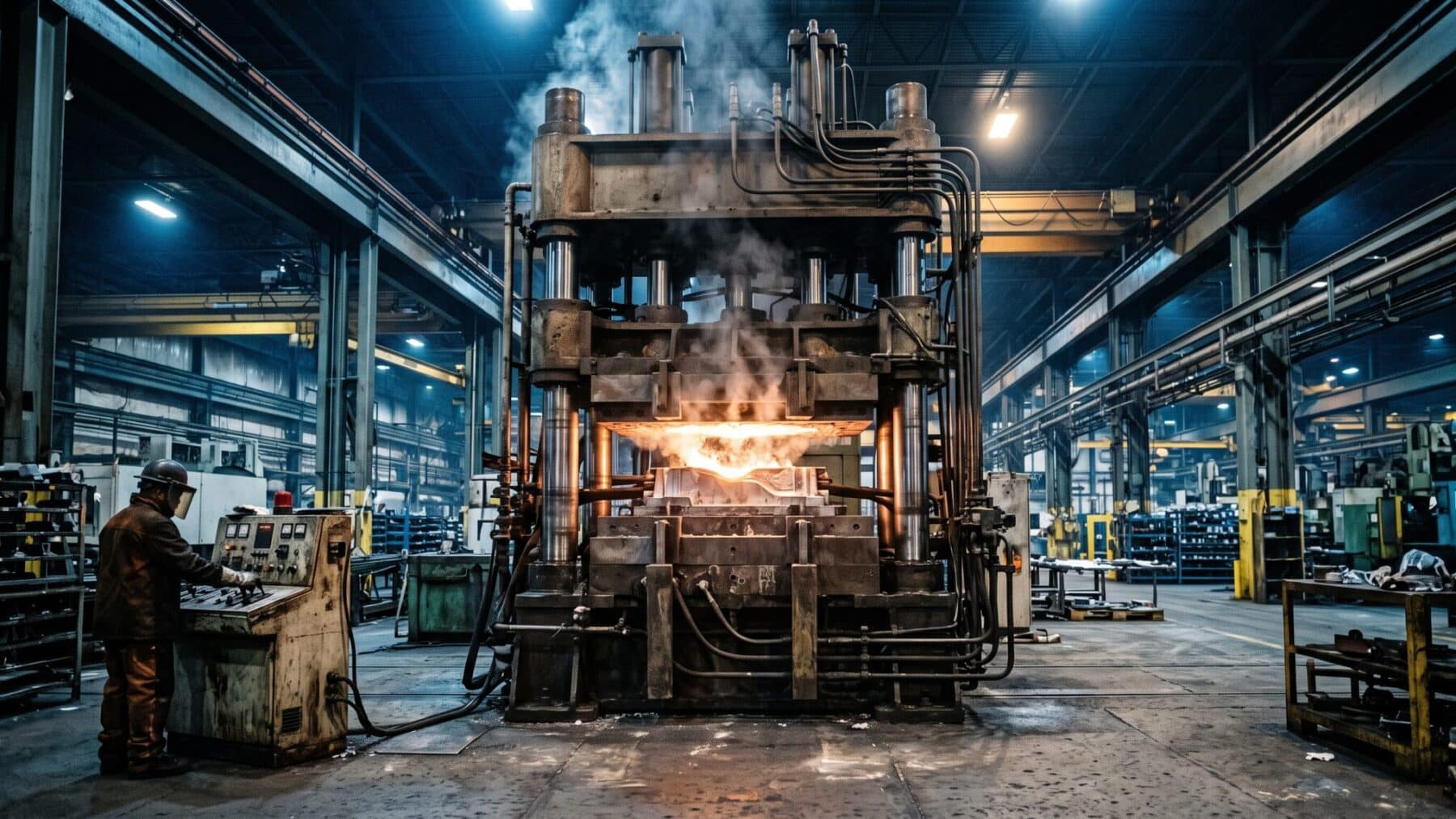
Now picture a single machine the size of a house squeezing all of that into one pour of molten aluminum done in minutes.
The numbers behind this process are harder to ignore than the machines themselves.
So how does liquid metal replace an entire assembly line?
How 9,000 tons of pressure turns molten metal into a car’s entire rear end
Gigacasting, also called megacasting, forces molten aluminum alloy under extreme pressure into a steel die, producing a single structural component where dozens of stamped-and-welded parts once lived. The presses generate between 6,000 and 9,000 tons of locking force, holding the die shut until the metal solidifies and the platen opens to release a finished piece.
The cycle is fast. Industry reporting describes machines using optimized alloys and integrated process control to hold tolerances across parts that would once have required a dozen separate tooling setups. What comes out needs almost no secondary assembly before moving down the line.
The physics favor electric vehicles specifically. EV bodies sit heavy low in the floor, so every kilogram saved in the structure above matters more than on a gasoline car. A large aluminum casting is inherently lighter than the welded steel assembly it replaces, and it eliminates the overlapping flanges where corrosion traditionally starts.
What Toyota’s prototype and a Louisville assembly plant tell us about how fast this is moving
Ford’s Louisville Assembly Plant is mid-retool around large-scale aluminum casting as the backbone of a new EV production system. Assembly Magazine confirms that the technology anchors Ford’s Universal EV Platform, sandwiching a structural battery pack between a cast front structure and a cast rear structure. The battery itself becomes a load-bearing member of the frame, not just a box bolted underneath. Ford calls its version “unicasting,” though the underlying process is the same high-pressure aluminum die-casting technique.
That plant has already felt supply-chain pressure: an aluminum supply disruption hit second-quarter output hard, underlining how central aluminum has become to the company’s strategy. Unicasting deepens that reliance, demanding a specific alloy that flows well, cools predictably and holds strength without the brittleness that plagues ordinary die-cast parts.
Volvo’s EX60 electric crossover entered production at its Torslanda plant in Sweden in April 2026, with the rear underbody cast as a single piece that replaces hundreds of stamped and welded components. Toyota’s prototype work showed that 86 individual sheet-metal parts across 33 steps can be replaced by a single rear casting, and Toyota has projected that total body assembly time could be halved from around 10 hours per vehicle.
The real numbers: parts eliminated, time saved and machines sold
Eighty-six stamped components through 33 assembly steps, replaced by one cast piece in roughly three minutes. That ratio represents not just a shorter line but a fundamentally different factory layout, since body shops that once required thousands of square feet of welding fixtures can shrink substantially when most of the rear underbody arrives as a single unit.
The equipment market reflects the momentum. Multiple ultra-large machines have been sold across the industry since the technology reached production scale, with locking forces reaching up to 9,000 tons on the largest units. Multiple manufacturers now supply these presses, including firms in Europe and China.
At least three major automakers are at various stages of live production or active retooling. For buyers of full-size electric pickups with large structural battery packs, the implication is direct: the cast floor and the battery beneath it are engineered as one integrated load path, changing both weight distribution and repairability after a serious collision.
Where the process does not work as advertised
The repair problem is real and the collision industry is raising it loudly. A cracked or bent gigacast rear structure often means the entire piece must be replaced, because cast aluminum fractures rather than bending back the way steel does.
The insurance math follows immediately. Even a moderate rear collision that would once have been a straightforward repair can become a total-loss decision when the damaged component requires a complete new casting. Shops also need new equipment: aluminum demands different welding techniques, different cutting tools and technicians trained specifically on non-ferrous repair.
Legacy plants face a separate problem. Retrofitting a gigapress means ripping out stamping lines, reinforcing floors to handle machines that weigh thousands of tonnes, and reconfiguring the entire part flow. For a plant still running gasoline models on the same line, that surgery is painful without stopping production entirely.
What the next few years look like for the factory floor and for buyers
The competitive logic is hard to argue with. Parts counts slashed by factors of ten, assembly time cut roughly in half on Toyota’s projections, and a lighter structure that helps offset a large battery’s weight penalty: those gains compound quickly at volume.
Automakers committed to the process are already pulling ahead on per-vehicle production cost, and the gap widens with each successive model cycle. Even so, the transition is slower than the engineering case suggests. Capital costs for a single ultra-large press run into tens of millions of dollars, alloy sourcing adds supply-chain complexity, and the repair ecosystem has not caught up.
For most buyers, the shift will be invisible at purchase and only visible in the aftermath of a crash. But on the factory floor the change is already dramatic: fewer workers, fewer robots, fewer jigs and one gleaming aluminum piece where a hundred separate parts used to wait in line.
