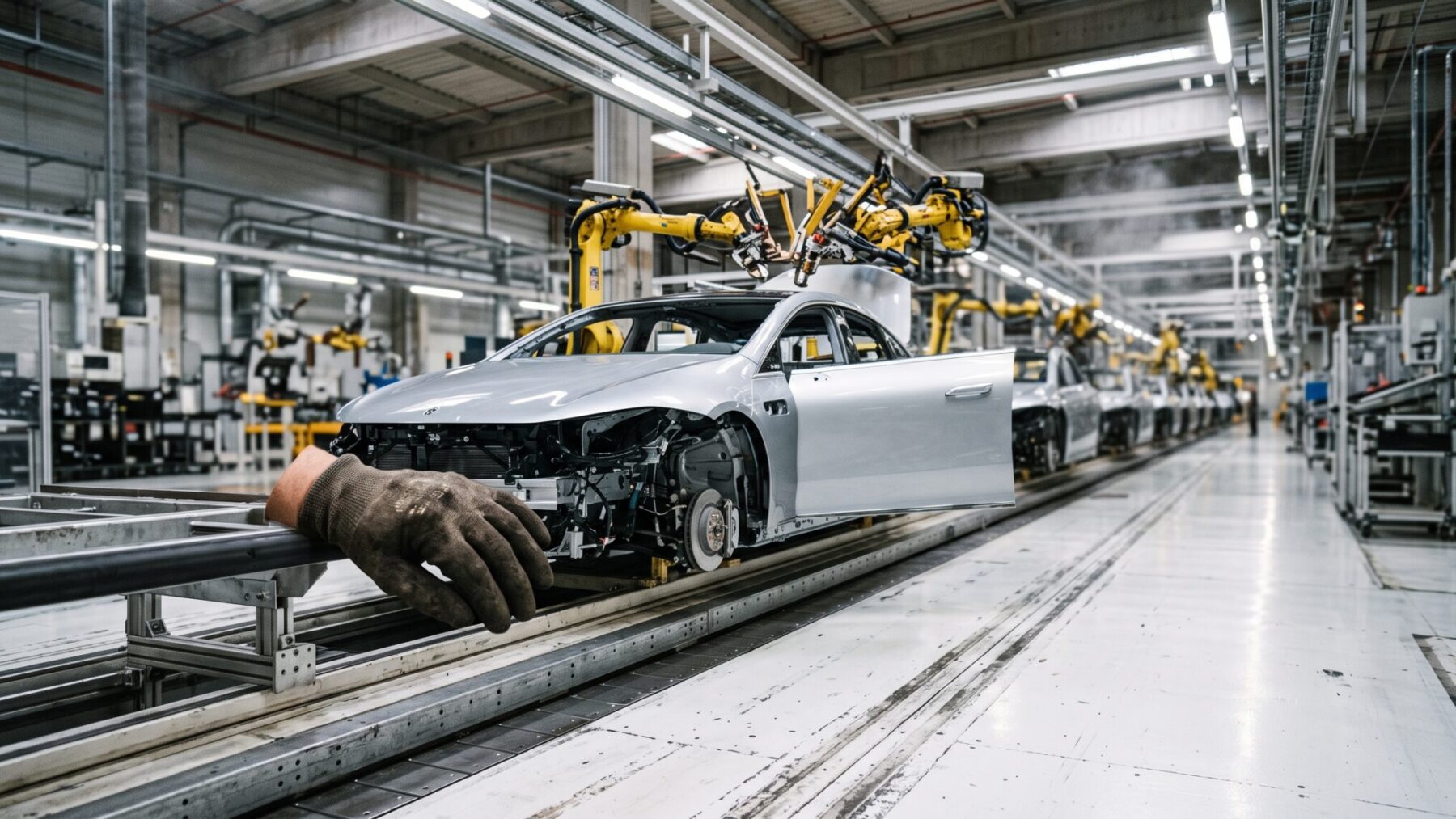
The room smells of fresh primer and warm aluminum.
Robots hover over a partly dressed car body, arms moving in arcs too precise to be hurried. A screen overhead ticks through a live readout climbing into the thousands. No one pulls the line to check a part. The car already told the system what it needed to know. So what, exactly, is it saying?
How a car reports on itself 20,000 times before it leaves the building
The assembly area inside the rebuilt Munich plant is set up for end-to-end digital processes: vehicles, systems and tools are all interconnected. During assembly the new electric sedan digitally transmits the status of up to 20,000 features to the production system in real time. That is not a post-build inspection report. It happens continuously, on the moving line, before the car reaches the end of the hall.
Camera systems and AI-driven sensors perform inline quality checks at the body shop and paint shop, catching surface defects during the running process rather than flagging them only at a separate post-build inspection. In a conventional plant, quality checks at the end of the line can flag a problem only after a full vehicle has been assembled around it. Here, the fault signal arrives while there is still time to act cheaply.
That gap, between catching a defect at the station and catching it at the exit gate, is where the cost saving lives.
What the plant actually looks like after four years of rebuilding
The automaker converted the Munich site over four years while production continued uninterrupted. A new body shop, a new assembly hall with integrated logistics, and a new delivery hall now occupy about a third of the plant site. Despite the construction, up to 1,000 vehicles were delivered per day throughout.
The investment came to roughly €650 million, or about $750 million. The new body shop features 800 industrial robots and 98 percent automation, notably higher than most traditional body shops, where human welders still handle the more complex geometries. Modernization of the press shop alone cost approximately €12 million and yielded a 30 percent increase in outer panel capacity.
Munich also carries a detail no other plant in the network has: it builds its own seats on-site, manufactured in-house and delivered to the line in exact sequence. A seat arriving late in the wrong color holds the whole line. So the savings are stacking at every stage, not just in final assembly.
The numbers behind the cost drop and where they come from
With the start of production of the new electric sedan, the plant cut overall production costs by a further 10 percent, bringing them below the level of the current vehicle generation. The reduction came through increased automation, digital manufacturing processes, and the architectural design of the new platform itself.
Fewer parts to weld means fewer stations. Fewer stations means a shorter line, less floor space, less energy, and fewer people moving components between steps. The electric platform is, by construction, a simpler thing to build than the combustion car it replaces.
The automaker is making the case that the electric transition is not just a regulatory response but the cheaper manufacturing path. For anyone watching record cash rebates squeeze dealer margins right now, a genuine factory-floor cost reduction is the kind of structural change that eventually shows up in transaction prices.
Where the new system still has limits and open questions
The 20,000-feature data stream is impressive, but it only works if the production software can act on the signal fast enough to matter. The approach aims to redefine the entire production value chain from suppliers to finished vehicles.
That supplier-to-finished-vehicle scope is where real complexity sits, because a car’s quality chain starts well before the body shop. Simulation can miss the human variable: a new worker on a new station who takes twice as long as the model predicted. Real-world ramp data over the next two quarters will tell far more than any launch announcement.
The Munich case also sits inside a wider industry tension. Automakers are rebuilding factories for EVs while managing tariff pressure that has already pushed up delivered costs. The mandatory fees that destination charges have added show how factory-level savings can evaporate before a car reaches a driveway.
What the Munich model means for electric factories everywhere
From 2027 the Munich plant will exclusively produce fully electric vehicles, making it the first existing plant in the automaker’s network to make that all-electric commitment at a home factory rather than at a greenfield site.
The greenfield approach, building a brand-new EV factory on empty land, has been the dominant industry model. The Munich team instead converted an existing plant over four years while keeping the line moving. Workers were rerouted around live construction, logistics flows were redrawn mid-run, and the budget had to cover both the rebuild and any production losses.
Keeping the line running while rebuilding a third of the building is the part that does not appear in a press release.
The 10 percent cost cut, the 98 percent body shop automation rate, and the live data stream together describe a specific theory: catch the defect earlier, at the station rather than at the gate, and both quality and cost move in the right direction at once. Whether that scales across an entire lineup, and across suppliers outside the same four walls, is the question Munich will spend the next several years answering.
