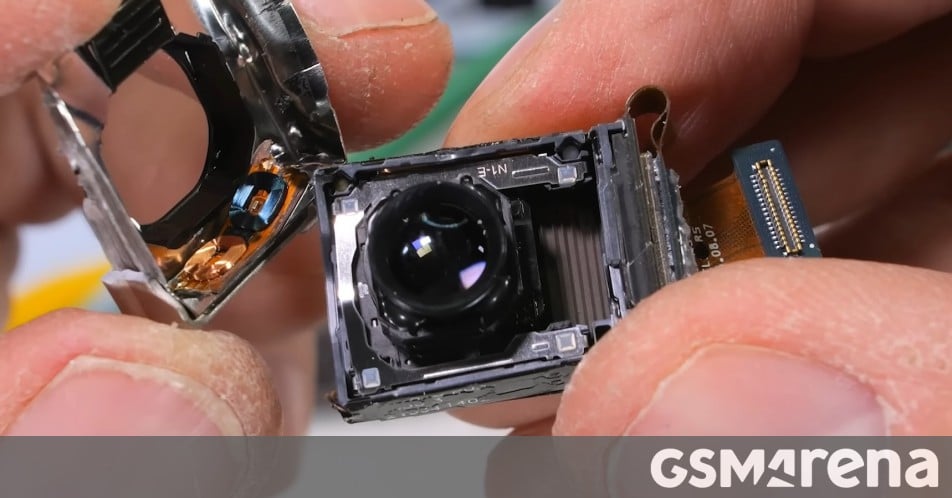
Hold a modern flagship sideways and look into the 5x zoom lens.
The opening is circular now. It was not last year. That small change is the visible hint of a complete rethinking of the most constrained piece of engineering inside a phone camera. What made that circle possible is a question of sequence.
Almost nobody buying the device knows it happened.
So what changed inside the module, and why did it take this long?
How stacking glass on top of a prism changes the physics of pocket zoom
Every zoom lens needs distance. Light must travel far enough between the front element and the sensor to achieve real optical magnification, and a phone gives it almost nothing to work with. The answer the industry settled on was to bend light sideways: a prism catches it at the entrance and deflects it 90 degrees through the phone’s length rather than its depth. That is the periscope design, and it has been the standard approach for nearly a decade.
The old arrangement put the prism first. Light entered, struck the prism, bent sideways, then traveled through a column of stacked lens elements before landing on the sensor. Making the opening wider meant a taller module, which meant a larger camera bump.
The new design alters that geometry entirely, positioning the lens stack on top of the prism rather than behind it. Light hits circular glass first, bends through the refractive curves, and only then strikes the prism below. The prism still turns the beam sideways, but it is no longer the gatekeeper that limits how wide the entrance can be. That single reordering is what the circular opening signals.
What the inside of the module actually looks like after the redesign
A teardown published in March confirmed the internal change in detail. The redesigned 50-megapixel telephoto uses a structure called ALoP, which stands for All Lenses On Prism, replacing the traditional arrangement where the lens stack sits between the prism and the sensor.
The visible sign is the shape of the opening. Where last year’s model had a rectangular entry cavity, the new one shows a circular glass element sitting flush against the cover. By stacking lenses above the prism, the manufacturer can shorten the overall module length while also allowing for larger apertures, meaning more light gathering and brighter, cleaner zoom at range.
The practical result is a module that is both smaller and optically faster at the same time. The manufacturer has moved away from the word “periscope” in some product descriptions for this phone, even though Samsung’s own engineers still use the term for the underlying architecture. The physics is the same. The sequence is new.
The verified numbers: 22 percent smaller, 37 percent brighter, and one trade-off
The confirmed figures from the teardown and manufacturer data are concrete. By rearranging the components, the module’s height shrank by 22 percent and the aperture widened from f/3.4 to f/2.9 despite the smaller physical footprint. That wider aperture allows the sensor to capture roughly 37 percent more light than the previous model.
The global chip sales surge underscores how rapidly flagship hardware is advancing season over season, and this camera module is a sharp example of where that silicon competition lands in your hand.
There is, however, one verified downside. The minimum focus distance doubled to 52 centimeters, compared with 26 centimeters on the previous model’s telephoto. The trade-off is structural: putting the lenses above the prism pushes the front element physically further from the subject it can resolve at close range.
Why the prism-first design held on for so long before this change
The engineering difficulty of this reversal is real. Precise alignment of prisms and lenses is required in any periscope-style system, since even slight misalignments degrade image quality across the zoom range.
The ALoP arrangement is designed to improve brightness and reduce noise while decreasing the module shoulder height and length, dimensions that translate directly into camera bump size, which has long been a pain point for smartphone designers. The geometry shift also changes which element absorbs thermal stress first, requiring new compensation strategies from the manufacturer.
The tighter factory tolerances demanded by the new layout follow from the same logic: the prism now sits beneath a lens group it cannot be adjusted independently of after assembly. The ALoP design was announced by Samsung’s imaging division in 2024, but it took until this product cycle to ship in a 5x configuration.
Yet the industry had a clear incentive to solve it. Achieving 5x optical zoom at f/2.9 with a large 50-megapixel sensor inside a thinner chassis would be mechanically difficult using the previous prism-first tunnel without substantially increasing the bump size. The bump shrank anyway. Smaller zoom modules also matter beyond one phone, and as flagships are now tracked closely alongside other wearable sensor advances, optical compactness is increasingly treated as a platform-level specification.
What this shift signals for the next generation of phone cameras
The ALoP approach is not a finished endpoint. The 5x telephoto still carries a 50-megapixel sensor, now using the new lens-first mechanism, while a 3x telephoto rounds out the rear camera system giving three distinct optical zoom levels, anchored by the main camera’s 2x quality zoom, with digital extension reaching 100x.
The question the industry is now working out is whether the same geometry can be applied at 10x without the close-focus trade-off worsening further. Moving the front glass further from the subject at 10x would make close-range telephoto shots nearly unusable, so the compensation required is substantially harder than at 5x.
For ordinary users, the practical upshot is simple: low-light 5x shots are meaningfully better than last cycle, close macro telephoto work is meaningfully worse, and the bump is no larger despite the sensor being bigger. When you see a round entrance on a telephoto module rather than a rectangular slot, you are looking at a phone that puts glass before the prism. That circle is not a styling choice. It is the visible edge of a geometry shift that took a decade to arrive.
