Traffic is moving normally. The car ahead is there, but at a comfortable following distance, no emergency, nothing imminent. Then the brakes fire anyway, without warning.
The car behind has no time to react. For more than 421,000 SUVs and pickups already in American driveways, federal regulators confirmed this is a documented design flaw. The question is how a system marketed to prevent crashes became one that triggers them.
How a camera reads a normal gap as a five-alarm emergency
The defect is rooted in calibration, not hardware. The front camera software, supplied by Mobis, is calibrated too aggressively. The software exhibits increased sensitivity to forward object proximity, which can result in sudden braking and elevate the risk of a rear-end crash with closely following traffic.
The camera cannot distinguish a comfortable merge gap from a genuine emergency, so it treats both identically. Every following driver becomes a victim of software they never knew existed. The car braking is not the car that gets hit.
Set the sensitivity threshold too loose and the car fails to brake in a real emergency. Set it too tight and the camera fires on ordinary traffic gaps in certain driving situations the recall report does not enumerate. That second failure mode is the one now under recall.
What 421,078 affected vehicles look like in a parking lot
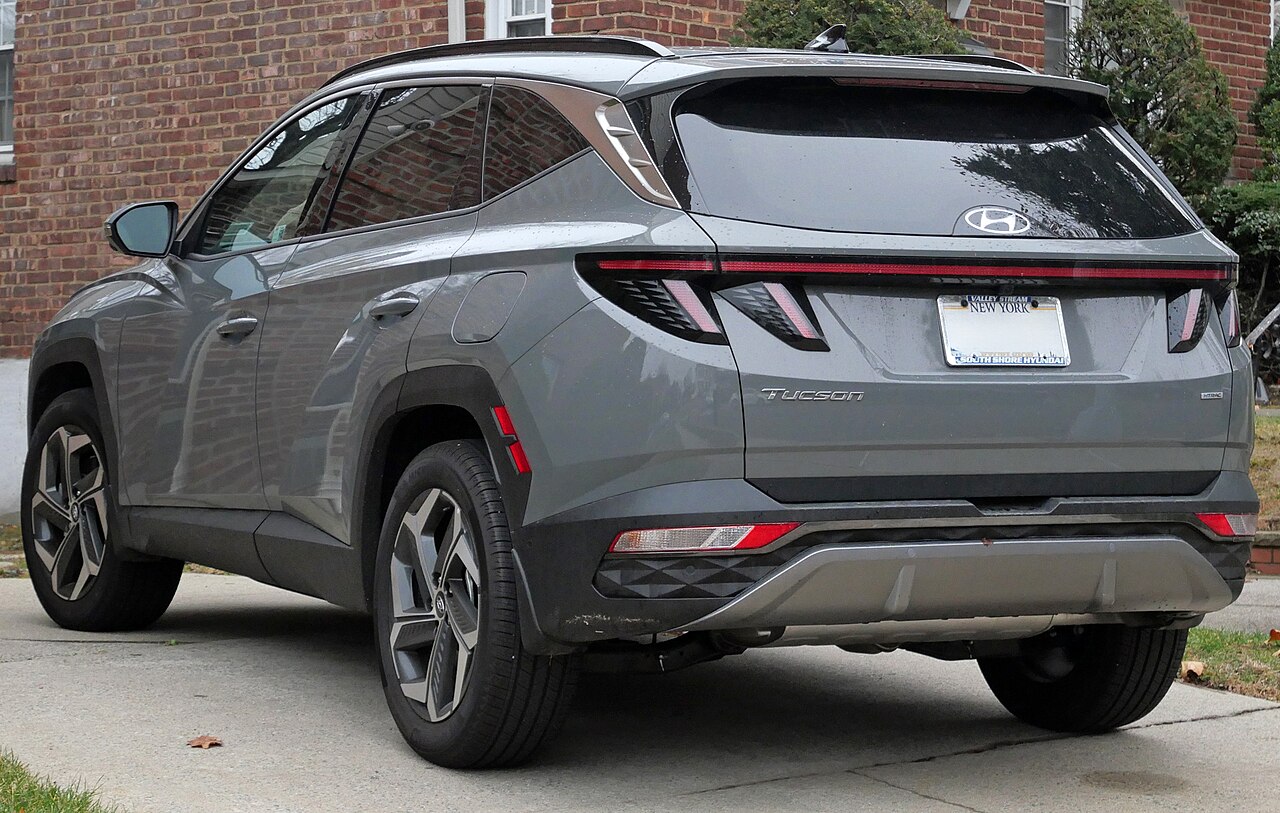
NHTSA recall 26V316, filed May 22, 2026, covers the Tucson at 292,805 units, the Tucson Hybrid at 110,844, the Tucson Plug-In Hybrid at 4,347, and the Santa Cruz pickup at 13,082. That is four separate nameplates sharing the same camera supplier and the same overly sensitive software.
Buyers of hybrid and plug-in models are caught in the same net as buyers of the standard gas version. Both NHTSA and Transport Canada have filed recall actions, and Transport Canada’s filing covers 81,646 vehicles in Canada. The combined North American footprint runs well above half a million SUVs and pickups.
Hyundai estimates the defect rate at approximately one percent of the recalled population. One percent of 421,078 is still more than 4,200 vehicles that could phantom-brake at any moment, and owners had already been driving on public roads for months before the recall was announced.
The complaint trail, the crashes, and how long it took to act
Hyundai’s North America Safety Office opened the underlying investigation in January 2025 after receiving a Vehicle Owner Questionnaire alleging unintended braking. As of the recall decision date, the company had received 376 reports related to FCA operation between October 28, 2024 and April 27, 2026.
Four of those reports describe crashes in which vehicles were rear-ended by closely following vehicles, allegedly resulting in four injuries. No fatalities have been attributed to the condition in the US. Those four collisions are the exact scenario the system was engineered to eliminate.
Hyundai’s safety team replicated the condition in fleet vehicles in June 2025, then exchanged data with the supplier and Hyundai Motor Company throughout the summer. Joint vehicle testing followed at Hyundai’s Safety Test and Investigation Laboratory in November 2025. After completing prototype software testing at the California Proving Grounds in February 2026 and follow-up evaluation at test tracks in South Korea in March and April, Hyundai’s North America Safety Decision Authority decided on May 11, 2026 to conduct a safety recall. The gap between the first owner complaint and the formal recall decision ran to about sixteen months.
This pattern of gradual complaint accumulation before a recall is issued is part of a broader story in driver-assist technology. Commercial vehicles face the same phantom-activation problem at a different scale, with a repositioned radar box leaving an automatic braking system uncalibrated and producing a dangerously delayed stop.
Why collision-avoidance software is hard to tune and easy to get wrong
Camera-based collision systems face a fundamental engineering tension: the system may become overly sensitive in certain driving situations, potentially triggering emergency braking even when no actual collision risk exists, startling drivers and putting the people in the car directly behind at equal or greater risk.
Those following drivers had no input into the software calibration at all. And this is not unique to one brand. Phantom braking incidents can occur in any vehicle with an automatic emergency braking system and are not necessarily a reflection of a particular brand’s overall reliability.
The challenge is that buyers selecting these features from an options menu are choosing the promise of fewer crashes, not a detailed briefing on the camera’s sensitivity curve. The fine print in owner manuals rarely surfaces during a dealership walkthrough.
What happens next and what owners can do right now
Hyundai plans to resolve the issue through a software update applied to the front camera system, performed at no cost. Owner recall notification letters are expected to be mailed July 17, 2026, allowing drivers to schedule a free dealership visit to install updated software designed to reduce the system’s oversensitivity.
The repair is performed at no cost regardless of warranty status. Hyundai will also reimburse owners for out-of-pocket expenses related to the issue, under a reimbursement plan submitted to NHTSA on March 2, 2026. Until the updated software is installed, owners should drive with extra caution wherever following distances may be reduced.
Drivers can verify whether their vehicle is included by checking their VIN through the federal recall filing or the NHTSA recall database using recall identification number 26V316.
The broader lesson is one the industry is still absorbing. Driver-assist features are selling faster than ever, and design flaws in popular models can reach into the hundreds of thousands of vehicles before a pattern becomes visible enough to force action. The software watching the road ahead updates on a schedule set by engineers, not by the driver who depends on it. That gap between what a system promises at the point of sale and what it does in the real world is where phantom braking lives.
