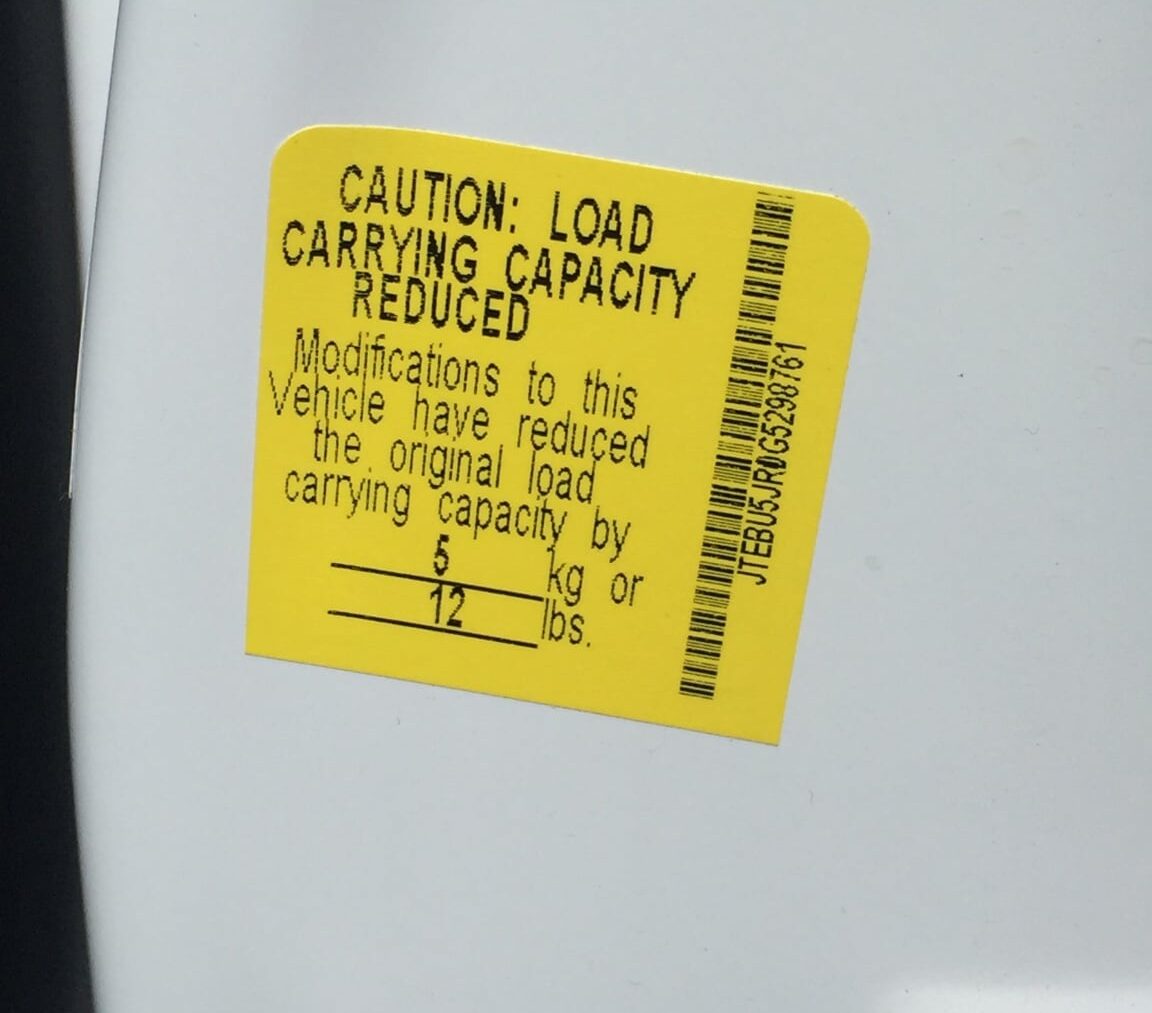
A small yellow label sits inside the driver’s door of almost every pickup and SUV in America.
Most owners have never read it past the tire pressure numbers.
Yet that single label is now the reason a batch of trucks is heading back to dealers.
The vehicles affected are recent, popular, and ordinary, and so is the fix. But the number printed on that label turns out to carry more legal weight than almost anyone realizes.
How one small label can overrule an entire truck’s engineering
Every new truck and SUV sold in the United States carries a federally mandated placard near the driver’s seat listing the vehicle’s gross weight rating and how much of that capacity is left for cargo and passengers after factoring in tires, wheels, and any dealer-installed add-ons. Automakers calculate that remaining number, called payload, and print it on the label before the truck ever reaches a lot.
The trouble starts when a dealer bolts on accessories, such as running boards or bed liners, after the truck leaves the factory. Each one adds weight, which is supposed to subtract from the printed payload figure through a secondary label.
When that math is wrong, the label understates how much the suspension and tires are already carrying. A federal rule known as FMVSS 110 exists so drivers never load a vehicle past what its tires can handle, because an overloaded tire can fail at highway speed.
Inside the newest recall touching popular hybrid trucks and SUVs
That is exactly the defect the manufacturer disclosed to regulators this month. Toyota is recalling certain 2024 Toyota Tacoma Hybrid, 2025 Tundra Hybrid, Tundra, 2026 RAV4 Hybrid, 4Runner i-Force Max Hybrid, and 4Runner vehicles because the load carrying capacity modification label may display inaccurate added weight values, putting the trucks out of compliance with Federal Motor Vehicle Safety Standard number 110, “Tire Selection and Rims.”
Nothing mechanical is wrong with these trucks. The suspension, tires, and frame are all exactly as engineered.
What failed is the paperwork trail connecting an installed accessory to the number a driver sees every time the door opens. Even so, regulators treat it with the same seriousness as a hardware defect, because a driver trusting an inflated payload number could overload the bed or cabin without ever knowing it.
This is not the automaker’s first label-related action this year. A separate recall earlier in the year covering 2024-2025 Toyota Tundra, Tacoma Hybrid, Tacoma, RAV4 Hybrid, Land Cruiser Hybrid, Lexus GX550, 2024-2026 Tundra Hybrid, 2025 Sequoia Hybrid, Crown Signia, Grand Highlander, Lexus TX500 Hybrid, Lexus NX350 Hybrid, 2025-2026 Grand Highlander Hybrid, and Lexus TX350 vehicles flagged the same kind of inaccurate added weight values on the load carrying capacity modification label .
What the paper trail actually looked like once the automaker dug in
Dealers will replace the load carrying capacity modification label, free of charge, once parts are ready, and owner notification letters are expected to be mailed October 18, with Toyota’s number for this recall listed as 26TA18 , per recall filings.
The automaker filed the campaign under its own internal number with the federal safety regulator. No crash, injury, or on-road failure has been tied to the mislabeled placards.
The filing describes the fix as a paperwork correction rather than a parts replacement, a quieter category than engine or suspension campaigns even though it carries full federal force.
So technicians can usually finish the job in minutes, not the hours a suspension recall might demand.
Where this kind of recall runs into real limits
Label recalls do not fix themselves instantly, because parts must be produced and distributed before every affected truck gets a replacement label. Owners sometimes wait weeks between notice and appointment, during which the old, inaccurate number stays on the door.
That gap matters more for commercial users and overlanding buyers who load Tacomas and 4Runners closer to their rated limits than typical commuters do. A camper shell, a winch bumper, and a full set of recovery gear can quietly stack several hundred pounds onto a truck whose label was never updated.
None of that means the trucks are unsafe meanwhile. The agency’s own recall database confirms the remedy is limited to the label itself.
Why a label this small keeps resurfacing across the industry
This is not a problem unique to one brand. The same labeling standard governs every automaker selling trucks and SUVs in the US, which is part of why payload and label errors keep surfacing even as recalls for bigger mechanical defects trend down.
Shoppers cross-referencing recent coverage of another automaker’s truck and SUV recalls or an earlier Tacoma suspension campaign will notice the same pattern, a small, overlooked component turning into a federal filing almost overnight.
For owners, the step is simple: check the VIN, confirm whether a label has shipped to a local dealer, and avoid loading the truck right up to whatever number the current label claims.
The bigger lesson sits quietly behind the recall. A small label, filled out long after the factory line, still carries enough legal weight to ground a batch of vehicles until the number printed on it is finally right.
