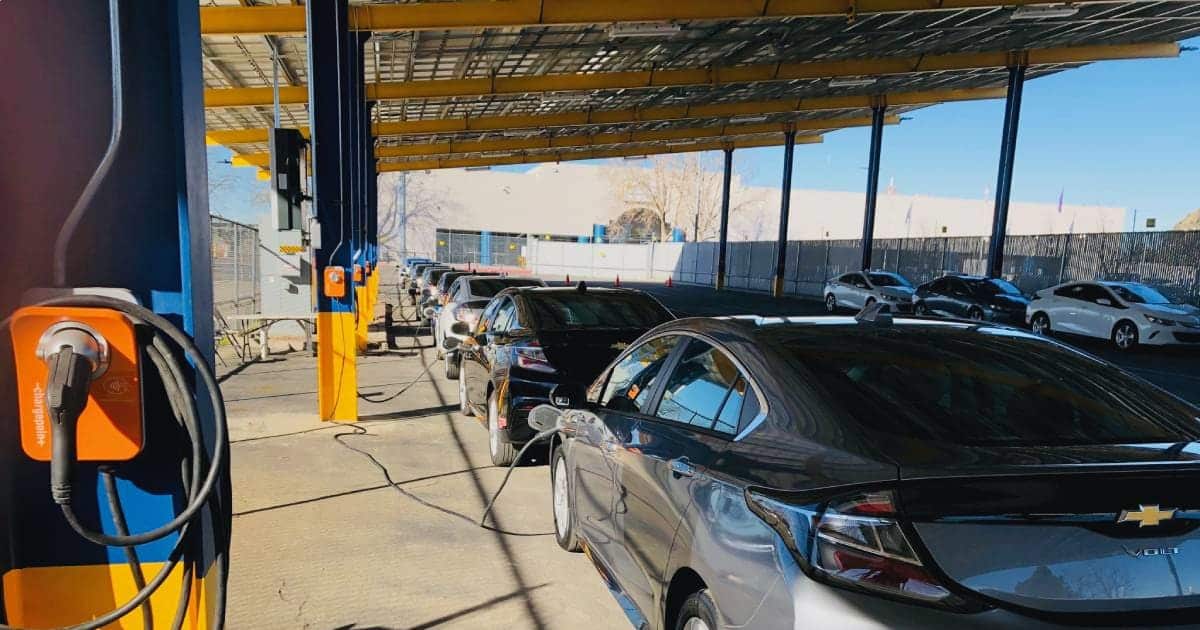
Rows of two year old electric crossovers sit nose to tail at a wholesale auction lot.
Charge ports still bear dealer stickers from the day they were leased.
Three years ago, a buyer drove one off the lot on a payment too good to pass up.
Today that same car is back, with roughly 25,000 miles on the clock.
Hundreds of thousands like it arrived within months of each other.
Everyone assumed this flood would crush prices, so why didn’t it?
Why a supply surge did not translate into cheaper sticker prices
The mechanism starts three years earlier, when a federal tax credit for electric vehicles got applied to leases in an unusual way. Because leased EVs were classified as commercial vehicles, they weren’t subject to the same domestic production and sourcing requirements that applied to EVs purchased for personal use. Dealers could still claim the full $7,500 tax credit and pass it on to lessees, even if the vehicle wouldn’t have qualified for an incentive when purchased. That loophole made leasing dramatically cheaper than buying outright.
So automakers and their finance arms wrote those leases assuming the cars would still be worth a lot in three years. For dealers already navigating a low-traffic environment, 300,000 returning leases represent the largest affordable EV inventory opportunity the market has ever produced, with residual value assumptions of approximately 50%, meaning a $50,000 EV was expected to be worth roughly $25,000 at lease end, while the reality is closer to 35, 40% of original MSRP.
That gap is the engine driving everything that followed.
Because the real value came in lower than projected, lessees had little reason to buy out their own cars. Most simply walked away, sending vehicles flowing back to dealers and auctions all at once rather than staying in private hands, a very different kind of supply shock than a factory simply overproducing a model.
What the sales data actually shows once the cars hit the market
Analysts had penciled in a straightforward prediction before the wave arrived. Black Book forecast used EV prices would drop $1,500 to $2,500 as off-lease returns met softer demand.
That drop never showed up.
Prices for used EVs are up 5.1% from January to June 2026, according to a Recurrent market report published this year, even as the lease returns hit the market, the opposite of what the supply math alone predicted. Quarterly figures back the same pattern: used EVs averaging $34,821 versus $33,487 for used internal combustion vehicles, a gap that has narrowed from over $10,000 as recently as 2023.
Sales volume moved with it, too. Americans snapped up 93,500 used EVs in Q1, up 17% from Q4 and up nearly 12% from the first quarter of 2025, meaning buyers absorbed the extra inventory almost as fast as it arrived. Shoppers running a vehicle history check on a returning lease typically find a single owner and a clean record.
Inside the lot where the wave actually landed
CDK Global projects more than 300,000 electric vehicles will return from lease in 2026, more than triple the 123,000 units projected for 2025, with J.D. Power placing the figure as high as 330,000.
Picture what that means on an ordinary lot. A dealer who once saw a handful of off-lease EVs trickle in each month now watches entire rows arrive together, often the same model, trim and color repeated down the line.
Most are not worn-out commuter cars.
Most of the 2026 returning vehicles will be two to three year old models from 2022 and 2023 with about 25,000 miles, many still carrying factory warranties including federally mandated battery coverage of eight years or 100,000 miles. That matters for anyone comparing this wave to a used gas car sale, since buyers are often getting years of remaining protection built in rather than a trade-in nearing the edge of its coverage.
Where the pattern breaks down and prices stay stubborn
None of this plays out evenly across every brand or region. Wholesale losses on individual lease turn-ins were real even as retail prices firmed up, because dealers often absorbed the gap between a lease’s promised residual and what the car actually fetched at auction.
That unevenness shows up in broader market data too.
Wholesale used-vehicle prices firmed in the first 15 days of October, lifting the Manheim Used Vehicle Value Index 0.7% from September to 207.4 on a mix, mileage and seasonally adjusted basis, a level 2.2% above October 2025. Cox Automotive noted that supply, not demand, appears to be what slowed depreciation, with analysts crediting tight supply rather than booming demand.
Even the broader lease pipeline carries a built-in expiration. CDK Global data shows EV lease returns climbing from roughly 123,000 units in 2025 to more than 300,000 in 2026, with industry analysts projecting another doubling to approximately 600,000 in 2027, but the pipeline runs dry after that since new-vehicle leasing rates have collapsed since their late-2010s peak, meaning fewer leases signed today means fewer off-lease vehicles returning in three years.
What this means for anyone cross-shopping a used EV right now
For a shopper walking a lot this fall, the lesson is not that bargains vanished. It is that the bargains sit in specific models and trims rather than across the category as a whole, even as the average headline number climbed overall.
Used EVs under $20,000 have seen prices increase 9.4% in the first half of 2026, compared with 5.6% for those in the $20,000 to $30,000 range and 6.5% in the $30,000 to $40,000 range, while used EVs at higher price points saw declining prices, with a 1.2% drop for those costing $40,000 to $50,000 and a 3.3% drop for those over $50,000.
So the smarter move is comparing a specific trim’s auction history and remaining warranty window rather than assuming a flood of supply means a flood of savings. That eight year coverage is worth more on an EV than on a comparable gas trade-in with no such backstop.
The bigger picture is a market still working out how to price a wave of vehicles nobody had seen at this scale before, and whether the next leasing cycle gets written differently because of it.
