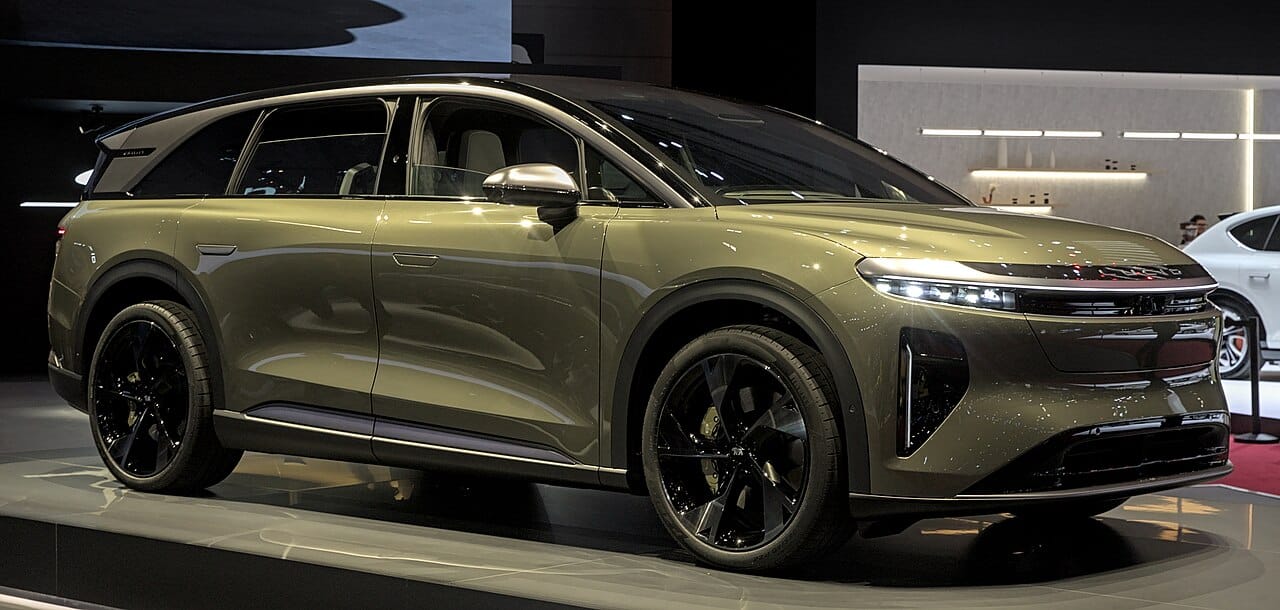
A three row family SUV just ran from a dead stop to 60 mph faster than most sports cars manage it.
The launch happened on a stage at a car week event in California last August.
No engine roared.
No exhaust note hit the crowd.
Just a quiet surge of torque and a number on a screen that made seasoned auto writers do a double take.
What makes a seven seat family hauler capable of beating that kind of time down a straight line?
How a family SUV out-accelerates most sports cars
The answer sits underneath the body panels, not under a hood. The Gravity GT-S from Lucid pairs two electric motors with a high voltage architecture that can dump enormous current into the drive units almost instantly, without the lag of spooling turbos or shifting gears.
That setup produces 1,070 horsepower, enough to propel the 7-passenger SUV from 0 to 60 mph in just 3.1 seconds , according to the automaker. Lucid says the Gravity GT-S is “America’s most powerful three-row SUV,” a label built entirely on how efficiently those motors convert electricity into forward motion.
So the trick is not just raw power, it is weight management. A low slung battery pack keeps the center of gravity down, which lets all that torque reach the pavement without the body lurching or the tires simply spinning in place off the line. A slippery shape with a remarkably low drag coefficient of 0.24 means less air resistance fighting the acceleration curve, so the same power translates into a quicker sprint than a boxier rival would manage with an identical motor setup.
The scene at Monterey Car Week when the car was revealed
Lucid picked a deliberately high profile stage to reveal the car. Monterey Car Week draws collectors, dealers and enthusiasts who typically gather around vintage coachbuilt classics, not family crossovers built to haul soccer gear and seven passengers.
Into that setting rolled a vehicle that looks every bit the luxury SUV, with seating for up to seven adults, generous cargo capacity , yet carries a straight line punch that lands it in supercar territory among vehicles on sale today. The GT-S starts at a six figure price tag around $125,900 USD, excluding tax, title, license, options, destination, and documentation fees , positioning it well above the standard Gravity lineup.
That price buys an electronically limited top speed of 155 mph alongside the sprint number. Even the seating arrangement had to be engineered around the performance goal, since three rows add weight and length that normally work against quick acceleration.
So every other component in the car had to compensate for that added bulk. That tradeoff is exactly what makes the claimed time notable among three-row rivals in the segment, even though it does not top every seven-seat SUV on sale.
Where the record claim actually comes from
Lucid’s own newsroom material lays out the specification directly, listing the GT-S with its full power figure and a 0 to 60 mph time of 3.1 seconds , with room for up to seven occupants. That figure comes from the automaker’s published spec sheet rather than an independent test, which is standard practice at a vehicle’s public debut.
Coverage from outside outlets echoed the same number within days of the August reveal. Several outlets repeated the 3.1 second figure based on that factory claim, and described the acceleration as competitive with dedicated sports cars. Independent instrumented testing by a third party magazine had not been published at the time of the reveal. It is worth noting that other seven-seat SUVs already on sale claim quicker factory times: the Tesla Model X Plaid has an official 0-60 mph time of 2.5 seconds , available with up to seven seats, and the Rivian R1S Quad-Motor has been quoted at around 2.6 seconds to 60 mph in a seven-passenger layout, so the Gravity GT-S’s claim to fame rests on horsepower and three-row packaging rather than outright sprint supremacy.
That distinction matters for anyone comparing spec sheets. Manufacturer claimed times are typically measured under ideal test conditions, with a full battery charge, warm tires and a closed course.
Real world results from owners can vary once cars reach driveways across the country.
The limits that still apply to this kind of speed claim
Even a verified spec sheet number has real constraints attached to it. Towing a trailer, running on cold tires, or carrying a full load of seven passengers and cargo will all add weight that pulls against that 3.1 second figure in everyday use, and Lucid’s own published numbers make that gap clear across the lineup.
The GT-S sits at the very top of a three trim Gravity lineup that starts well below six figures. The GT version reaches 60 mph in 3.4 seconds , which is still quick for a family SUV but behind the flagship’s claim.
None of that undercuts the underlying engineering shift happening across the EV market generally. Instant torque delivery is reshaping what counts as fast, moving speed claims that once belonged only to two seat exotics into vehicles built to carry a family to school and back.
What the car means for buyers shopping this segment
For shoppers comparing three row SUVs, the GT-S reframes what the segment can deliver without forcing a tradeoff between performance and practicality. A buyer no longer has to choose between a fast car and a family vehicle, at least at this price point, and that shift echoes a broader pattern already playing out lower down the market.
Shoppers are also watching electric buyers respond to shifting incentives as automakers push performance and value into the same showroom. Competition in the segment is intensifying from multiple directions, including fleet focused electric programs like the one behind the recent tripled van order, signaling that electric drivetrains are being asked to do more jobs than ever.
Whether rival automakers answer with their own three row performance flagships remains an open question. What is settled, for now, is that a seven seat SUV holds a sprint time that would have belonged almost exclusively to sports cars a decade ago, and that time carries a dealership sticker instead of a racetrack one.
