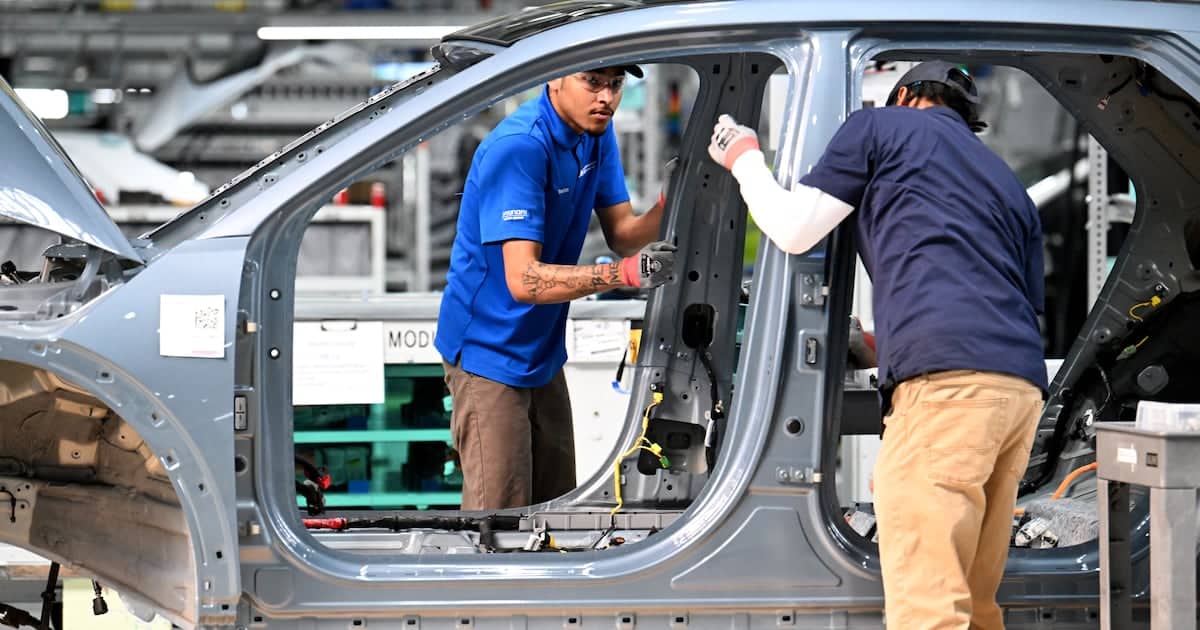
Hyundai Motor Group’s Metaplant America in Bryan County, Georgia, has reached 4,420 total jobs across the companies operating on site as the complex adds hybrid vehicle production without altering its long-term manufacturing targets, the company told North Atlanta Star this week.
Hyundai confirmed the plant remains on track for its goal of 500,000 vehicles annually and 8,500 jobs by 2031.
Hiring progress at the Georgia complex
Hyundai Motor Group Metaplant America said approximately 2,200 people have now been hired directly by HMGMA, while employment among all eight companies operating at the Bryan County site has reached 4,420 .
That puts the complex at 52% of its goal of creating 8,500 jobs by 2031, according to the company.
The facility near Savannah has become one of the largest manufacturing projects in Georgia history since groundbreaking.
Hyundai says its growing push into hybrid vehicles is not reducing the production or employment targets attached to its massive Georgia manufacturing complex.
That update matters because the plant was originally pitched almost entirely as an electric vehicle operation, and its pivot toward gas-electric models reflects a broader shift across the industry, one GCN has tracked as hybrids claimed a record share of new US vehicle sales this year.
A flexible line built for multiple powertrains
Hyundai is broadening the original electric-vehicle-focused plant into a more flexible manufacturing operation capable of producing EVs and hybrids as consumer demand changes.
The assembly system is designed to handle multiple models and powertrains on the same line. The Metaplant currently produces the all-electric Hyundai Ioniq 5 and Ioniq 9 as well as the Kia Sportage hybrid.
Hyundai said the addition of hybrid vehicles has not changed its long-term production goal of 500,000 vehicles a year at the site, telling North Atlanta Star that “Once we are up to full production, HMGMA will produce approximately 500,000 vehicles and a model mix of up to 10 vehicles.”
The flexible setup mirrors strategies automakers elsewhere are pursuing as they hedge against swings in EV demand, a dynamic also shaping decisions like automakers pushing rebates to keep electric models moving off dealer lots.
Context: tariffs and a possible bigger expansion
The jobs update follows months of discussion about expanding the Metaplant’s capacity well beyond its current scope.
In August, Hyundai CEO José Muñoz told CNBC the company is considering plans to increase the expected production capacity at its Georgia Metaplant from 500,000 units to between 700,000 and 800,000 units by 2028 , which Muñoz told CNBC would make it the largest vehicle assembly operation by capacity in the U.S., overtaking other facilities from companies such as Tesla and Toyota Motor .
Muñoz linked that potential expansion directly to trade policy, saying “Tariffs are helping accelerate our localization plan. That’s very, very simple,” he said. “The good thing is that we had already started before tariffs were announced. So in a way it’s helping us to accelerate.”
Why the manufacturing mix matters
The $7.6 billion Metaplant, first announced in 2022, has become a bellwether for how automakers retool factories built for one technology to handle another as market demand shifts.
Any further capacity decision would fall within Hyundai’s plan to invest $26 billion in the U.S. through 2028 .
Hyundai has targeted a goal to produce at least 80% of the vehicles it sells in the U.S. domestically by the end of this decade, up from roughly 40% in 2024 .
For now, the near-term headline out of Bryan County is less about a formal expansion announcement and more about steady hiring and line flexibility.
Those are metrics Hyundai says confirm the plant’s original production targets remain intact even as its product mix evolves.
