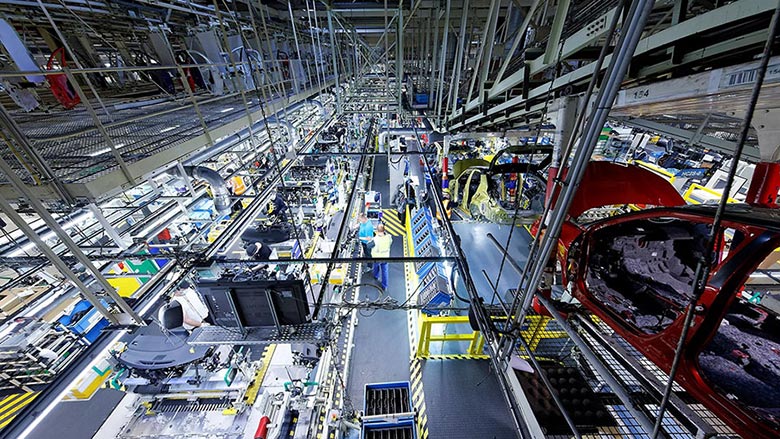
A single welding line can swallow a pickup truck frame one minute and a compact SUV shell the next, with no pause between them.
No conveyor stops. No crew swaps tooling by hand.
No shift is lost to a changeover.
Inside the cage of robotic arms, something switches automatically between one body style and the next.
What actually flips over in those few seconds is the real story.
How a single line builds three different vehicles without stopping
The trick is not speed, it is memory. Modern welding robots on a flexible body shop do not carry a single fixed task; instead each one carries a library of programs holding the exact grip points, weld locations and clamp pressure for a specific model, so switching vehicles means loading new instructions, not swapping a machine.
That shift from hardware based tooling to software defined fixtures turned car plants from single model factories into flexible ones. Older body shops used dedicated steel jigs built for one body shape, so changing models once meant tearing out fixtures and rebuilding the line for weeks.
A programmable system instead uses adjustable clamps and sensors that reposition themselves.
So when a frame rolls in, vision systems scan it, confirm the model, and trigger the matching program before the first spot weld fires. Because the robots were engineered to flex across a family of shapes from the start, the changeover happens in software, not steel.
Inside a plant built to run three vehicles on one floor
At the Belvidere Assembly Plant in Illinois, this flexible setup was not a future promise but the shop floor as it existed for years. In 2006, the factory became the first Chrysler plant to use a body shop consisting entirely of robotics. The 780 robots in the body shop could make necessary tool changes automatically, within a 47-second cycle time.
That number matters because it sits inside the normal pace of assembly, so switching models never forces the line to idle.
The factory is capable of building three models of vehicles as well as test-building a fourth vehicle, meaning it could respond to shifting demand without a dedicated rebuild. Other automakers chase the same target differently: a flexible welding line built for a Ford-badged pickup program in China uses a flexible and removable fixture loading table that can be easily reconfigured for different assembly tasks and parts, with an aggressive average switching cycle time of 50 seconds , a number close to Belvidere’s.
The decades of trial and error behind rapid tooling swaps
None of this spending happened overnight, and the roots trace back further than most car buyers would guess. The discipline behind rapid tooling swaps began on stamping presses, where Toyota found that the most difficult tools to change were the dies on the large transfer-stamping machines that produce car vehicle body parts, which must be changed for each model, weigh many tons, and must be assembled in the stamping machines with tolerances of less than a millimeter.
Those exacting tolerances meant early changeovers consumed entire shifts.
Engineers who have studied the history describe it as a steady compression of hours into minutes across generations of machines, rather than a single breakthrough. Toyota decreased changeover times from hours to fifteen minutes by the 1960s, three minutes by the 1970s, and ultimately just 180 seconds by the 1990s, a compression that later spread into welding robotics industry wide.
Where the flexibility still runs into limits
Even so, flexible lines are not unlimited. Fixtures still have to physically fit every body shape in rotation, which limits how different those vehicles can be. A compact sedan and a full size truck generally still need separate lines, because the geometry gap is too wide for one set of adjustable clamps to bridge economically.
There is also a cost the flexibility hides: programmable robots and reconfigurable fixtures carry a steeper upfront price than fixed tooling, so plants only recover that investment when volumes justify running several models through the same expensive cell for years. That is part of why flexible body shops tend to appear at larger plants built to juggle several nameplates rather than at single-model lines.
What this means for the next wave of factory investment
None of that has slowed the shift. As automakers juggle gas, hybrid and electric versions of the same nameplate, a flexible body shop lets one roof cover all three without separate buildings, which is increasingly the difference between a plant that survives a demand swing and one that gets idled.
That flexibility also connects to decisions happening well beyond the welding cage.
Commercial buyers watching the shift toward electric platforms have already seen how built in data tracking on new electric vans changes ownership costs long after the plant ships the vehicle. Meanwhile the sales side is adjusting too, something visible in how electric vehicle sales share has swung sharply across recent quarters as plants built for multiple powertrains let automakers react fast.
So the next time a new model badge shows up in a familiar factory town, the real change probably is not a new building going up. It is likely a line already standing there, reprogrammed in under a minute to build something else entirely.
