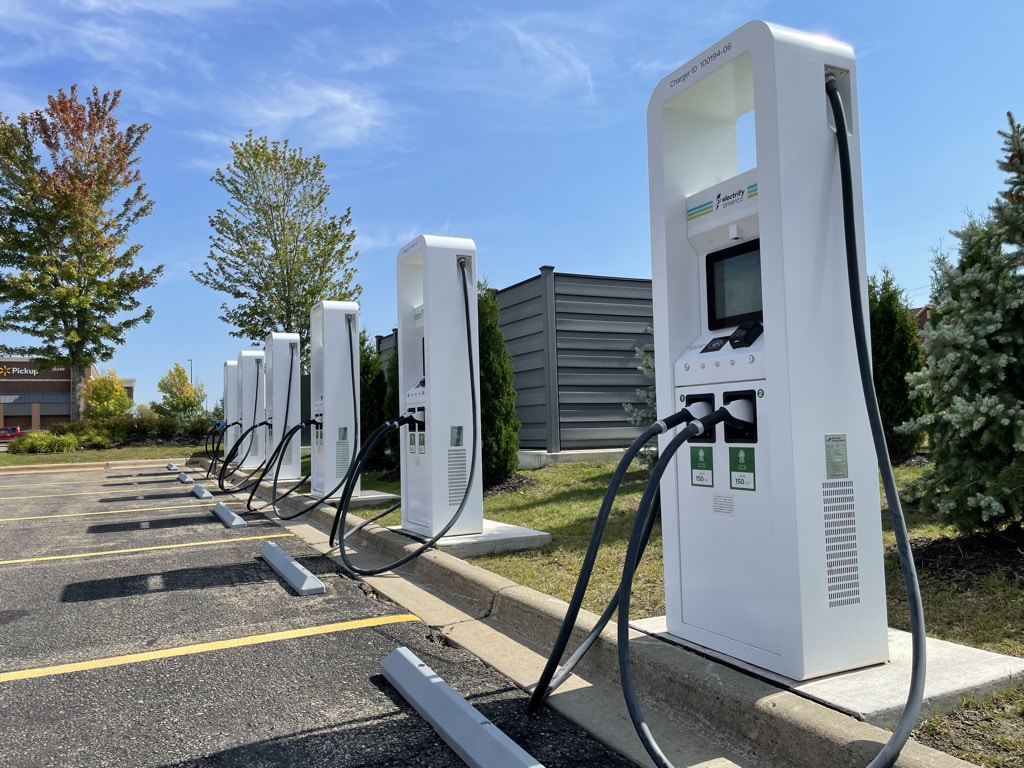
A driver pulls off the interstate near Durham, North Carolina, and finds something new at this exit.
A canopy of fast chargers with a coffee counter and clean restrooms.
The cable she grabs is not the industry leader’s.
It belongs to a network built jointly by eight rival automakers.
Less than a year ago there were roughly 80 of these stops nationwide.
So why are competing car companies suddenly building chargers together?
Pooled money is the mechanism behind the surge
The mechanism behind the surge is pooled money. Building a single fast charging site with reliable 400 kilowatt hardware, canopy lighting and a food partner can run into the millions, a cost no single automaker wanted to absorb alone while EV demand wobbles.
So BMW, GM, Honda, Hyundai, Kia, Mercedes-Benz, Stellantis and Toyota split the bill instead, forming a joint venture called Ionna that spreads construction costs and risk across eight balance sheets rather than one. That shared funding model let the network move faster than any single brand’s in-house charging push ever could.
Instead of each automaker quietly building its own small, proprietary network, the group agreed on one shared standard, one build-out plan, and a common goal of 30,000 stalls by 2030. Which is why the partnership with a national convenience chain matters so much.
Since announcing that retail tie-up with Circle K in April, the company has brought 40 of those locations online. Real estate that already pulls drivers in for coffee and gas became instant charging infrastructure instead of empty lots waiting years for permits.
What 180 charging stops actually look like on the ground
Picture a typical site and it looks less like a gas station and more like a small transit hub. Canopies shade a handful of dual-head stalls per location, built to push up to 400 kilowatts into a battery, fast enough to add real range during a bathroom break rather than a long layover.
Even so, the network has leaned hard into convenience over raw size. It continues to rapidly expand its US footprint, now operating more than 180 sites nationwide, more than double since January, a pace that outstrips most rival buildouts this year.
None of that scale matters if drivers cannot use it with the car they already own. That is where the group’s decision to skip building its own app paid off. Support now stretches across 19 separate automaker and third-party apps.
And the discounts are no longer limited to the founding brands that paid to build it. GM and BMW drivers already get charging discounts, while Hyundai and Mercedes-Benz drivers will now enjoy new ones too.
The scorecard that proves the strategy is working
None of this would matter without independent proof the chargers actually work when a driver needs them. That proof arrived this year in the form of a satisfaction ranking most new charging networks never crack in their first year of eligibility.
The network earned the top spot among DC fast chargers in a national public charging satisfaction study, in its first year of eligibility, a detail our own earlier coverage laid out in full.
That score sits inside a broader public ports count that has been climbing across every network, something our earlier reporting tracked as the national total crossed a quarter million plugs this year.
The company’s own anniversary announcement, filed through a national wire service, put a harder number on the buildout. It said the network has more than doubled since the start of the year, growing from 80 sites in January to over 180 now, with its total site count on pace to top 200 by year’s end.
Where the shift stalls and why one network still leads
None of this means the industry leader has lost its grip. Its Supercharger network remains the largest fast charging system in the country by a wide margin, and that scale is not vanishing anytime soon.
But the share is moving, slowly and steadily, in one direction. Independent trackers of nationwide stall counts found it remains largest with 35,682 stalls and a 52.5 percent share at the start of this year, down from 57 percent at the start of last year.
If that trend holds, the leader could fall below half within several months. The gap is closing from both directions at once, industry trackers note.
The leader keeps adding stalls at a rapid clip, yet the overall pool of fast chargers is growing even faster as rivals build out in parallel, diluting any single network’s share. A joint venture answering to eight corporate boards also moves more cautiously than one company chasing a single CEO’s targets.
What it means for a driver choosing where to plug in next
For an ordinary driver cross-shopping a new EV this fall, the practical upshot is simple. The charging map looks less like a single dominant network with scattered alternatives and more like a genuine three or four way contest.
That competition tends to push reliability up and prices down over time, which is exactly what stalled early EV adoption in the first place. Because the new network skipped building a proprietary app, switching between it and rival fast chargers requires little more than the automaker app already on a driver’s phone.
That is why the next twelve months matter more than the last. If the joint venture keeps doubling at anything close to this year’s pace, it could credibly rival the biggest independent networks by next summer, giving American drivers a real second home for a fast, reliable charge.
