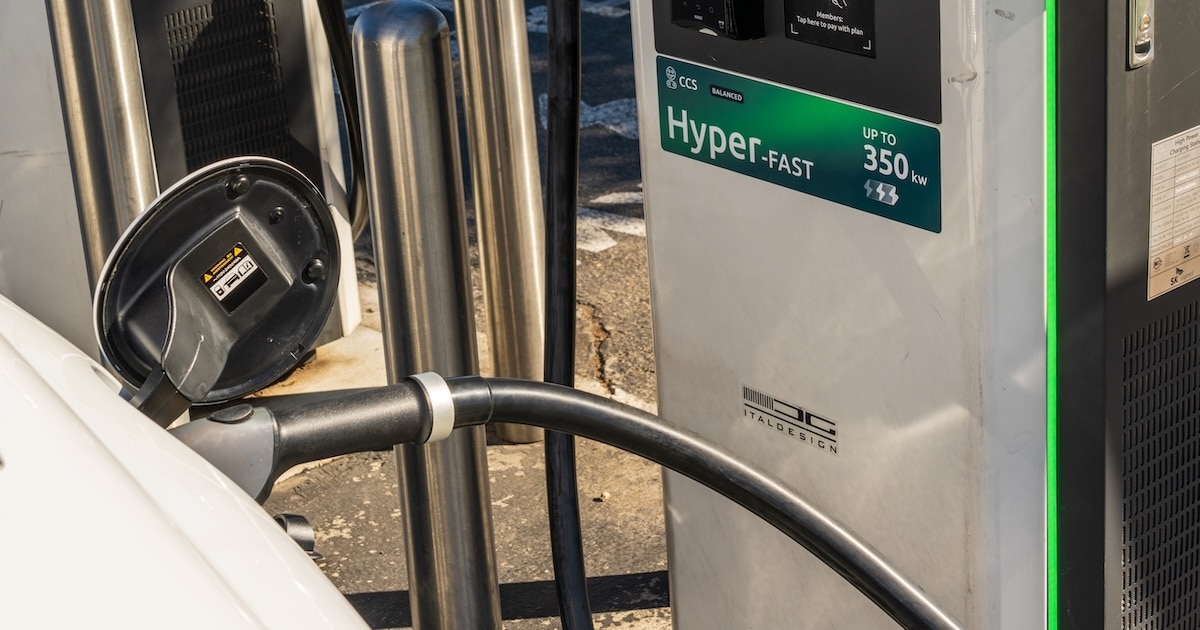
A driver pulls into a shopping center charging stall and skips the bulky adapter sitting in the glovebox.
The slim connector now in hand used to belong to only one brand of car.
That small plastic plug is becoming the center of a much bigger fight.
Behind it sits a quiet reversal in how public charging companies are betting their money.
Across the country, stalls built for one plug shape are being swapped for another.
So what made an operator tear out hardware it only just finished installing?
Why charging companies are ripping out plugs that still work fine
The short answer is that drivers stopped buying the cars those plugs were built for. For years, the combined charging standard known as CCS was the default connector on nearly every non-Tesla electric vehicle sold in America, so networks built their stalls around it. That assumption is now collapsing fast.
Automakers from Ford and GM to Rivian and Hyundai have spent the past two years switching new models to the rounded Tesla-style plug, officially called the North American Charging Standard, or NACS. Once enough vehicles on the road carry that port built in, a stall wired only for CCS starts looking like a gas pump missing a nozzle half its customers need.
So a Los Angeles based operator that for years ran one of the country’s largest public fast-charging networks outside Tesla is now retrofitting its own stations. After its successful 2025 pilot, during which the company installed nearly 100 NACS connectors across 22 major metropolitan areas, EVgo plans to accelerate deployment to reach more than 500 NACS connectors installed by the end of this year.
That is not cosmetic. It is a bet that the adapter era for EV charging is ending.
Where the new connectors are actually landing
The operator is not scattering these connectors evenly. In 2026, EVgo intends to deploy additional NACS stalls in key markets with increasing NACS vehicle penetration including Austin, Houston, Las Vegas, Orlando, Phoenix, Chicago, Dallas, Detroit and San Francisco, and by the end of 2026, EVgo plans to offer NACS charging in more than 25 states. That means busy urban stations could end up majority NACS within a year.
Meanwhile the operator is pairing this hardware shift with new real estate. Recent flagship charging sites built alongside fleet charging partners now mix both plug types under one canopy, letting a Tesla and a Chevy Bolt charge side by side without either driver carrying an adapter.
That matters because convenience, not stall count, is what keeps drivers loyal to one app over another in a crowded market.
The number behind the bet, and where it comes from
The operator’s own projection is the boldest part of this story. With more than 80% of new EVs sold in North America expected to be NACS compatible by 2030, EVgo’s NACS deployment plans are designed to broaden its existing customer base and increase throughput while meeting anticipated consumer demand , a forecast that, if it holds, would make CCS a legacy format within a handful of model years rather than the default it was built to be.
That forecast is not coming out of nowhere. Nearly every major automaker except a handful of holdouts has committed to the plug, and total public charging ports have climbed past 250,000 nationwide this year.
Software matters just as much as the connector shape. The company detailed its progress in a recent press release noting rising NACS throughput on its network, proof drivers prefer skipping manual steps whenever they can.
Why this shift still has real limits
None of this means CCS disappears overnight. Millions of older vehicles already on US roads, including older Ford, Hyundai and Kia models, will need either an adapter or a dedicated CCS stall for years, so networks cannot simply rip out the older hardware.
Because of that, most CCS drivers can still use the new infrastructure through the automatic session app. Most EV drivers with CCS vehicles can also enroll in the operator’s automated payment system, which has enabled millions of charging sessions since its launch a few years ago.
Even so, the retrofit carries real cost and risk. Every new connector installed is money not spent adding brand-new stalls elsewhere, and if automaker plans shift again, a network could end up overbuilt for one shape just as it did with the last one.
That tension plays out at rival networks and automaker-backed chargers alike.
What it means for drivers choosing where to plug in
For an ordinary driver shopping for an EV today, the plug shape that once decided which networks worked for your car matters far less than it did two years ago. A Tesla owner and a GM owner can now realistically charge at the same stall.
That convergence helps explain why automakers have leaned so heavily into cross-brand charging deals, pairing EVs like the Chevy Bolt with networks once built for a single brand.
Still, the shift rewards planning over assumption. Drivers cross-shopping an EV should check which connector their specific model ships with, since the physical port on a window sticker still determines which chargers plug in without extra gear.
Public charging has stopped being a one-size-fits-all business, and for now the smart money is lining up behind the plug that started on one brand of car and is becoming everyone’s default.
