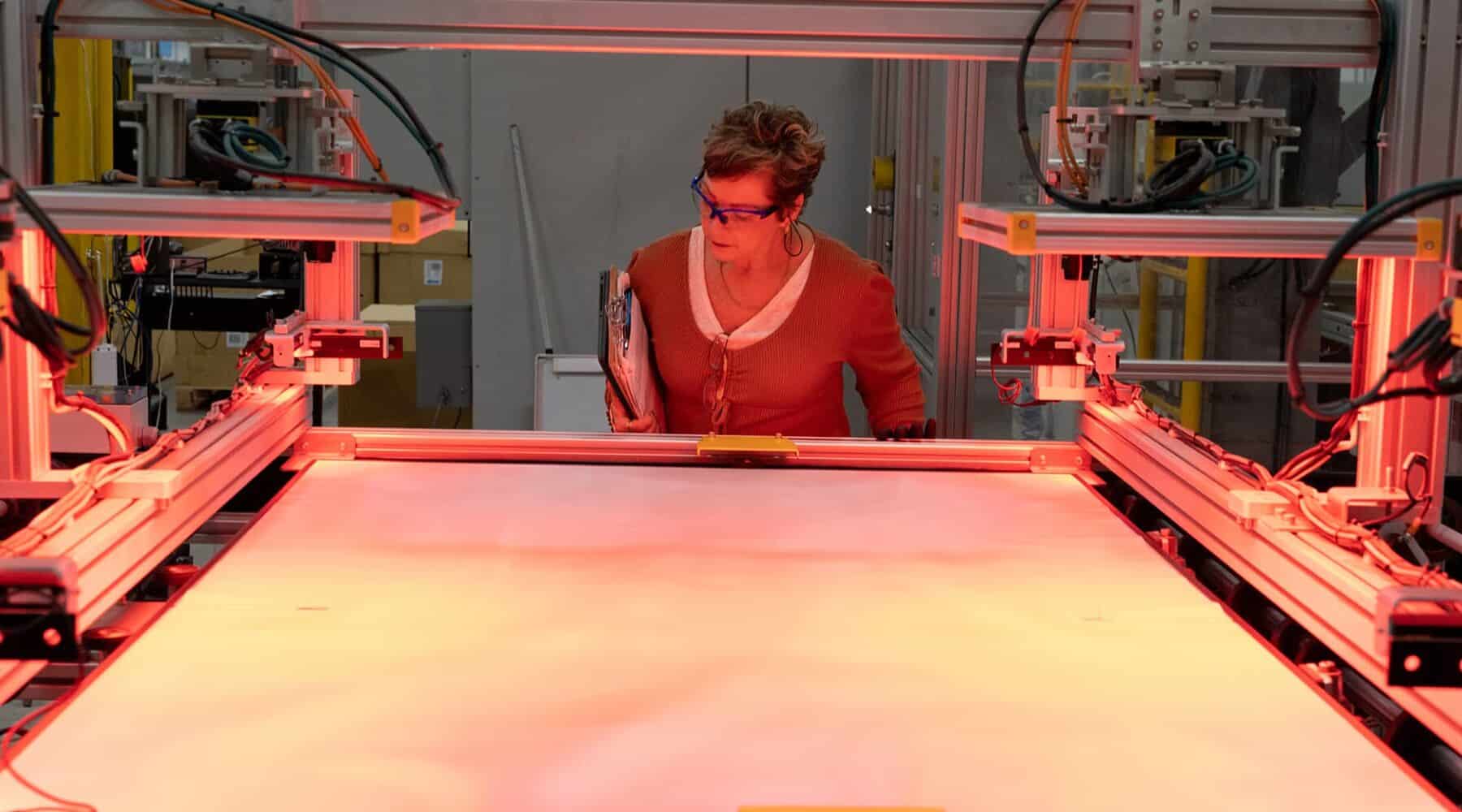
Inside almost every high-efficiency solar cell sits a nearly invisible layer of metal oxide, thinner than a human hair.
That layer holds the entire device together electrically, and it has quietly become a chokepoint for the industry. A team of researchers just built a commercial-size cell that works without it, using a far cheaper substitute instead. The cell still hit a certified efficiency above 31 percent.
So how does a panel lose its scarcest ingredient and come out ahead?
The hidden layer that both connects and damages the cell
Tandem solar cells stack two light-absorbing materials, typically a perovskite layer on top of a silicon layer, so each one captures a different slice of sunlight. Between and around those layers sits a transparent conductive layer that has to do two jobs at once: let light through and carry current out.
For two decades the industry’s default choice has been indium tin oxide, prized for being both clear and conductive. That same layer is also where the trouble starts, since indium-based conductive oxides are widely used as electrodes and recombination layers in perovskite and silicon tandem cells, yet their scalability is constrained by indium scarcity and sputtering damage.
The standard way of applying it, called sputtering, fires energetic particles at the wafer to build the film atom by atom. Unlike conventional sputtering, which bombards the target with high-energy ions that can damage sensitive materials such as perovskites , the process routinely punches into the delicate perovskite layer sitting just beneath, degrading the material the cell depends on for its efficiency gains.
The new approach instead replaces the damaging material itself, swapping indium tin oxide for a tin oxide film applied through a gentler technique called reactive plasma deposition. RPD is a vacuum-based thin-film coating technique in which a plasma generated from oxygen reacts with evaporated metal atoms to form a metal oxide film, generating lower-energy particles that allow dense, conductive oxide films to be deposited with minimal damage to the underlying layers.
Why the swap matters on the factory floor, not just the lab bench
Indium is not mined on its own. It turns up almost entirely as a byproduct of zinc refining, which means supply can’t simply expand to meet solar demand no matter how badly a factory needs more. Every panel built the old way carries a supply constraint baked in long before a single cell reaches a production line.
Tin carries no such baggage. It is mined directly, traded as a bulk commodity, and priced accordingly, which is why study co-lead Yuan Cheng described the swap as “a highly viable engineering route for low-cost, sustainable and scalable tandem photovoltaics.”
The cost gap is stark. Tin costs about 1 percent as much as indium.
A factory running gigawatts of annual output through sputtering chambers buys enormous quantities of conductive oxide target material every year, and even a modest cost cut per cell compounds fast across millions of wafers. Cutting that input cost so sharply reshapes the economics of the whole deposition step, not just one lab sample. None of that solves anything if the cheaper material performs worse, so the real test was whether a tin oxide layer could still move current as efficiently as indium tin oxide does, across a cell large enough to resemble something a factory could actually build.
What the certified test results actually showed
The team built cells using reactive plasma deposited tin oxide as both the connecting layer between the two subcells and as the outer electrode, making the device fully free of indium. Those fully indium-free tandems delivered a champion power conversion efficiency of 33.2% (1 square centimeter) and a minimodule with a certified efficiency of 31.0% (207.9 square centimeters).
A minimodule built the same way reached a certified efficiency of 31.0 percent across 207.9 square centimeters. That second number is the one that matters for industry watchers, since tiny lab cells routinely post flashy figures that evaporate the moment anyone tries to scale them up.
Durability testing backed up the headline number. The indium-free minimodules exhibited high thermal, damp-heat, and outdoor operational stability and retained 65% of their maximum initial efficiency after 105 days of outdoor operation.
Separate accelerated aging pushed the cells harder still. Blade-coated minimodules maintained 94% of that efficiency after 1000 hours of maximum power point tracking at 85°C. The findings were published in the journal Science, where the research team laid out the full device architecture and testing protocol behind the certified numbers.
Where the limits sit and why the industry can’t ignore the clock
The devices withstood heat, humidity and more than three months of outdoor operation while maintaining strong performance , which tells engineers how a panel performs through one season, not how it ages across the long warranty periods that utility buyers expect from commercial solar installations. End of life questions remain just as open, since the work does not address what happens to these layers once a panel is retired, and how cleanly a tin oxide film separates from silicon during recycling has not been tested at all.
Recycling questions tend to get ignored early and expensive later, once millions of panels are already installed.
The pressure to solve this is not abstract. An international energy agency’s own materials modeling frames the stakes bluntly: indium demand will outstrip global reserves by the mid-2040s under all deployment scenarios, making it necessary to replace indium in transparent conductive oxides to achieve terawatt-level annual PV deployments.
That is the same supply math showing up elsewhere in solar’s domestic buildout, where US polysilicon fell from half of global output to a sliver in two decades once a single input became a bottleneck. Factories retooling cell lines already face enough disruption from tariffs and technology bets, a pattern visible in disputes like the recent TOPCon patent fight over rival cell architectures.
What it means for panels still years from a rooftop
None of this changes a panel installed this year. The cells on today’s rooftops and utility farms still rely on conventional indium tin oxide, and that will not shift overnight even with a strong lab result in hand. Manufacturing conversions take years, not months, and qualification testing alone can run longer than the entire outdoor trial described above.
What changes is the ceiling on how far tandem technology can scale once indium threatens to become genuinely scarce.
A material swap that costs a fraction as much, protects fragile layers during manufacturing, and still clears 30 percent certified efficiency gives factory planners a credible path that does not depend on a metal pulled as a side product of zinc mining. That matters most for the next wave of ultra-efficient panels aiming past the limits of silicon alone, and if tin oxide proves itself at full module scale with multi-year outdoor data to match, it could remove one of the quietest constraints standing between today’s solar industry and the terawatt-scale buildout planners are already counting on.
