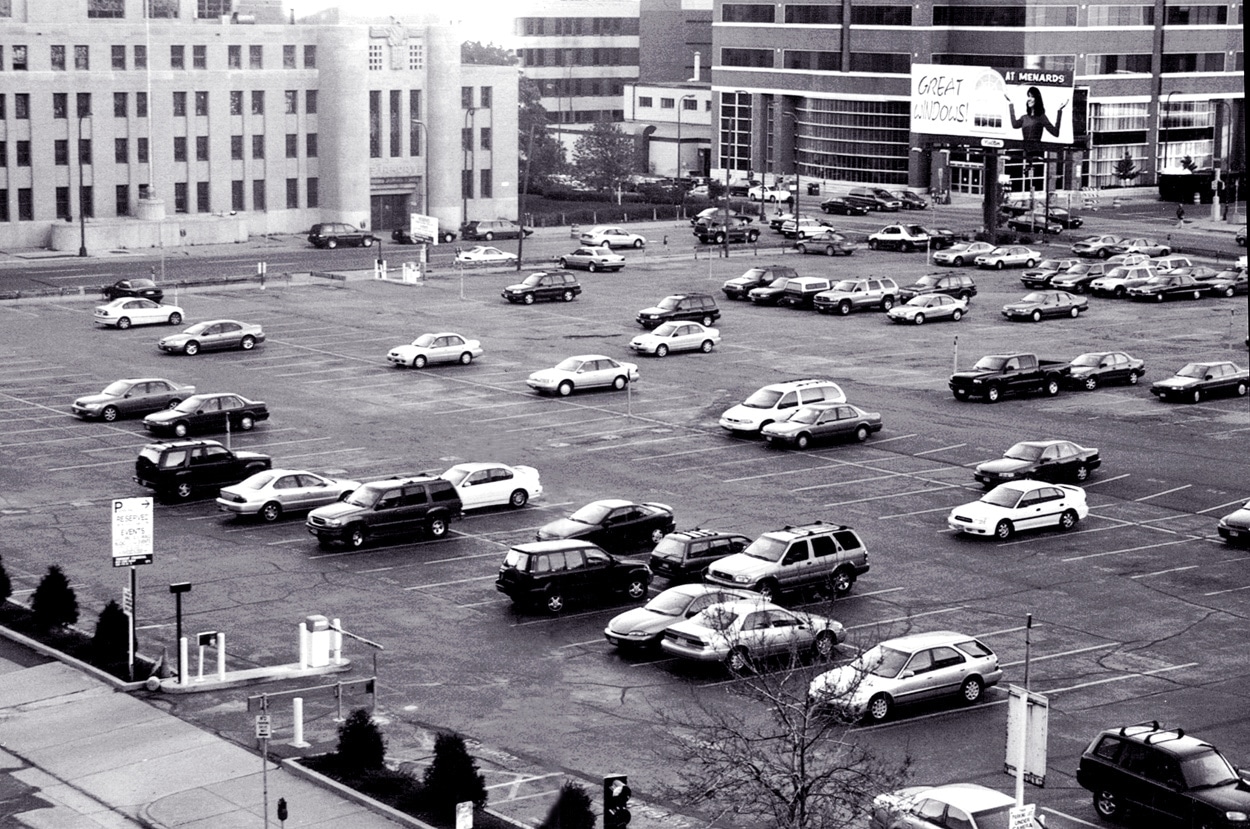
A single sedan sits alone near the entrance of a strip mall lot built for two hundred cars.
Behind it stretch rows of empty white lines, baking in the sun most of the day.
Nobody budgets for that blank asphalt the way they budget for gas or insurance.
Yet somebody is paying for every one of those painted rectangles.
Transportation researchers have finally put a number on exactly how much.
Why a parking space costs money even when no car ever uses it
Every parking space, whether it sits full or empty, still has to be built, paved, lit, striped, drained and maintained. That upkeep does not pause just because the spot sits vacant for eleven hours of a twelve hour day, which is the ordinary life of most suburban parking.
According to transportation economist Todd Litman’s comprehensive national analysis, typical North American communities have three to six parking spaces per vehicle, including many that are mandated but seldom used.
That is the mechanism in one line. Cities require far more parking than drivers ever use at once.
Each extra spot still carries a real annual price tag. Litman’s accounting finds parking costs average about $1,200 annually per space or about $5,000 per vehicle-year, totaling more than a trillion dollars per year in the U.S. , almost none of it visible on any receipt.
What a parking lot actually looks like once you count the spaces
Picture a commuter’s daily parking footprint: a driveway space at home, a spot in the employer’s lot, a few more scattered across the grocery store, the gym and the restaurant where she grabs dinner. Each one sat ready for her car long before she arrived and will sit empty again the moment she leaves.
That stacking effect explains why national estimates run so high. Research by engineers Chester, Horvath and Madanat, cited in Litman’s work, used various assumptions to estimate that in 2010 there were 105 million to 2.0 billion parking spaces in the U.S., averaging 0.5 to 8 spaces per vehicle , depending on the scenario and the city.
The land underneath carries value too.
Separate inventories have put urban land under parking near destinations among the costliest ground in any city, land that could otherwise hold apartments or storefronts. That tension helps explain why so many Americans remain frustrated with their daily travel options, a theme this desk has tracked in reporting on why most Americans are unhappy with their commute choices.
Where the trillion dollar figure actually comes from
The headline number is not a guess pulled from one source. It synthesizes decades of research going back to economist Donald Shoup’s foundational work on The High Cost of Free Parking, combined with newer satellite based inventories of parking supply across major metro regions.
Shoup’s own earlier accounting estimated that the subsidy for off-street parking in 2002 was between $127 billion and $374 billion, or between 1.2 percent and 3.6 percent of the gross domestic product. Add on-street parking and the total likely runs higher still, before Litman’s newer synthesis pushed the comprehensive figure past the trillion dollar mark.
Put simply, for every dollar motorists spend on their vehicles somebody spends about a dollar on parking.
A separate, much less rigorous valuation by a parking-space rental marketplace, ParkingCupid.com, reached an even larger figure in an early marketing report, which marked to market value America’s 800 million car spaces at $20,800 each, a total of US$17 trillion dollars , distinct from the annual operating cost Litman calculates and far less methodologically grounded.
Where the estimate gets shakier and who disagrees
Even researchers who study this closely admit the undercount problem is real. Sources probably underestimate total parking supply and costs, including spaces that are unrecorded in property tax records and permit data, missing informal lots, church parking, and spaces behind strip malls that never show up in any database.
So the national range stays genuinely wide.
That uncertainty ripples straight into the dollar figures built on top of it, since costs vary enormously by location. Considering land, construction and operating expenses, annualized costs per space typically total from $600 for basic surface parking on inexpensive land to more than $5,000 for high-amenity structured parking , with Litman’s analysis specifically noting costs range from $854 in suburban areas with low land prices up to $2,522 in a three-story urban parking structure.
A commuter parking at a downtown tower is therefore subsidizing a far pricier spot than someone at a suburban strip mall, even though neither pays anything at the curb. None of this accounts for shifting habits either, a trend this site has followed in coverage of how occupancy now peaks on only three weekdays, leaving employer lots fuller some days and nearly empty others.
What the trillion dollar number means for drivers going forward
The practical takeaway is not that parking should disappear, since cars still need somewhere to sit. It is that the current system hides an enormous hidden cost inside rents, grocery prices and property taxes rather than charging drivers directly for the space they use.
Several cities have already started testing an alternative, stripping away minimum parking requirements and letting developers build fewer spaces where transit or walkable blocks make that possible.
Early results suggest rents can ease slightly once buildings stop being forced to include parking nobody asked for.
Even so, most zoning codes still assume every household needs guaranteed parking everywhere it goes, an assumption baked into American suburbs for generations. That is exactly what keeps the trillion dollar bill quietly circulating through the economy, and the empty spot beside your car was never really free.
