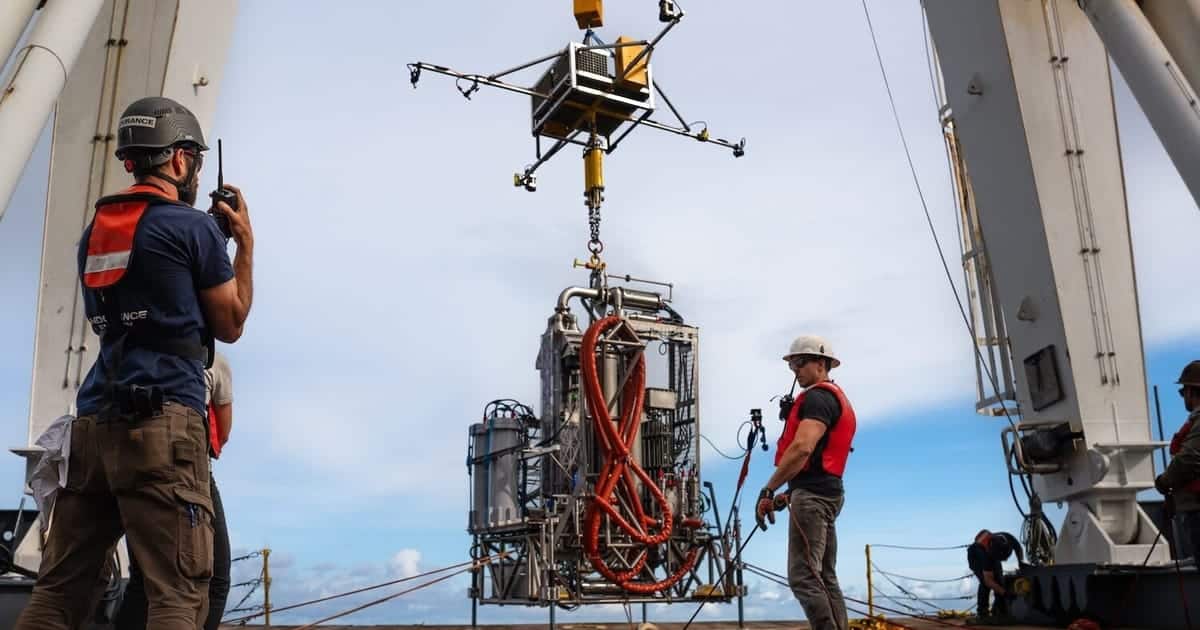
A Seattle startup has drilled what it calls the world’s first subsea geothermal well and briefly generated net-positive electricity from an active underwater volcano nearly a mile beneath the Pacific Ocean.
Endurance Energy announced on October 19 that its test unit, named Adélie, completed the first full demonstration of drilling, power generation and remote control entirely on the seafloor.
What happened at Axial Seamount
Seattle-based geothermal technology developer Endurance Energy has announced the successful testing of its Adélie subsea geothermal power system at Axial Seamount, approximately 300 miles off the coast of Oregon, USA , an active submarine volcano along the Juan de Fuca Ridge.
During a three-week expedition, the company drilled and completed a geothermal well at the seafloor, deployed a compact power generation unit at a depth of approximately 1,500 meters, and demonstrated net-positive electricity generation.
During the deployment, Endurance drilled and completed a 52-foot geothermal well approximately 5,000 feet beneath the ocean surface. The well, one of two closely spaced boreholes, was completed at a depth of 16 meters and, following cementing, produced fluids at a temperature of approximately 260°C. However, the newly drilled well delivered hot fluid but was too restrictive to run the plant. Instead, the company’s three-ton Adélie power generation system was connected to a nearby natural hydrothermal vent with a fluid temperature of approximately 281°C.
The pilot achieved a peak net output of 16.5 kW, although electricity generation was sustained for only 8.7 seconds, with operational issues encountered before the demonstration could continue, though Endurance has indicated it is now working toward longer-duration operations. According to the company, the net-positive run at the nearby natural vent ended when battery overcurrent protection stopped the system, and about ten minutes later, during a restart attempt, a power cable feeding Adélie’s refrigerant pump failed, ending the dive.
The company itself described the milestone in a press release as the first time a subsea plant produced more power than it consumed.
Controlled from land over fiber optic cable
Perhaps the more striking element is that engineers never had to be at sea to run the plant. The company operated its three-ton Adélie power generation system remotely from Seattle through the National Science Foundation’s Regional Cabled Array, a subsea fiber-optic network operated by the University of Washington.
The team also tested optical and acoustic communications links and ran high-temperature hydrothermal fluid through the plant.
More than 40 water, rock, and mineral samples are now with independent laboratories for analysis.
Reporting from Canary Media noted Endurance Energy deployed its Adélie geothermal test unit from the Ocean Guardian research vessel during a demonstration run in September 2026.
A young company moving fast
Endurance was founded in January 2025 and made its first deep-sea deployment in August 2025. Adélie was its fifth deep-sea deployment in just over a year and the first to test all the steps together.
Endurance has raised USD 63 million in funding to date, including a USD 54 million Series A round led by Founders Fund.
The pitch is a geothermal resource that does not depend on the specific hot-rock geology found onshore in places like Nevada or Utah, where enhanced geothermal developers such as Fervo Energy have drawn attention for projects including the Cape Station plant.
Instead, Endurance targets volcanic seafloor systems where extreme heat sits close to the ocean floor. Once commercialized, the company says subsea systems would supply continuous, weather-independent clean electricity for coastal grids and industrial sites around the Pacific and worldwide.
Early days, with a commercial pilot already planned
The company stresses that Adélie was a test article and not a commercial-scale power plant.
Although operational issues were encountered, the demonstration still represents an important proof of concept for subsea geothermal power generation, and Endurance has indicated that it is now working toward longer-duration operations and the development of commercial-scale systems. The company has already lined up its next step: this winter, Endurance will deploy Gentoo, a refurbished and upgraded version of Adélie designed to target higher power and longer sustained generation.
A commercial pilot is planned for the Kingdom of Tonga, a South Pacific island nation whose volcanic geology makes it a natural laboratory for undersea geothermal power and which today is heavily dependent on expensive, imported diesel. By the end of 2027, the company plans to deploy a 2-megawatt unit off the coast of the Kingdom of Tonga, a significant jump from the kilowatt-level output demonstrated off Oregon. Endurance and the Government of Tonga have signed a memorandum of understanding to explore supplying geothermal electricity to Tongatapu, the country’s most populous island.
The test adds a new frontier to a geothermal sector that has drawn growing interest from utilities and data center developers seeking steady, round-the-clock power, an appetite also visible in recent contract moves such as the renegotiated California geothermal agreements tied to rising demand for firm generation.
