A warehouse-sized shell on the edge of Sacramento sits mostly empty right now.
Soon it will be stacking steel battery enclosures the size of shipping containers.
None of the cells inside them will contain lithium.
The chemistry running through this factory traces back to something closer to table salt.
A grid storage company picked California to build around one question.
How else can America actually store electricity at scale?
Why sodium instead of lithium actually works on the grid
Lithium-ion cells dominate grid batteries because they pack a lot of energy into a small space, but that density comes with a price. The cells need active cooling systems and careful thermal management to stay safe, since lithium chemistries are more prone to the runaway heating problem that has caused fires at storage sites around the country.
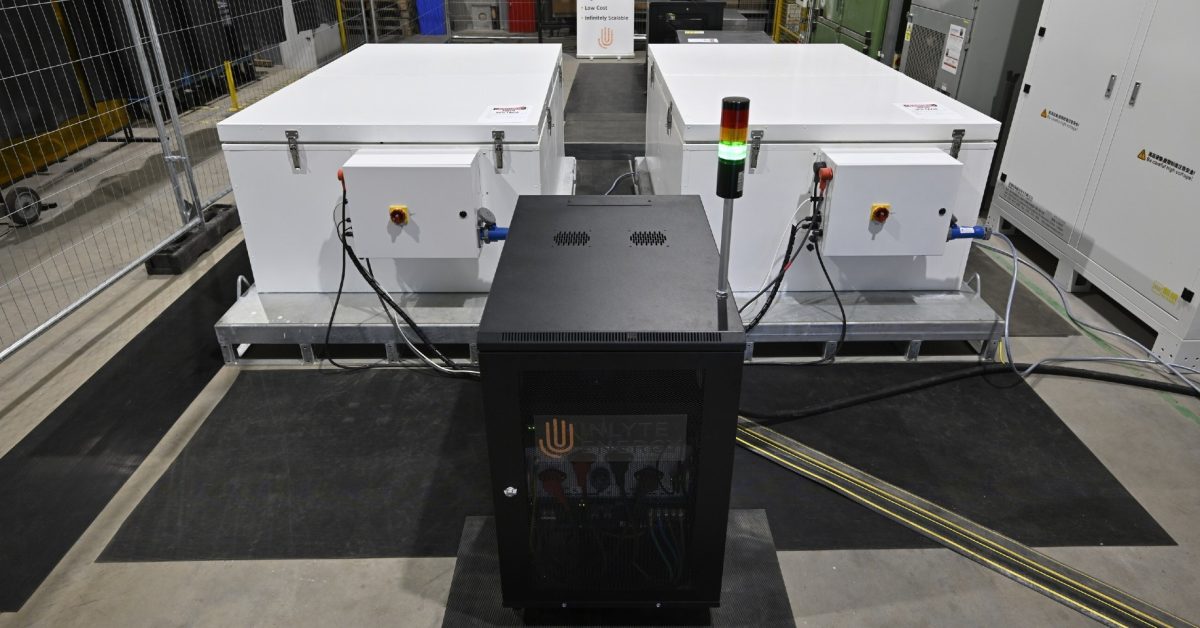
Sodium-ion cells trade some of that energy density for simplicity. The company behind the Sacramento plant, Peak Energy, builds what it calls a fully passive cooling design, meaning the system has no fans, pumps or ventilation components doing the work active cooling normally handles.
So the battery runs cooler by design rather than by constant management.
That matters for a grid asset meant to sit outdoors for two decades with minimal upkeep. Peak Energy says its system is built to run maintenance free for decades. And sodium itself is not scarce. Unlike lithium, nickel or cobalt, the raw material comes largely from soda ash, a mineral the United States holds in massive domestic reserves.
The scene inside a factory built for one battery chemistry
The Sacramento site is not a chemical plant churning out raw battery material from scratch. It is what the industry calls a system assembly facility, where finished sodium-ion cells arrive and get built into the full storage units utilities actually install.
That distinction shapes the building’s interior. Rather than vats and chemical lines, the floor holds rows of assembly stations where workers bolt cells into racks, wire them into gray steel enclosures, and test each finished unit before it ships out.
The plant covers 183,000 square feet.
It represents a $71 million investment, according to coverage of the project by a hardware news site, which tracked the announcement through trade reporting this summer. Production is expected to begin early next year, and the factory is slated to produce up to 4 gigawatt-hours of storage capacity annually, a scale that puts a single sodium-ion line in the same conversation as established lithium battery plants.
Where the hard numbers come from and who is already buying in
The Sacramento factory did not appear out of nowhere. Peak Energy first proved the chemistry worked at grid scale with a 3.5 megawatt-hour pilot system at a Colorado test facility, which the company announced last fall as the first large-scale sodium-ion battery system operating anywhere in the country.
From there the commitments stacked up fast. The company has secured more than 6 gigawatt hours in orders, including a deal with power producer Jupiter Power worth up to $500 million for as much as 4.75 gigawatt-hours running through the end of the decade.
Utilities are testing it directly too. RWE Americas energized Peak’s sodium-ion system on the Midcontinent grid in Wisconsin this past March, following the kind of non-lithium funding push backing several alternative chemistries lately. Even an automaker has joined in, as General Motors codevelops sodium-ion cells with Peak at a Michigan battery center.
Where the limits sit and what still has to be proven
None of this means sodium-ion is about to replace lithium-ion on the grid. Sodium cells store less energy per pound than lithium cells do, which is exactly why they have found a home in stationary storage, where a heavier box sitting still in a field costs nothing extra.
Even so, the commercial case still needs to survive contact with the massive wave of storage already filling the grid.
US battery installations are projected to add roughly 24 gigawatts of new utility-scale capacity this year alone, and nearly all of it remains lithium-ion, built on supply chains and cost curves that took a decade to mature. That broader buildout, tracked in the record summer demand, leaves sodium-ion a small but notable slice of a far larger wave.
What the milestone means for the grid going forward
Still, a dedicated factory changes the conversation from laboratory promise to supply chain reality. Once a company commits $71 million and a 183,000-square-foot building to one chemistry, it is signaling it expects buyers for years, not just a single pilot contract.
So the real test begins when production starts and the first commercial units ship to utility yards rather than test fields. If the passive cooling and simplified design hold up under years of daily cycling, sodium-ion could carve out a durable market niche.
That would not dethrone lithium-ion. But it would give grid operators a second credible chemistry built from a mineral the country already has in abundance, a kind of insurance for an industry racing to keep pace with demand.
