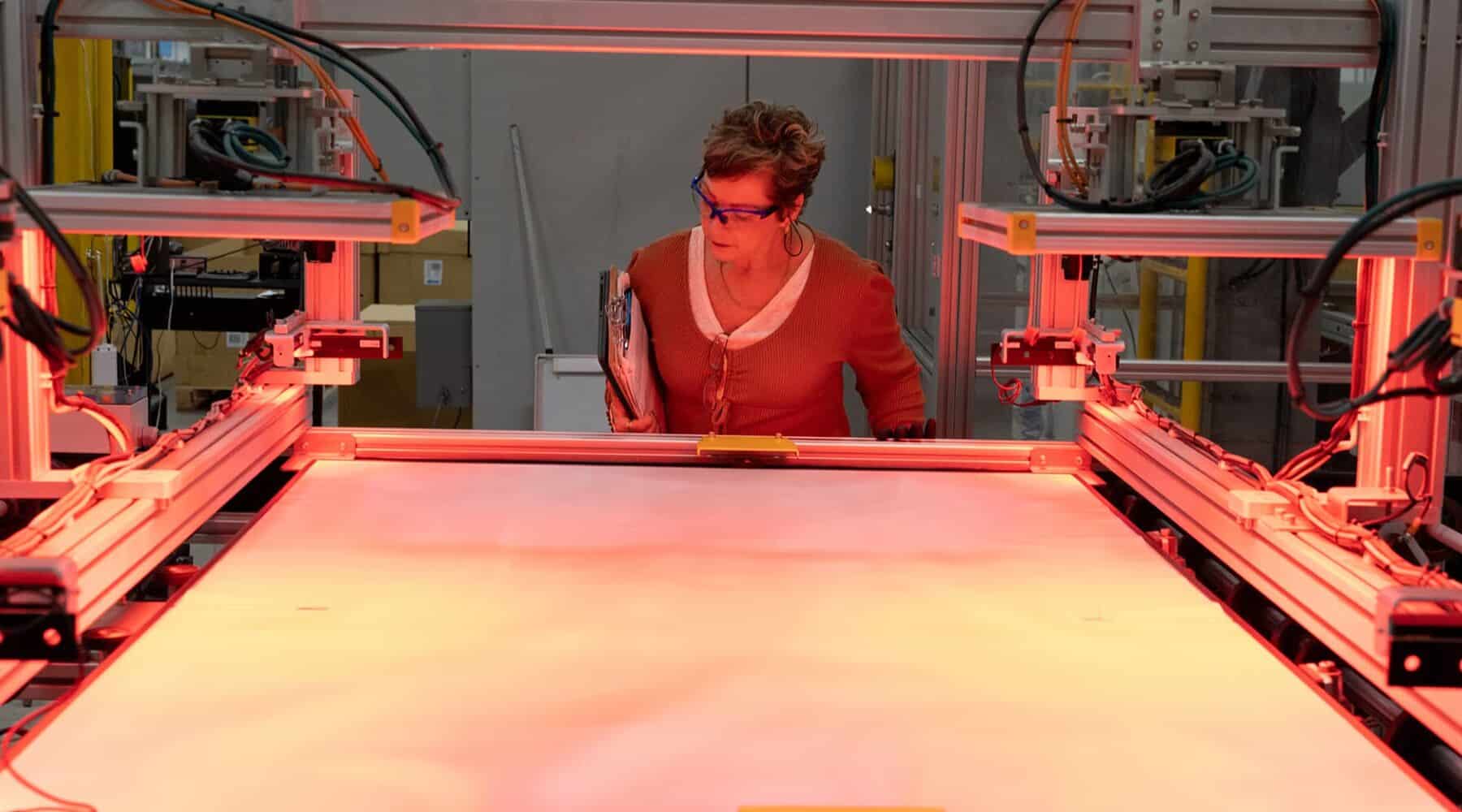
Canadian Solar said it will expand its heterojunction solar cell factory in Jeffersonville, Indiana to 6.3 gigawatts of annual capacity.
Trial production for the second phase is set to begin in the first quarter of 2027. The company disclosed the expansion timeline in its second quarter 2026 earnings report, filed with the Securities and Exchange Commission in August.
Phase two adds 4.2 gigawatts
The quarter’s marquee development was the July 2026 opening of Canadian Solar’s flagship heterojunction (HJT) solar cell factory in Jeffersonville, Indiana, which the company describes as the largest crystalline silicon solar cell facility in North America. Phase I has a nameplate capacity of 2.1 GWp and is the first commercial-scale HJT solar cell facility in the U.S.
The Company expects to begin trial production for Phase II in the first quarter of 2027. This expansion will add 4.2 GWp of capacity, bringing the Company’s total solar cell nameplate capacity in the U.S. to 6.3 GWp.
Canadian Solar CEO Colin Parkin said the July opening marked a historic milestone, as Canadian Solar became not only the first commercially operational HJT manufacturer in the United States, but also a meaningful contributor to the local economy and community development. In addition to ramping up the Phase I capacity of 2.1 GWp, the company will start installing equipment for Phase II before the end of the year, bringing total nameplate cell capacity to 6.3 GWp in the first half of 2027.
This will position CS PowerTech as the largest crystalline silicon cell manufacturer in North America.
When combined with its 10 GWp module facility in Texas, CS PowerTech solidifies its position as one of North America’s premier integrated PV manufacturers.
Filling a domestic cell supply gap
Heterojunction technology layers crystalline silicon with thin films of amorphous silicon. The design typically yields higher efficiency and better heat tolerance than the PERC or TOPCon cells that dominate most factory lines today.
Output from the Jeffersonville plant will be used by Canadian Solar’s module factory in Mesquite, Texas, with Canadian Solar expanding that facility toward 10 GW of annual module capacity, creating a more closely integrated U.S. production network between the two plants.
Parkin called the opening a milestone for the company’s US strategy, saying it marked a historic milestone, as Canadian Solar became not only the first commercially operational HJT manufacturer in the United States, but also a meaningful contributor to the local economy and community development.
The push into domestic HJT cells comes as patent disputes have complicated the use of rival TOPCon technology in the United States. On May 9, 2025, First Solar filed suit in the district court for the District of Delaware asserting that Canadian Solar Inc. and related affiliates directly and indirectly infringe a First Solar patent through Canadian Solar’s manufacture, import, use, sale, and offering for sale of certain TOPCon solar products, and sought both monetary damages and injunctive relief.
Canadian Solar has disclosed in SEC filings that it does not believe its proprietary technology infringes on the patent asserted by First Solar, and is vigorously defending itself in the lawsuit. In a related case involving a different TOPCon patent dispute, First Solar has also sued other manufacturers over TOPCon patents, part of a broader legal campaign that has added uncertainty for companies relying on that cell design.
A wider manufacturing buildout
The Jeffersonville project is part of a broader wave of new US cell and module investment tied to trade measures and the domestic content rules under the 2022 climate law. The United States has added significant solar module assembly capacity since the 2022 Inflation Reduction Act created a tax credit for advanced clean energy manufacturing, but production of cells that are assembled into panels has lagged, leaving manufacturers dependent on imports.
Other manufacturers have pursued similar waivers and capacity additions, including a separate solar cell maker that recently secured a Commerce Department waiver to import gigawatts of solar cells while US cell capacity continues to ramp.
The nearly $1 billion investment by Canadian Solar’s U.S. manufacturing arm, CS PowerTech, is expected to produce more than 6 GWp annually, support more than 1,200 skilled manufacturing, engineering, and technical jobs in Southern Indiana, once fully operational.
Canadian Solar said it is also increasing module assembly capacity at its Texas plant to 10 gigawatts a year to keep pace with the added cell output from Indiana.
