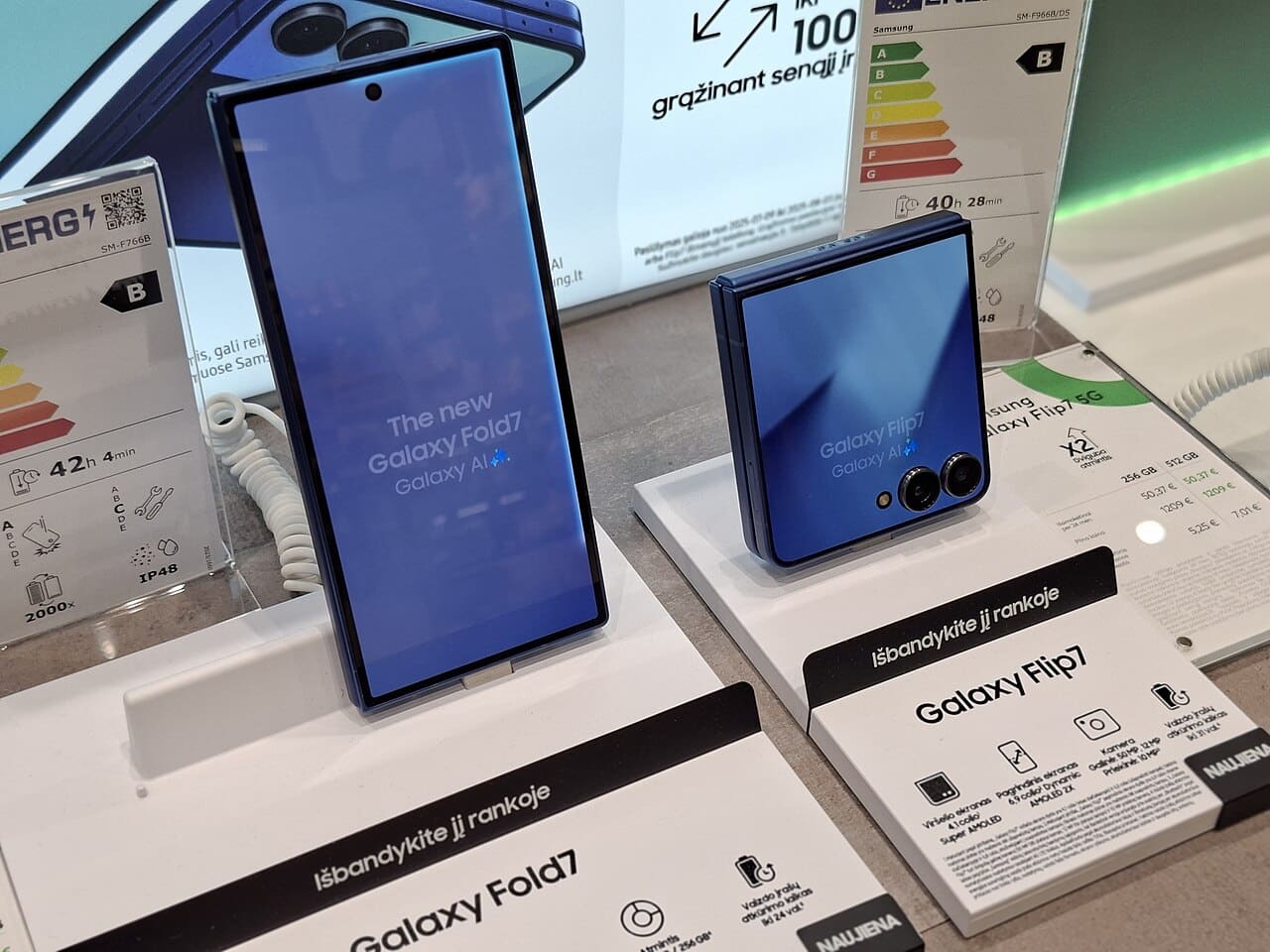
A hinge clicks shut in a showroom display case, and the screen folds in half like a paperback novel.
For eight straight years, one company has dominated that fold.
This year a rival with no folding phone history at all walked into the same aisle.
Store shelves are being rearranged because of it.
The question is simple: how does one newcomer dent a lead this wide this fast?
Why a single new entrant can move an entire market overnight
The mechanism is distribution, not clever engineering. When a company with hundreds of millions of existing phone owners adds one new model to its lineup, it does not have to win new customers from scratch. It just has to convert people who already trust its brand and were waiting for exactly this option, which is a far shorter path than building demand from zero.
That is the core shift behind the foldable category this year. Global foldable smartphone shipments are expected to grow 21% YoY in 2026, and Samsung is projected to remain the leading brand in 2026, although its share is expected to decline.
The market is projected to continue to expand from 2025, supported by continued demand for premium book-type devices, stronger product competition among leading smartphone vendors, and Apple’s expected entry into the category.
So the math is brutal for the longtime leader. The South Korean giant is expected to stay ahead of its rivals, but its own share is projected to fall from 40 percent last year into the high 30s this year even as the total market expands, with Counterpoint Research’s most recent update putting that figure at Samsung 38%, enough to rank first, ahead of Apple at 25% and Huawei at 22% . Growing slower than your rivals, inside a growing pie, still reads as losing ground.
Inside the showroom, the new three way race looks nothing like last year
Walk into a carrier store this fall and the foldable table has a third logo on it for the first time: Apple. That used to be a two horse race between the entrenched Korean leader, Samsung, and the Chinese challenger Huawei, which mostly sold at home.
Instead, Apple is forecast to take 25% of the market in 2026, enough to help it rank second , with the longtime Chinese contender close behind in third.
Because the new model arrived mid year, the first wave of buyers is still working through preorder queues and limited stock. Counterpoint’s own analysts noted that initial supply constraints for Apple’s first foldable iPhone are expected to be unavoidable , with sales and deliveries likely to ramp gradually after launch, reshaping a pecking order that had barely moved in years.
That rollout pattern matters for anyone comparing this to past phone launches. A staggered release means the full scoreboard will not be final until early next year, but the early trend line is already unmistakable in the data analysts have published so far.
The hard numbers behind the shift, and where they come from
Here is where the methodology matters. The forecast comes from Counterpoint Research, which draws on sell in shipment tracking across vendors and regions.
That is the same framework the firm has used for years to measure the broader smartphone market, including the device category this one sits inside. The firm’s most recent update projects the category will grow further as new launches land, after the firm’s initial outlook called for 21 percent growth this year.
The firm’s analysts say cumulative global foldable smartphone shipments are set to surpass 100 million units by the end of 2026 . That milestone took roughly eight years of a single company essentially building the category alone before competitors caught up, which explains why this year reads as a turning point rather than routine competition. This is in the eighth year since the launch of the first commercially available foldable in 2019.
For most of that stretch, the leader’s share sat well above half the global total, with little pressure from anyone outside China. Samsung led global foldable shipments in 2025 with 40%, ahead of Huawei at 30%, according to Counterpoint. Now the newcomer’s forecasted six million foldable iPhone shipments during 2026 , limited by early production ramp, sound modest next to the leader’s tens of millions, yet they are enough to reshuffle the entire podium in a single cycle.
Where the forecast gets shakier, and who else is fighting for the table
Even so, not every research firm agrees on the exact split, and that disagreement is itself telling. Counterpoint’s own forecast moved within a matter of weeks: an earlier estimate in July put Samsung’s share expected to decline to 32% from 40% in 2025 as competition tightens , before a September update lifted that figure back up to 38 percent as the newcomer’s supply constraints became clearer. Other trackers, like TrendForce, have put the leader closer to 35.1% market share, while Huawei is expected to ship around 5 million units for a 24.8% share , with Apple near the same level.
That spread exists because foldables remain a small slice of the overall phone market. Foldables accounted for 2.5 percent of global smartphone shipments in the third quarter of 2025 , which makes percentage shares swing harder on relatively small shipment numbers than they would in the mainstream smartphone business most buyers know.
Meanwhile the Chinese contender has its own momentum story. It built a commanding position at home across recent quarters, and earlier this year it briefly overtook the longtime leader worldwide: Huawei took 48% of global foldable shipments in the April to June period, far outpacing Samsung, before the newcomer’s launch reshaped the full year outlook.
Worth noting too is regional variation, since forecasts suggest the new entrant could claim close to half of the North American foldable market this year, with Apple’s installed base and brand loyalty remaining particularly strong in that region, and a 46% share projected there , a far bigger bite than its projected global share.
What the reshuffled podium means for buyers and the next device cycle
For shoppers, the practical upside of three credible brands fighting over one shelf is straightforward: more choices, more aggressive pricing, and faster yearly upgrades as each company tries to out spec the others before the holidays.
That competitive pressure is already visible beyond foldables too, in how phone makers support devices long after the initial sale. A crowded premium segment tends to push every brand toward better long term software and parts support to keep buyers loyal.
