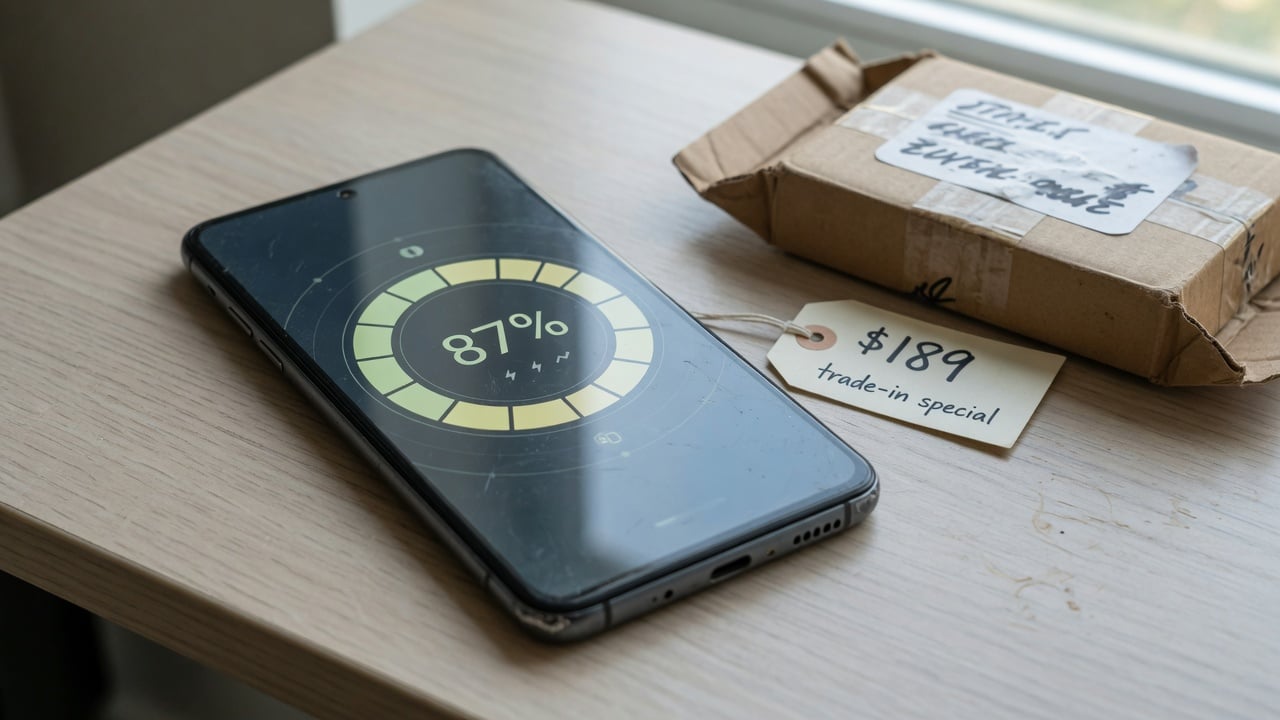
A two-year-old phone still unlocks fast, still holds a signal, still does everything it did on day one.
Then a single screen buried in settings flashes a number that changes everything.
Seventy-nine percent.
Nothing about the phone has visibly changed.
But that one figure is about to decide how much cash a trade-in kiosk or a resale app will offer for it, and the gap can run into hundreds of dollars.
How one battery number quietly overrides everything else about a phone
The number comes from a built-in capacity gauge that every modern smartphone carries, comparing how much charge the battery holds now against how much it held new. Apple calls this reading maximum capacity, and it sits inside the Battery Health screen on every iPhone sold today.
Once that gauge drops under a specific line, the phone itself starts warning the owner. If capacity drops below 80 percent, the device shows a service message explaining that the battery’s health is significantly degraded. That message is not a suggestion buried in fine print, it is a flag the operating system raises on its own.
So the threshold is not folklore invented by resellers. Apple says the batteries in iPhone 14 models and earlier are designed to retain 80 percent of their original capacity after 500 complete cycles under ideal conditions, while iPhone 15 models and later are designed to hold that line after 1,000 cycles. That is roughly two years of ordinary daily charging for most owners before the warning can appear.
A phone that works perfectly still gets priced like a broken one
Picture two identical phones sitting side by side on a trade-in counter. One reads 81 percent battery health, the other reads 79. They feel the same in a pocket, open apps at the same speed, and last roughly the same number of hours between charges.
Yet the used phone market has adopted that 80 percent line as its central grading rule. Battery health below 80 percent automatically triggers a discount at trade-in kiosks, making battery condition a key factor before selling, and many programs use it as a primary evaluation metric.
That creates a strange cliff in value. Readings of 79 and 81 percent feel almost identical in daily use, but the market treats them very differently anyway. Industry guides describe the gap between those two numbers as worth real money, even though the actual performance difference is almost impossible to feel.
One resale guide described the effect bluntly: buyers look at 81 percent and feel fine about it, but 79 percent suddenly seems like a problem, even though the phone works exactly the same way.
Third party testing confirms the penalty, and the price to escape it
Grading guides used by trade-in services spell out the math in plain tiers. Battery health in the 80 to 84 percent range is usable now, but buyers are advised to budget a replacement within the year, while readings in the mid-80s and above typically draw little to no markdown.
Drop under 80 and most tiers reclassify the device entirely rather than simply shaving a few dollars off. Private buyers and resellers commonly treat 80 percent as the line between good and needing a battery, and some trade-in services report price cuts of 15 to 25 percent below that line, even when the phone otherwise passes every cosmetic check.
The fix is not expensive on paper. An Apple battery replacement for an iPhone costs between $69 and $129 out of warranty in the US depending on the model, with newer and larger iPhones costing the most.
The newest Pro models now sit at the top of that range, since the iPhone 18 Pro and 18 Pro Max are now $129, the first time Apple has charged more than $119 for a battery.
With an active AppleCare+ plan, the math flips entirely. The same job costs nothing once a battery has dropped below 80 percent of its original capacity. A flagged phone covered by the plan costs its owner nothing to fix before a sale, the same quiet fee structure that shows up in other gadget categories, like a pricey pair of smart glasses whose coverage plan still charges extra every time a part fails.
The threshold does not always behave the way owners expect
Even so, the 80 percent line is not an automatic death sentence for a trade-in offer. Some of the biggest buyback programs quietly work around it rather than enforcing it to the letter.
Apple and carriers sometimes pay full value for a sub-80 percent phone if it works and passes other checks, and if a phone powers on and functions normally, Apple’s own refurbishing process may include a battery replacement anyway. Some users report getting close to full quoted value even with battery health in the low-to-mid-70s.
That inconsistency matters because it means two sellers with the same 76 percent reading can walk away with very different outcomes depending entirely on which program evaluated the phone. Many third-party buybacks are stricter and will re-grade or refuse sub-80 percent devices, treating the same reading far more harshly than a carrier or manufacturer trade-in would.
So the penalty is real, but it is not perfectly uniform. Private buyers and smaller resale platforms tend to apply it the hardest, since they lack the refurbishing pipeline that lets bigger trade-in programs absorb a weak battery and still resell the phone profitably.
What it means for anyone about to sell or trade in a phone
None of this means the 80 percent line is unfair exactly, since a tired battery really does mean shorter days and eventual throttling for whoever buys the phone next. But the size of the price swing around a single percentage point catches most sellers off guard.
The practical lesson sits inside the settings menu rather than in a repair shop. Checking the reading early, the same way owners now track device value trends covered in GCN’s look at climbing trade-in payouts, gives a seller time to act before the number crosses the line.
For owners under AppleCare+, that action costs nothing but a visit to a service counter. For everyone else, a modest repair bill can still beat the markdown waiting on the other side of that same screen.
