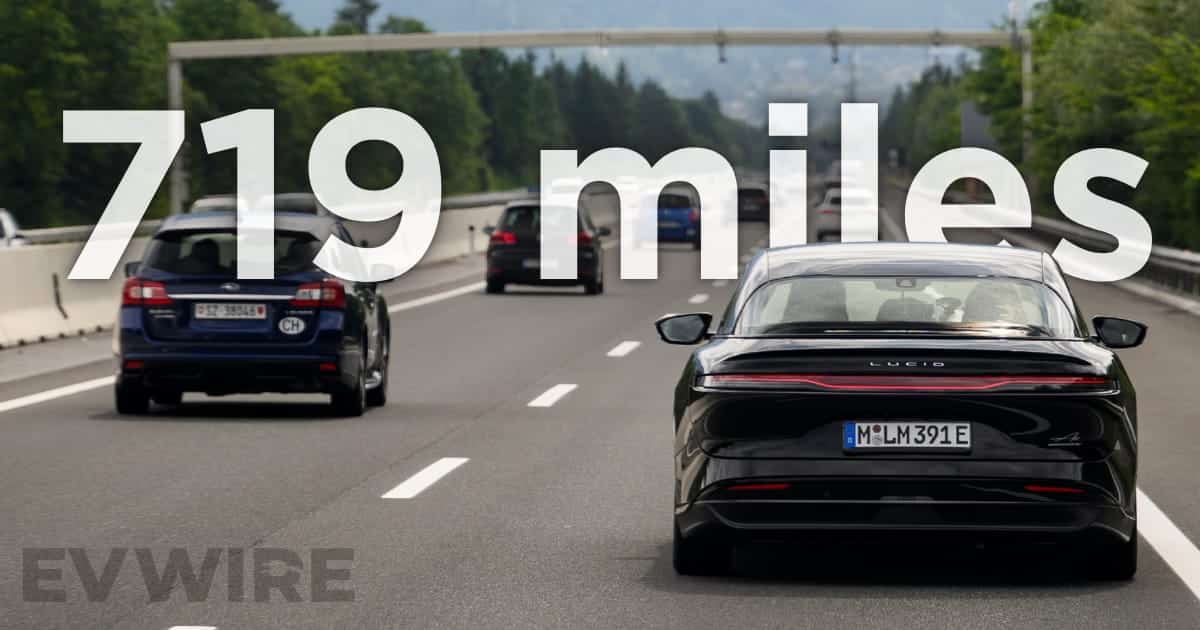
A single charge port seal, a notarized log, and a long stretch of European highway were all it took to settle an argument that has followed electric cars for years.
The question was simple.
How far can a real car, sold to real customers, actually go before the battery runs dry.
A team pointed a stock sedan down a route from the Swiss Alps toward southern Germany to find out.
What the odometer showed at the end reset the bar for every automaker chasing range.
How a stock sedan stretched one charge so far
The trick was not a secret battery or a hidden fuel tank. It came down to raw aerodynamic efficiency paired with a driving style built around keeping the motor in its most efficient band, plus a route that worked in the car’s favor. Starting at about 6,000 feet in St. Moritz gave a slight edge with downhill regenerative braking , and the net elevation drop into Munich let the Air Grand Touring recapture meaningful energy that a flat route would not have offered.
The run averaged 5.1 miles per kWh at highway speeds with the climate control on, a figure most EVs never approach even in mild conditions. That kind of efficiency comes from a slippery body shape, a lightweight platform, and a motor and inverter combination engineered to waste as little energy as possible turning electricity into forward motion.
So instead of chasing top speed, the drivers held a steady pace that let the car’s aerodynamics do the work. Wind resistance grows sharply as speed increases, which is why a measured steady cruise beats a quick sprint when the goal is distance rather than time, even before accounting for the elevation assist along the way.
The drive itself, from the Swiss Alps to Munich without a plug
The route ran through the Alps and across Central Europe, starting in St. Moritz, Switzerland, and ending in Munich, Germany, covering 1,205 kilometers, or 749 miles, without a single stop to recharge, completed on the energy stored in one battery pack.
Independent adjudicators sealed the charge port at the start and verified the battery state-of-charge at the finish, which is standard practice for keeping a distance record honest.
The car itself was a stock Air Grand Touring fitted with the standard 19-inch wheels, the same configuration that carries Lucid’s official EPA rating. Lucid has not disclosed any hardware changes to the car for the attempt, though the route itself, with its net descent out of the Alps, was chosen deliberately to help the result.
A government sticker number this drive blew past
This is where the record becomes more than a stunt. The Air Grand Touring carries an official EPA rated range of 512 miles on its standard wheels, the number that appears on the window sticker at every Lucid dealership in the country. That federal estimate is meant to reflect realistic mixed driving, not a best case scenario.
Yet the Air Grand Touring exceeded its EPA-rated range by 237 miles during the run, a gap wide enough to matter for anyone cross shopping range claims against real world results. Because EPA testing averages city and highway conditions at varied speeds, a disciplined highway cruise, aided by a mostly downhill route, can outperform the sticker by a wide margin.
The result also toppled the previous mark. The previous record for the longest single-charge EV journey was 649 miles (1,045 km) and it was set earlier this year in June. Lucid has just smashed that record by roughly 100 miles , a record that had itself represented a major jump for the industry just weeks earlier. Beating it by roughly 100 miles made the new number stand out even among engineers who track these benchmarks closely.
This was not Lucid’s first turn in the record books either. The automaker’s sedan platform has carried the longest EPA range figures of any EV sold in the US for several years running, giving this latest result a foundation built over years of incremental efficiency gains.
How the record was measured and verified
Guinness World Records adjudicators oversaw the attempt under standard rules for distance records: the charge port was sealed before departure and the remaining state of charge was checked at the finish to confirm the car never drew outside power along the way. The drive combined alpine roads, highways, and secondary roads rather than a single steady highway stretch, which means the result reflects a mixed but favorable route rather than a worst case test.
The driver behind the wheel had done this before. This marks the second major record Lucid has achieved in partnership with London-based entrepreneur Umit Sabanci. In 2024, Sabanci and a Lucid Air Grand Touring crossed nine countries on a single charge , also setting a Guinness record.
“When I completed the nine-country journey in 2024, it was just the beginning. This new achievement takes that journey even further. I’m proud to be part of a movement that proves electric mobility isn’t just the future; it’s already redefining what’s possible today,” Sabanci said.
Where this kind of result runs into real world limits
None of this means every Lucid owner will see anywhere close to 749 miles on a normal commute. The run depended on favorable alpine and highway conditions, a net downhill route, a steady cruising speed, and an experienced driving team optimizing every variable along the way.
Cold weather, stop and go traffic, flat or uphill terrain, and aggressive acceleration all cut into real world range far more than they affect a controlled record attempt. Which is why the EPA sticker, not the Guinness certificate, remains the number most buyers should actually plan around for daily driving.
Even so, the underlying efficiency the car showed is real and repeatable in spirit, even if the exact mileage depends on a route most commuters will never drive. That matters because range anxiety remains one of the biggest reasons shoppers hesitate on long-range electric vehicles in the first place. A verified result like this gives skeptical buyers a data point that is harder to dismiss than a marketing claim, even with the favorable terrain factored in.
So while most drivers will never attempt a 749 mile run without charging, the underlying efficient engineering filters down into everyday ownership through better range in normal conditions. The record stands less as a one-time spectacle and more as a preview of what careful electric design, paired with the right route, can deliver when pushed to its edge.
