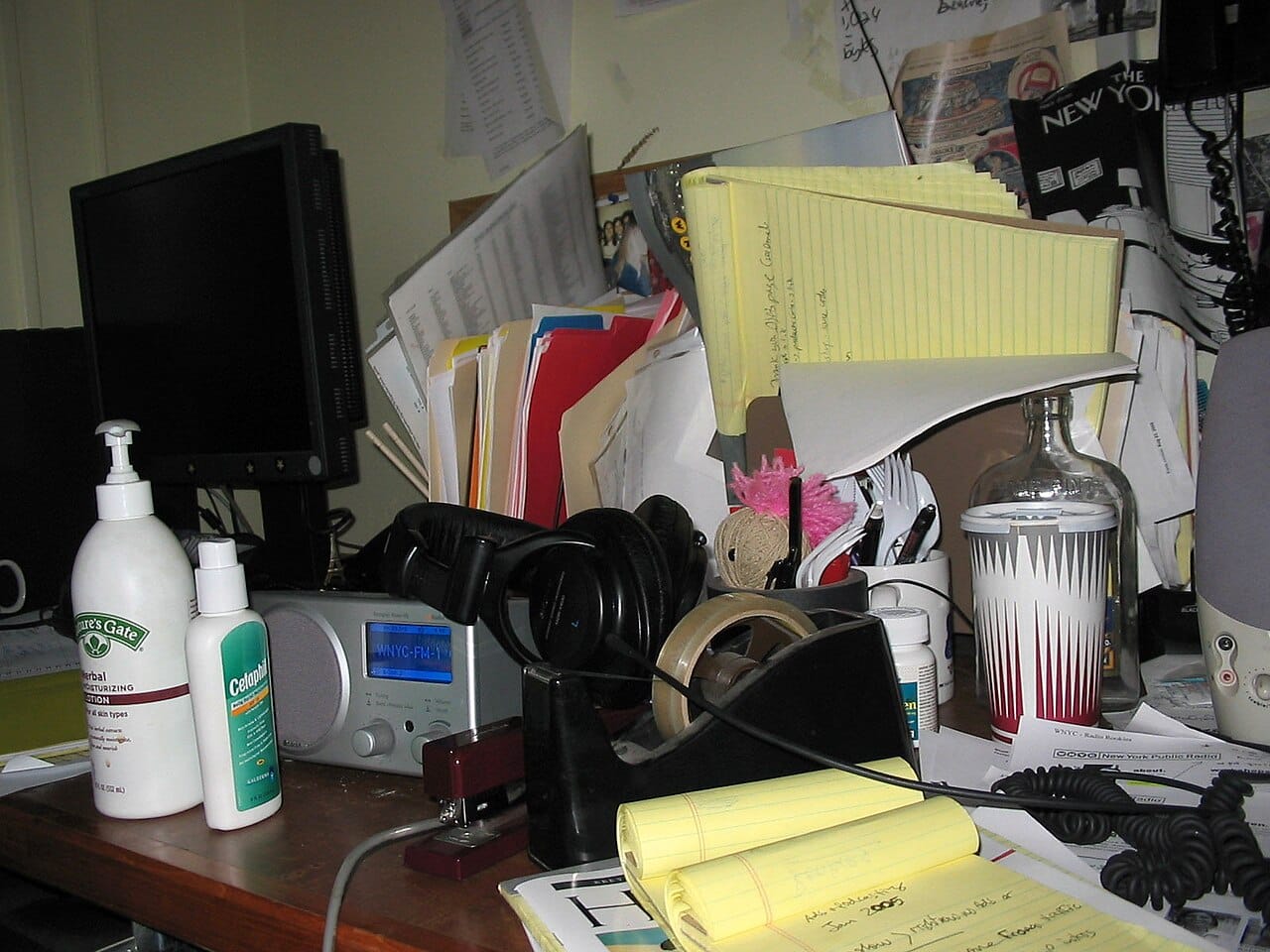
A cubicle sits empty for the lunch hour, one desk bare and gray, another crowded with photos, a mug, a small plant leaning toward the window.
Two coworkers return to finish the same stack of paperwork.
One works through it in a hurry, the other seems to settle in before even picking up a pen.
Nobody told either one how to arrange their space, yet the gap in how fast they move is not random.
So what is actually driving it?
What actually happens when a worker controls the clutter
The mechanism is not the plant or the photo itself, it is the act of choosing to put it there. A study run by psychologists Craig Knight and Alex Haslam shows how the office themselves, productivity rose by up to 32% when the choice belonged to the worker. The decoration mattered less than the decision.
So why would picking your own mug or taping up a photo change how fast someone works through a stack of forms? The leading explanation involves a sense of ownership over physical space translating into a felt sense of ownership over the work itself.
When a desk feels like an extension of a person rather than a seat assigned to them, researchers argue, that person treats the tasks sitting on it with more investment too. The reverse appeared true as well, with disengagement following discomfort.
Workers who personalized a space and then had it rearranged by someone else did not just lose the décor, they lost the psychological lift that came with choosing it, and their output slid back down toward where it started.
Four office setups, one obvious winner at the desk level
Picture four nearly identical small offices. One is stripped down to a bare desk and chair. Another has plants and framed art added by researchers before anyone walks in. A third lets the worker arrange everything personally. A fourth starts personalized, then gets quietly reset to match the decorated version, without the worker’s input.
Those four conditions are not hypothetical. In 4 independent conditions the researchers examined the impact of space management strategies in which the office is either lean, decorated by the experimenter with plants and art, self-decorated, or self-decorated and then redecorated by the experimenter . Office workers moved through identical paperwork tasks in each one, and the researchers timed how long each version took along with how many mistakes workers made along the way. None of this requires an expensive redesign.
The same logic shows up in how often people buy small plants for a kitchen counter or a desk, a cheap, low effort way of marking a space as theirs without asking permission from anyone.
The numbers behind the claim, and where they came from
The original research, led by psychologist Craig Knight, then of the University of Exeter, and Alex Haslam, was published in the Journal of Experimental Psychology: Applied and ran as a pair of controlled experiments rather than a simple survey. The work compared the four office types directly against each other, timing completion and counting errors.
People working in enriched spaces, decorated for them rather than by them, moved noticeably faster than those left in a bare lean setup. That alone supported the idea that any decoration beats none.
The empowered office, where workers chose everything themselves, nearly doubled that effect. Workers sitting at empowered desks were markedly faster than their lean counterparts, and they were not only quicker but reported feeling more comfortable in their surroundings too. Crucially, the error rate did not rise alongside the speed, workers were simply finishing faster while making roughly the same number of mistakes as everyone else.
Where the effect gets complicated or breaks down
The disempowered condition is the part most people skip past, and it is the most telling. These were workers who personalized their space exactly like the empowered group, then had their changes erased without being asked.
When their personal choices were overridden, their performance slid back down toward the bare lean baseline, erasing the gains they had just earned by decorating in the first place.
That detail matters because it rules out a simple explanation. If plants and photos alone boosted output, the disempowered group should have kept at least some benefit from having decorated, even briefly.
Instead the loss of control appeared to cancel out any benefit that the décor itself might have provided. None of this means every job benefits equally, either. A call center with rigid seating or a shared hot desk setup, the kind increasingly common as office vacancy rates climb in cities rebalancing around hybrid schedules, offers workers far less opportunity to claim a permanent spot to personalize in the first place.
What this means for anyone eyeing their own desk today
The practical takeaway is modest and cheap. A framed photo, a small plant, a mug chosen rather than issued, these are not productivity hacks dressed up as decor tips. They are small, repeatable acts of claiming a space as one’s own.
Even so, the research offers a useful correction to open plan office trends that strip desks down for a cleaner look. Managers chasing uniformity may be trading away a real, measured source of output for the sake of tidiness.
That is a trade worth questioning the next time a workplace bans personal items from desks. A cluttered desk, it turns out, is not always a sign of disorganization, it may be doing quiet useful work.
