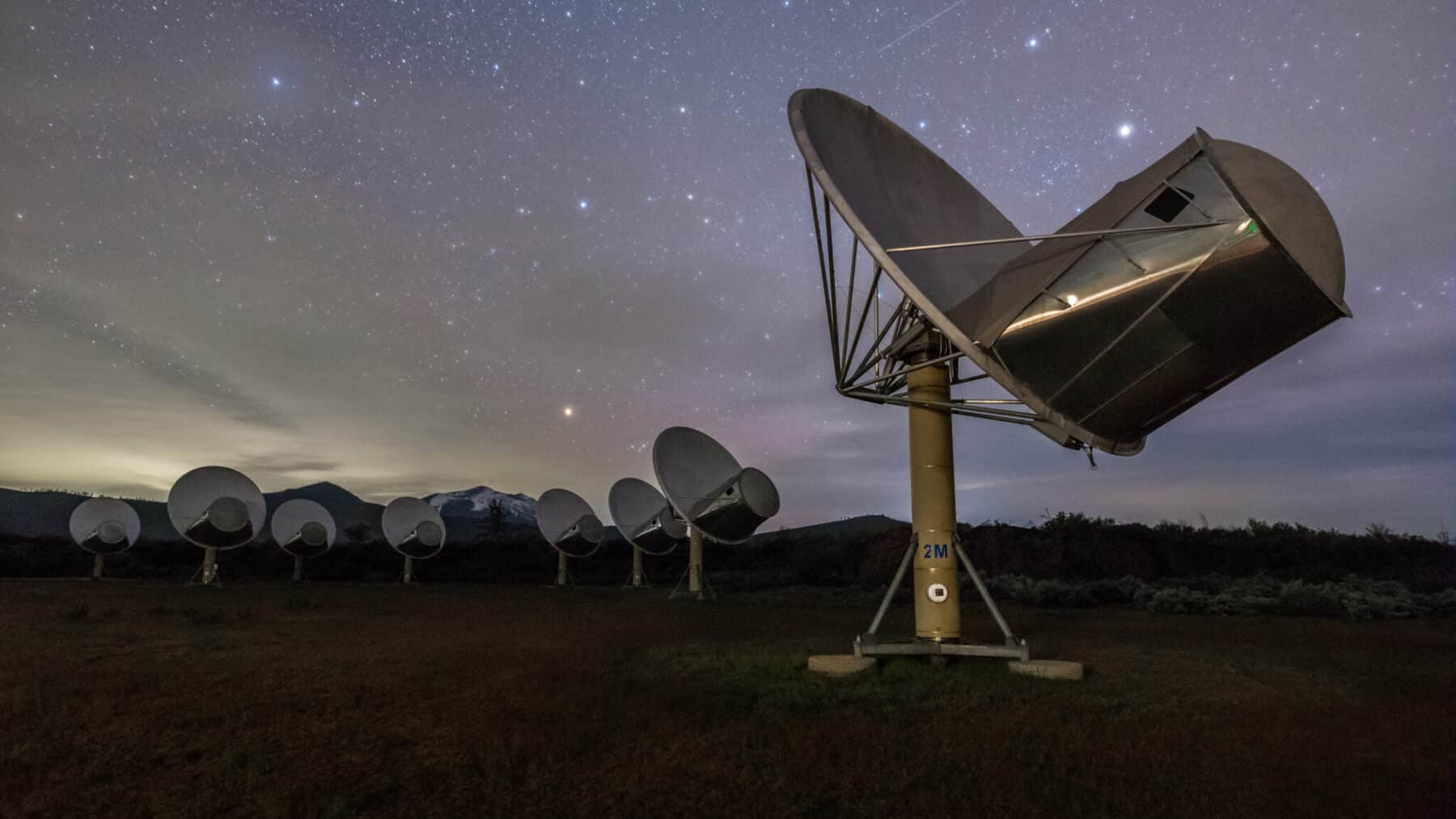
NVIDIA and the SETI Institute have begun using agentic AI to operate a radio telescope array in real time, letting software agents steer the instrument and analyze incoming data from a single plain-language command.
The system is now running at the Allen Telescope Array in Northern California, according to an NVIDIA blog post published this week.
What changed at the telescope
Breakthrough Listen and the SETI Institute are bringing agentic AI into the daily search for extraterrestrial intelligence. At the Allen Telescope Array, agents can now steer the instrument, enhance and correct incoming data, and apply AI models to the incoming stream, all from a single natural language request.
The NVIDIA Holoscan platform processes the massive streams of sensor data, giving agents live data to act on.
The project builds on earlier work pairing the SETI Institute with NVIDIA hardware. Researchers from the Breakthrough Listen initiative, in collaboration with NVIDIA and using the SETI Institute’s Allen Telescope Array (ATA), have developed a revolutionary AI system for detecting Fast Radio Bursts (FRBs). The new AI system processes data 600× faster than current methods, operating 160× faster than real time, while improving accuracy by 7% and reducing false positives tenfold.
Built on NVIDIA’s Holoscan platform and IGX hardware, that earlier system powered an early real-time AI search for fast radio bursts, flashes of radio energy that last milliseconds.
How the agents actually work
The new setup relies on CyberEther, a signal-processing framework built at the SETI Institute. CyberEther handles signal processing with CUDA-X libraries cuFFT and cuBLAS.
Those are the same graphics processing chips that underpin mainstream AI training workloads, repurposed to sift astronomical data streams for anomalies.
According to NVIDIA’s announcement, the system is designed to process signals directly at the telescope rather than requiring data to be recorded and analyzed later. Put together, the system enables an agent to steer a telescope’s antennae, calibrate and focus the instrument for a clean signal, catch and fix data errors and plot the result.
That marks a shift from how radio astronomy has traditionally operated. Data historically had to be recorded and analyzed offline well after an observation ended, a process that could miss faint or fleeting signals entirely.
The agentic approach instead lets software make steering and processing decisions while the telescope is still listening, cutting the lag between a signal arriving and a scientist knowing about it.
Who is behind the project and what they found
The effort is led by Andrew Siemion, the Bernard M. Oliver chair for SETI at the SETI Institute and principal investigator of Breakthrough Listen.
Siemion said: “As our new agentic observatories reach out into the universe, what they find may have much more in common with themselves than with the humans who created them.”
So far the system has not reported any detection tied to extraterrestrial intelligence. The one confirmed real-time result from the new agentic pipeline is a detection of a pulsar in the Crab Nebula, not an alien signal.
In earlier tests of the separate fast radio burst system, the AI successfully detected giant pulses from the Crab Pulsar, handling data streams up to 86 gigabits per second. The Allen Telescope Array itself comprises an array of 42 antennas, each 6 meters in diameter, which can be simultaneously used for both SETI and cutting-edge radio astronomy research, searching for technosignatures, evidence of technology built by civilizations beyond Earth.
Why it matters beyond astronomy
The SETI project is a visible example of a broader trend already reshaping other corners of computing, where AI agents are being trusted to take actions rather than simply answer questions.
That same shift has shown up recently in software development tools, where GitHub Copilot lets AI approve its own terminal commands, and in security practices, where Google urges Gmail users to run a two minute security checkup to guard against automated threats.
In SETI’s case, the stakes are scientific rather than commercial: letting an agent control a multimillion dollar instrument and judge what counts as an anomaly worth chasing, in a field where a false alarm could draw global attention before independent verification is possible.
