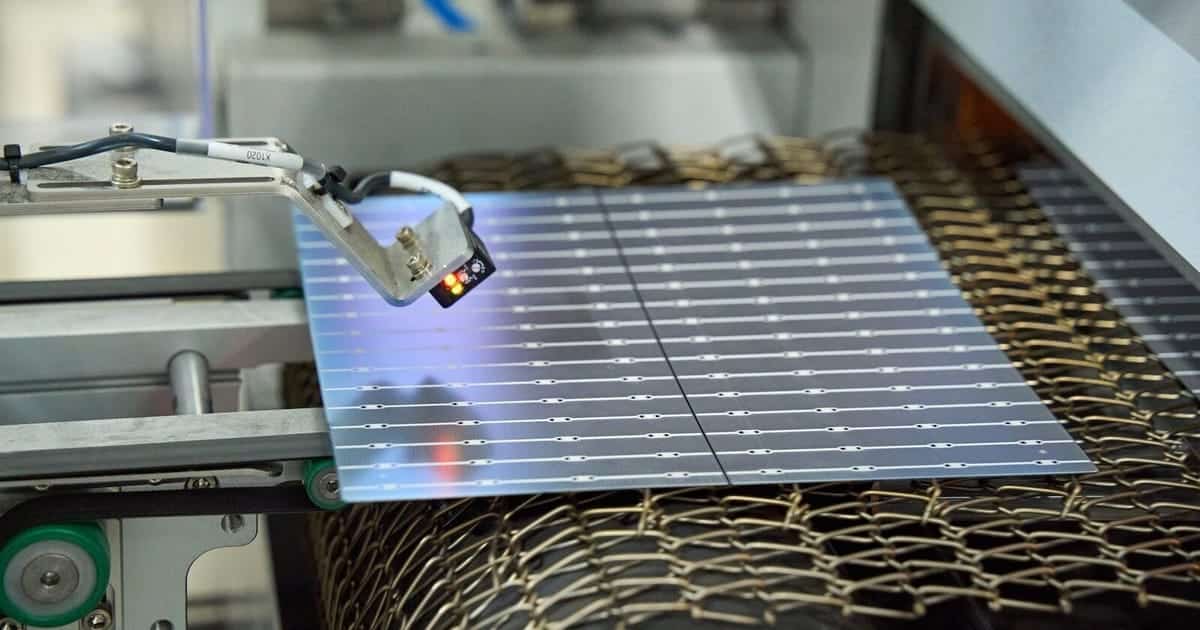
A forklift rolls a pallet of sun bleached solar panels toward a conveyor belt in rural Georgia.
Within seconds, a machine starts peeling each one apart.
Glass splits from silicon, metal splits from plastic, and almost nothing gets thrown away.
This building did not exist two years ago.
Now it runs around the clock, and the question worth asking is what actually happens inside it, with 96 percent value recovery on every panel that enters.
How the machine actually pulls a panel apart
Most of what a solar panel is made of sits in plain sight. Glass constitutes approximately 75% of a typical silicon-based panel, and the aluminum frames make up about 10% , with the rest being copper wiring, polymer layers, a plastic backsheet, the silicon cells, and a junction box.
Pulling the frame off is the easy part, and it is where many recyclers quietly stop. Removing the frame is straightforward, and a lot of recycling stops there and the rest gets shredded and sold as low-value glass cullet . The real value is buried, not stacked on top, in silver traces and copper threads underneath.
So the harder engineering problem is separating those layers cleanly instead of pulverizing them together. Teasing the glass from the cells and then separating the silver and silicon is far harder, and no single commercial process yet recovers all of it cleanly . That is the exact gap the new Cedartown plant was built to close, using staged separation so metals and glass come out clean enough to resell rather than dumped as cheap debris.
Inside the building that just switched on
The facility itself is enormous by recycling standards. The 255,000-square-foot recycling facility is home to the company’s proprietary advanced recycling technology, which delivers more than double the throughput of the company’s first-generation recycling lines , which is what lets it handle industrial volumes instead of boutique batches.
Because panels installed a decade ago are starting to retire now, the timing was not an accident. The 255,000 square foot plant is designed to process up to 5 gigawatts of panels per year at full capacity, making it the largest dedicated solar recycling facility in the United States.
The ramp up started small on purpose. The site is now processing thousands of solar panels per week and will continue to scale toward one million panels annually by the end of 2026 , well short of the 5 GW full-capacity design for now. Meanwhile the building sits beside an empty lot reserved for a second factory meant to close the loop entirely, turning recovered material straight back into new solar glass rather than shipping it elsewhere.
What the opening day numbers actually showed
SOLARCYCLE announced on January 29, 2026, that it had begun recycling operations at its new state-of-the-art facility in Cedartown, Georgia , with the company confirming commercial recycling had begun at the site. The new process allows for 100% landfill diversion and recovers 96% of the value from the silver, copper, aluminum, glass and other critical minerals within a solar panel , a figure unusually high next to older methods that salvage little beyond scrap glass.
That lines up with a broader supply problem. The country still cannot make enough of its own raw components, a gap visible in GCN’s coverage of a polysilicon tariff meant to force more domestic production, and echoed in moves like a new Oklahoma cell plant.
“Our recycling facility in Cedartown represents a step-change in how we’re delivering end-of-life infrastructure,” said Suvi Sharma, CEO and co-founder of Solarcycle , of the Cedartown operation. Already, the company has secured customer commitments covering more than 80% of the glass factory’s planned 5 GW capacity, reflecting strong demand for domestically manufactured solar materials , a striking level of buy in for a plant that has not broken ground.
Where the model still has to prove itself
None of this guarantees the economics hold once the volume gets heavy. For glass- and aluminum-only mechanical recycling, processing costs currently exceed recovered material value, producing a net disposal cost of roughly $15, 25 per panel , and advanced recycling is supposed to beat that math even though it has never run at this scale before.
Construction timelines stretch further out than the recycling line’s opening day suggests, with the project on track to break ground in mid-2026 and deliver its first production of glass in 2028 , which means the two buildings will not actually function as one loop for roughly two more years. Because they are meant to work together, a delay on either side ripples through the other.
If the glass factory slips, recovered cullet still sells on the open market, just not at the premium a dedicated buyer would pay. Even the industry’s own trade voices admit growth elsewhere in the chain is uneven, noting that broader cell and wafer capacity nationwide still lags far behind assembly lines.
What this means for the next wave of panels
Still, the basic shift is real and measurable: a facility now exists that treats a dead panel as a parts bin instead of trash. That matters because the volume of retired panels is about to climb sharply as the first big wave of installations from over a decade ago reaches the end of its life.
So the Cedartown campus is less a one off project than a bet on timing, building recycling capacity now before the wave of retirements peaks. Whether other states follow will depend on the economics at full volume, not the opening day numbers.
But the mechanism itself, pulling glass, silver and copper cleanly apart instead of shredding them into dust, is now running in a Georgia warehouse rather than a lab, a quiet kind of progress that keeps a fast growing industry from drowning in its own old hardware.
