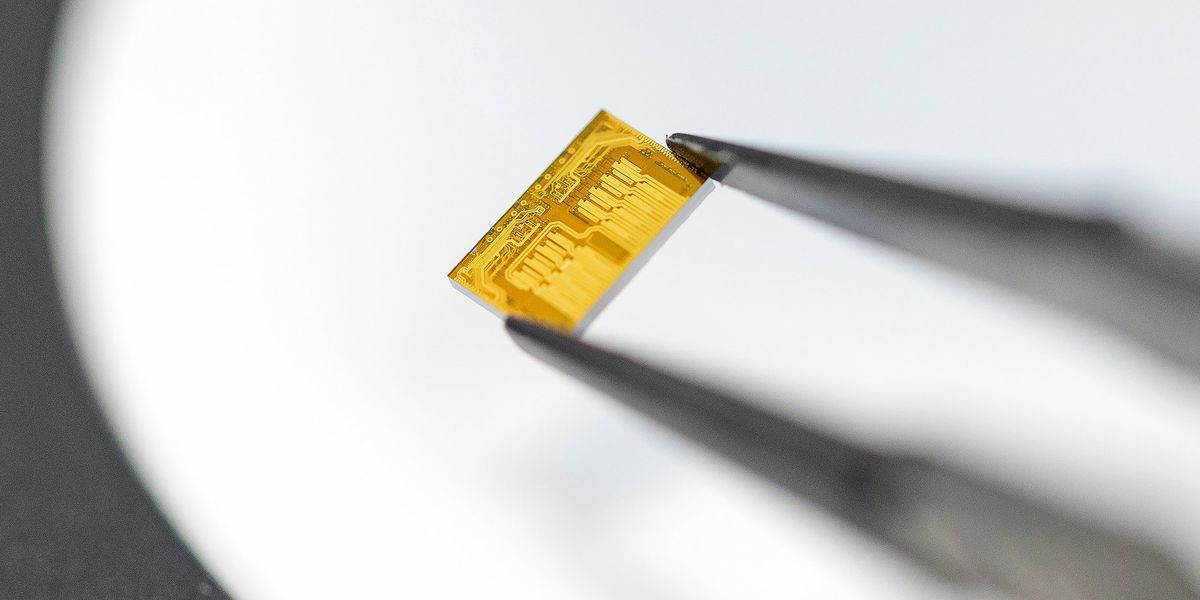
A box small enough to tuck under one arm just spent two years quietly outrunning almost every internet connection on the ground below it.
It carried no dish, no gimbal, no moving laser turret of any kind.
Instead, the whole spacecraft itself had to swivel, tilt and hold its aim while traveling faster than 17,000 miles an hour.
That single design choice is the whole story, and it explains why a payload barely bigger than a shoebox could beat equipment built by entire satellite fleets.
How a satellite with no moving laser parts actually aims itself
Most spacecraft that try laser communication mount the beam on a powered swivel mount, a gimbal, a mechanism for pointing the narrow laser beam, independent of the body around it. That approach works, but it adds weight, moving parts and failure points to a satellite that is already crammed with electronics.
The TeraByte InfraRed Delivery payload, known as TBIRD, skipped that hardware completely. Another aspect of TBIRD that is new is its lack of a gimbal, relying instead on a laboratory developed error signaling concept for precision body pointing of the spacecraft. That means the entire small satellite carrying the payload physically rotates and tilts itself to keep a narrow infrared beam locked on a single telescope on a mountainside in California.
So the satellite becomes the aiming mechanism itself. Error signals are fed to the CubeSat bus so it knows exactly how to point the body of the entire satellite toward the ground station. That stability is what let the link overcome one of the biggest challenges in laser communications, holding a narrow beam steady while moving at orbital speed and getting buffeted by atmospheric drag.
Without a gimbal correcting for vibration in real time, the body itself had to stay rock steady enough that a beam fired from low orbit still landed accurately on a ground receiver hundreds of miles away. Dropping the gimbal also let the payload itself be shrunk down much further.
A record that kept climbing inside a box the size of tissues
The payload itself is almost comically small for what it does. Roughly a month after its May 2022 launch, this Lincoln Laboratory built payload, launched into orbit 300 miles above Earth’s surface, delivered terabytes of data from space to a ground based receiver at rates up to 100 gigabits per second, a hundred times faster than the fastest internet speeds in most cities.
Then the team pushed further. A group of researchers from NASA, MIT and other institutions achieved the fastest space to ground laser communication link yet, doubling the record they had set the year before. The TBIRD system reached a 200 gigabit per second optical link speed on April 28, a speed most home broadband customers will never see from a wired connection, let alone one beamed down from a spacecraft the size of a lunchbox.
What that speed means in practice is staggering. One test run transmitted close to five terabytes of data in a single five minute pass over its ground station. One brief flyover could move more data than most people watch in video over a long stretch of ordinary viewing.
What the mission logs actually confirm
The hardware behind this achievement was built through a government and industry partnership, and its origin reaches back further than most people would guess. In May 2022, the TBIRD payload onboard a small satellite was launched into orbit 300 miles above Earth’s surface, tucked inside a satellite bus built for a short demonstration window.
A month later, this compact payload delivered terabytes of data from space to a ground station at 100 gigabits per second, setting the record for the fastest space to ground laser link ever achieved at the time. According to the MIT Lincoln Laboratory project page, engineers built multiple new technologies into the tiny payload specifically so it could hit these rates without a single moving part.
The craft carrying it was never meant to last this long. Though only planned to operate for six months, TBIRD carried out its demonstration for well over two years, letting NASA learn far more about laser communications operations in low Earth orbit than a short test ever could have.
One later test of a related ground terminal captured just how much that extra time was worth. In that test, a newer low cost ground terminal produced enough uplink intensity for the TBIRD payload to identify the laser beacon, connect, and maintain a link to the ground station for over three minutes. In an actual mission, a three minute connection like that would be enough to return over five terabytes of science data, the equivalent of roughly 2,500 hours of high definition video in a single pass.
Where the approach runs into limits
None of this means laser links are ready to replace radio for every mission. The same narrow beam that enables a huge data rate also demands near perfect alignment, which is exactly why body pointing without a gimbal was considered a genuine engineering gamble going in.
Clouds and atmospheric turbulence remain a real constraint too. A laser beam traveling from orbit to a mountaintop telescope can be degraded by weather in ways that radio signals, which spread more broadly and tolerate more interference, generally are not. That tradeoff limits how much mission planners can lean on optical links alone.
Even so, the tradeoffs clearly paid off here, and the record did not stay still for long either. Separate teams working on cloud computing style infrastructure have been racing through similarly compact engineering tradeoffs, squeezing more performance from smaller footprints across very different kinds of hardware.
What comes next for satellites built this small
The mission’s own accounting frames this less as a finish line and more as a working proof of concept for everything that follows. A future demonstration is planned for the Artemis II mission, this time testing a different laser communications terminal built for crewed lunar flight rather than the TBIRD hardware itself, part of the same broader push to move optical links beyond low orbit.
That matters because future missions, from Mars rovers to deep space telescopes, generate far more imagery and sensor data than their radio links can realistically send home. NASA’s Space Communications and Navigation program is expected to keep leaning on lessons learned from TBIRD as it expands the scope of laser communications across future missions.
So the real legacy of a payload the size of a tissue box may not be the speed record itself, but the proof that a satellite does not need extra moving parts to hit it. Engineers elsewhere are already applying similar lean hardware thinking to problems as different as optical chip connections on the ground, where shedding moving parts and cutting size has become its own kind of competitive edge.
